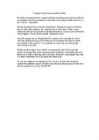
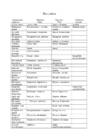
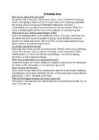
Computers breed laziness and discontent Nowadays most people have computers.People are getting more and more addicted to computers and of course Internet. I think that every human should control his or her computer using habits. First of all, people have to use their brains lesser. They do not have to remember how to spell words anymore, the computer does it all for them. What is more, students do not have to go library to do their home tasks. They can just use Internet search engines. For this reason, people`s brains grow lazy. Secondly, people are just sitting behind the computer and watching the screen. They are chatting or doing work but they do not understand that they must take break and do some exercises. In my opinion not exercising can make people stressed and unsatisfied. Finally, we think that is very comfort to communicate with friends and other people via Internet.This kind of communication can lead ...
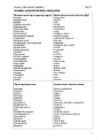
sense of humour generosity 1 Russian 2 Oral Essential Vocabulary Week 3 ,f duplicity , f greed animosity, spite , f laziness , f meanness , f nervousness , f indecision , f passivity pessimism , f prudence, mercantilism , f weakness egoism 2
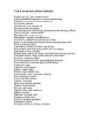
Unit 6 vocabulary (from textbook) Fundamental- alus-, põhi-, fundamentaalne General extended life expectancy- keskmine oodatud eluiga In terms of - As measured or indicated by, /with reference to For the better- paremaks Stem from sth - to be caused by sth Fast paced world- kiire maailm Dehumanising effects of technology- ebainimlikustavad tehnoloogia effektid Slaves to machines- orjad mesinatele Mess about with- to interfere with sb/sth Breed laziness- arendab/ suurendab laiskust Contribute to- millegile kaasa aitama/ panust andma Impetus for technological development- tõuge tehnoloogia arengu jaoks Result in- tekitama (mida?) Superseded by- ületama, asendama, välja tõrjuma Double-edged sword- kahe poolega mõõk/ kahe vaatenurgaga Bring about- to cause, to happen Designer babies- parents can "design" their babies before they are even born Ever-greater reliance- veelgi suurem toetumine/ usaldusväärtus Increase in- suurenema millegis
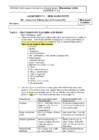
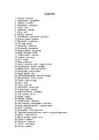
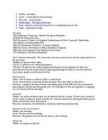
TASK 1 DISCUSSION ON HAZARDS AND RISKS Bad stuff happens, right? a. Make a list of all of the events which could affect your success in your studies at the university. What are the probable reasons for you to fail in your studies, to fail in exams and not getting the certificate? This is a brainstorming activity. There are no wrong or right answers. 1. Laziness 2. Health 3. Young love 4. Financial problems 5. Not understanding of the teacher's language skill 6. Mental health 7. Unhealthy lifestyle 8. Lack of motivation 9. Bad luck (you get hit my a car) 10. Stress 11. Too many distractions 12
lõpetatud(kooli) Applied- appliance Apply- kandideerinud kandideerima/taotlema Enrolled- Enrolment- registreerimine Enrol- registreerima registreerinud Passed- Pass- õnnestumine Pass- õnnestuma õnnestunud Intelligent Intelligence intelligently Obedient- Obedience- kuuletumine Obey- kuuletuma sõnakuulelik Lazy- laisk Laziness- laiskus Laze- laisklema Loyal Loyalty Loyally- lojaalselt Arrogant- ülbe Arrogance- ülbus Arrogate- Arrogantly- ülbelt ülbitsema Cruel- julm Cruelty- julmus Cruelly- julmalt Independent- Independence- Independently-
I like that Võru is such a small and quiet town, which makes it nice and secure to live in. Do you get any pocket money? I don't get any certain amount of pocket money. When I need to buy something or just want money, I ask my parents. Of course, I have money that I have earned myself, or I have received for my birthdays, I use that for buying electronics or more expensive things. What do you argue about with your parents most? Sometimes I argue with them, usually it is related to my laziness not wanting to put dishes to the dishwasher, or not wanting to go to bed. How is school life for you? I like school because there I can communicate and talk to my friends. Studying and tests have never been a difficulty for me, but this year physics and math are getting hard. I don't like math, never have. What are the biggest pressures for teens in you city? Võru doesn't have pressure for teens because it is a small and a peaceful city, at least I can't feel any.
34. Tark, nutikas clever 35. Rumal - stupid 36. Paindlik flexible 37. Järeleandmatu inflexible 38. Ambitsioonikas, edasipüüdlik ambitious 39. Kaine, praktiline mõistus common senise 40. Idioot and idiot 41. Esmamuljed first impressions 42. Väga head esmamuljet jätma make a very good impressioon 43. Näima come across as 44. Näima, paistma appears to be 45. Lahkus kindness 46. Optimism optimism 47. Täpsus punctuality 48. Laiskus laziness 49. Usaldus, kindlus, usk confidence 50. Ambitsioon ambition 51. Ülbe, upsakas arrogant 52. Kamandav bossy 53. Võistlev, konkureeriv competitive 54. Kaha jalaga maas downto-earth 55. Lojaalne loyal 56. Seltskondlik, sõbralik sociable 57. Intellektuaalne võimekus intellectual ability 58. Võimekus ability 59. Arukas, intelligentne intelligent 60. Terane, tark bright 61. Taibukas clever 62. Terane sharp 63. Nupukas, kaval shrewd 64
II thesis Man (one) can not learn to use hes reason. Society can. III thesis Nature has not made our society to grow more complex thanks to the previous generations, who have built our society. But nature gave us our minds, that we were able to use to work out this complex society and happiness. IV thesis The same force, that drives us to progress, has also arranged us in the order within a society. Nature urges us to rise above other men. Also to remove us from lifestile of sloth and laziness. V thesis Nature made us seek a best civic society to administer law upon ourselves. Nature demands we leave peacefully together. VI thesis Man is an animal, who needs a master, if that man lives among other men. Man needs to limit hes freedom, because his nature wants to seperate himself from others. But highest master must still be just a man and obey the laws. ,,Such crooked wood as man is made of, no straight thing can be built. VII thesis Nations want to compete and make war
The army is based on one man having more power over another man. Kat believes the problem is that they have too much power. Civilians are not permitted to torment others the way men in the army torment one another. Tjaden arrives and excitedly reports that Himmelstoss is coming to the front. Paul explains that Tjaden holds a grudge against Himmelstoss. Tjaden is a bed wetter, and during training, Himmelstoss set out to break him of this habit, which he attributed to laziness. He found another bed wetter, Kindervater, and forced them to sleep in the same set of bunk beds. Every night, they traded places. The one on the bottom was drenched by the other's urine during the night. The problem was not laziness but bad health, rendering Himmelstoss's ploy ineffective. The man assigned to the bottom often slept on the floor and thus caught a cold. Haie, Paul, Kropp, and Tjaden plotted their revenge upon Himmelstoss. They lay in wait for
After 1660. 2 main themes: sex (whoring), drinking.Charles II’s court wa despite of its cloak of Anglican conformity, far more inclined to accept and enjoy sexual, religious and verbal licence. Cultured but lusty court. Sexual hints flourished. Stimulated and fostered the stricter disciplines of poetic satire, which fed on contradictions, the ironies and hypocrisies of society. Sharpness of wit, degree of profanity (pühaduseteotus) or ribaldry (nilbus), cultivated laziness, ministerially abetted (õhutatud) twists of laws and distractions of his mistresses. John Wilmot, Earl of Rochester: writer of satirical and bawdy poetry. To a Lady in a Letter, Song, A Song Charles Sackville: The Advice, from the Latin Sir Charles Sedley: Song Dryden: 14. Restoration drama (Dryden, Etheridge, Wycherley, Congreve) Theatres closed in Civil War, resumed in altered society of Restoration, florishing after Puritan regime.
Yet, her travel Á and intercultural communication Á with Romanians and her own readers Á ends on an optimistic note. On a personal level, what really seems to matter is that, in spite of serious shortcomings (laziness, corruption, racism in her opinion), Romanians can also be stereotyped in terms of highly positive cliche´ s: `courage, resilience, unstoppable humour, disinterested kindness' (Murphy, 1992, p. 235). On a cultural level what
5 have been able to 3 hands 6 arms 4 What I'd really like to do is travel 6 was able to Animal: around the world. 7 Can you 1 wings 3 horns 5 What worries me is Frank's 8 couldn't read 2 tail 4 claws laziness. 9 not being able to 6 What surprised me was the 4 1 The Centaurs 7 The Harpies ending of the film. 3 1 have been able to 2 The Sphinx 8 The Sphinx 7 What I need to do is work faster. 2 couldn't 3 The Harpies, 9 The Minotaur 3 was able to/could
welcomed the Caucasians with open arms, but were stabbed in the back with the Bible and guns. At least in the earliest times, you could blame the Europeans for this miseducation of the Africans; but now, the culprits are the Africans scholars themselves, who have been too lazy to research our past and correct the convoluted history being taught in African schools. UNLESS YOU KNOW THE ACCURATE HISTORY OF YOUR PAST, YOU CANNOT KNOW THE PRESENT AND NEITHER CAN YOU PREPARE FOR THE FUTURE. This laziness continues to contribute in a major way to the annihilation of the history and culture of Africa. It permeates the whole educational system of the African. It avoids what is most relevant in place of what is expedient. It is this miseducation of the African that continues to make him dependent on the Caucasian for everything he does. We have a high cadre of Africans who have degrees, but whether they are highly educated is another matter
energetic adj. full of life, action, or power n. energy Syn. vigorous adv. energetically Sam hasn't been as energetic as he usually is. There's a lot of energy in these batteries. frail adj. weak in health or in body n. trade Syn. fragile The frail wings of the newborn bird could not lift it off the ground. One of the frailties of human beings is laziness. refine v. to make pure, to improve n. refinement Syn. perfect (v.) adj. refined Factories must to refine oil before it can be used as fuel. A squirt of lime juice is the perfect refinement to cola. worthwhile adj. value in doing something Syn. rewarding It was worthwhile waiting 10 hours in line for the tickets. It's worthwhile to prepare for the TOEFL. MATCHING Choose the synonym. 1
ostensibly singular referring expressions. In general, an anaphoric expression inherits its meaning from another expression, its antecedent, usually though not always occurring earlier in the sentence or in a previous sentence. For example, in 28 Reference and referring (15) The man who lived around the corner was eccentric. He used to snack on turtle heads "he" refers back to the man who lived around the corner. Geach (1962) called such a term a "pronoun of laziness" and suggested that it merely abbreviates a boilerplate repetition of the antecedent phrase, so that (15)'s second clause is precisely equivalent to "The man who lived around the corner used to snack on turtle heads." Geach's suggestion is only one among several theories of anaphoric pronouns, but the general idea is that the pronoun has the referent that it does only in virtue of its relation to the antecedent phrase.
Remember our target to log ve sessions of new behaviors? It's the ve sessions that are important, not the duration of those sessions. Rig the game so you can win. Do what's needed to make those rst ve sessions as painless as possible. Five snow akes are all you need to start the snowball effect of consonant decisions. Take the pressure o and put in your ve easy sessions, whether meals or workouts. The rest will take care of itself. In 2008, a 258-pound Phil Libin decided to experiment with laziness. He wanted to lose weight. This is common. As is also common, he wasn't particularly keen on diet or exercise. He'd tried both o and on for years. The intermittent four- to eight-week programs helped him drop pounds--and then his other behaviors helped him gain them back even faster. He began to suspect there might be an easier way: doing nothing. Phil had a simple method in mind: "I wanted to see what e ect being precisely aware of my weight would have on my weight."
end of the spectrum in the relationship may also take a little vacation from his or her comfort zone, or may be driven to a complete reversal himself. It can become uncomfortably crowded at one pole if both people in the relationship are suddenly expressing the same kind of energy. If Character Z has been habitually lazy, and has come to depend on a habit ually energetic Character A to do all the work, it can be alarming when the energetic A suddenly decides to experiment with laziness. N o one is left to do the work, and Z, who is lazy by nature, may be forced into the unfamiliar role of the worker, with potentially comic results. In movies like Trading Places, characters get to walk in each other's shoes, experiencing unfamiliar worlds, undergoing temporary reversals, and experimenting with unfamiliar behavior. Analyze This is built around two characters reversing polarity in opposite directions, as Robert De Niro's gangster character
Yet they are among the most common words in English because the relationships they express are so common. In English, only ten of these words constitute more than one quarter of any text: the, of, and, to, a, in, that, it, is, and / totalled 26,677 of 100,000 words in a count made by Godfrey Dewey. Inevitably this preponderance will affect the frequency table. H, for example, owes most of its occurrences to the. The second source of redundancy stems from the human laziness that favors sounds easier to pronounce and identify. The voiceless stops /ptk/ require less energy to articulate than the corresponding voiced stops /bdg/ and they average twice the frequency of voiced stops in sixteen widely varying languages surveyed by George K. Zipf. Similarly, short vowels are markedly more frequent than long vowels or diphthongs. In the same way, auditors of English, at least, seem to prefer sounds that are easier to identify. Tests made with nonsense syllables show that
 annaabi.ee