a contemporary computer instead.. On the other hand, up-to-date technology may replace human's labour. We entrust technology a lot of duties, so that it can have harmful consequences. If technology progresses, there will be no need for human's work. As a result, the part of population will become unemployed. Furthermore, technology has an effect on psyche, especially children are at risk of it. They lose themselves in the individualistic activities and a bedroom becomes a place to socialise. All in all, technology has as positive and as negative effect. It will be beneficial if we appreciate humanity more than technology and do not forget about its cons.
The importance of a shared meaning seems to be more explanatory in communities with high cohesiveness, for example religious groups, where people feel the presence of the meaning in their daily activities and thus experience the bonding effect of it. However, as the world is growing more and more anonymous due to globalization and emergence of megapolises, it becomes harder for people to experience the meaning, as their lifestyles are growing more individualistic. Similarly, as not all people share the same meaning, in areas with high cultural and ethnic diversity, meaning can cause conflict. All in all, a shared meaning can be the main basis for social order in smaller and cohesive communities, whereas in larger and more varied habitats this explanation becomes lacklustre. Norms and values For social order to emerge, not only need individuals to understand and share with each other,
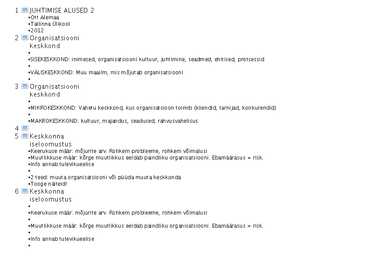
Hong Kong, Taiwan, Japan, and South Korea Hofstede käsitlus riigiti Organisatsiooni neli Rahvusvaheline juhtimine Kohalike olude tundmine Kliima, ajalugu ja kultuur- erinev tarbimine Infrastruktuurid ja traditsioonid Jaotuskanalid ja turundus Seadused Omahind vs spetsiifiline toode Elutempo erinevates riikides Predictors of Pace: Economic vitality: The more vital a city's economy, the faster its pace of life. Climate: Hotter places are slower. Cultural values: Individualistic cultures are faster than those emphasizing collectivism. Population size: Bigger cities have faster paces.
arhetüüpi 60 Rahvusvaheline juhtimine Kohalike olude tundmine Kliima, ajalugu ja kultuur- erinev tarbimine Infrastruktuurid ja traditsioonid Jaotuskanalid ja turundus Seadused Seadused Omahind vs spetsiifiline toode 61 Elutempo erinevates riikides Predictors of Pace: Economic vitality: The more vital a city's economy, the faster its pace of life. Climate: Hotter places are slower. Cultural values: Individualistic cultures are faster than those emphasizing collectivism. Population size: Bigger cities have faster paces. 62 63 64 65 66 Org-kultuuri 2 põhilist küsimust Kellel on selles organisatsioonis õigus midagi otsustada, kelle käes on võim, mis määral on see võim koondunud ühte punkti, kui tugev on organisatsiooni tsentraliseeritus; Kui palju on reegleid ja protseduure, mida tuleb selles organisatsioonis järgida, kui formaalne on asjaajamine, kui äge on
emotions such as love and altruism. In civil society, a sphere of social interaction corresponds to economic life or the "system of needs." Civil society engages individuals as bearers of Abstract Rights, as owners of property and bearers of legal rights. In civil society, individuals relate to one another in universal terms. While private property as the basis of abstract right and morality is a positive force in promoting individual freedom, individualistic material interests, such as the pursuit of economic gain, could potentially destabilize society. When left unchecked, these destabilizing forces tend to polarize humanity into rich and poor. The individualism of private material acquisition also weakens the expression of the basic social bonds and common culture that hold society together. Certain institutions must be in place to prevent the system of private property and the individualist worldview it sustains from undermining society itself
It was assumed that cognitive processes follow universal laws, and that the same cognitive test could apply to everyone, but that is not the case. Cross-cultural psychologists are now aware of the social and cultural factors on cognitive processes. Culture influences memory. Our cultural upbringing shapes the schemas that we acquire and use to perceive the world and ourselves. People in northern Europe and North America tend to see the world in an individualistic way and people in Asian, African and South American countries see the world in a more collectivistic framework. Qi Wang held a study considering our earliest memories. He asked college students from Harvard University and Beijing University to recall their earliest memories. He predicted and found that the Americans were more likely than Chinese students to recall events that focused on the individual. The Chinese were more likely to recall memories that involved family or neighborhood
It was however recorded much earlier that is in 1882 for the first time, meaning ,,The Study of literary style, the study of stylistic features." A short history of the development of stylistics Stylistics is regarded a relatively new branch of philology, yet its roots go back as far as ancient Greece and Rome, where the rhetoricians (retoorikud) cultivated the art of clear and elegant use of language by developing and polishing stylistic devices. In the 18th century, an individualistic-psychological view on style and stylistics emerges. The late 19th and and early 20th centuries witnessed a utilitarian approach to stylistics. The tendency to regard stylistics as an applied science has been particularly marked in english- 1 speaking countries. It was believed here that the main aim of stylistics is to improve the style
the angles, to the saints and Virgin Mary. We are in Heaven that can only be Anglican, filled with deep inner piety which spoke of the anguish of heart in its search for God.Church resumed as holy place again, restoration, beautification, painting and sculpture aided liturgy. 7. 17th century philosophical writing (Burton, Browne, Hobbes) Thomas Hobbes: Leviathan – developed his political philosophy. Man by nature selfishly individualistic animal, constant war with other men. Fear of violent deat principle motive causes them to create state and submite to sovereign, whose power, though derived from people, is absolute and not subject to law. Though he favoured monarchy as the most effective form of sovereignty, theory could apply to parliament also. Led to investigations by other political theorists. Robert Burton: The Anatomy of Melancholy – on surface medical textbook, Burton applies his large and
themselves. The Pietists thus strove to develop the Estonian language and religious literature. The full vernacular Bible appeared in 1739. The translators tried to eliminate the vast difference between the `country language' and `church language'. The Bible translation became the basic text that regulated the written Estonian language for more than a century. Despite its enormous impact on the development of the Estonian language, individualistic Pietism found a direct response primarily among the German-speaking clergy and nobility. The Estonian peasantry appears to have welcomed the movement of the Moravian Brethren which had started in Herrnhut in Saxony. In contrast to the Pietism, emphasizing penitence in the spirit of the Old Testament, the christocratic theological approach of the Moravians made them an optimistic and popular movement. This began to spread widely among Estonian
It cuts across all the basic linguistic sciences: · Phonetics--silent, sleepy streets · Morphology--speak, spoke, spake · Syntax--he came in-in came he · Lexicology--finish-terminate (synonymic pairs) A survey of the development of stylistic studies: It is a relatively new branch in philology; yet, its roots go back as far as ancient Greek and Rome where the rhetoricians cultivated the art of clear and elegant use of language. 18th cent--emerged an individualistic-psychological view on style and stylistics. According to that, style bears the stamps of individual usage: every writer has a unique pattern of habits and abilities that form his style. Fr. Poet Buffon: "Style is the man himself." Late 19th, early 20th century--appeared a utilitarian approach to style remotely linked with ancient rhetoric. It became important to improve the style of a text and show the author how better express his thoughts. (Vallins, Lucas)
( in their terms "to sell themselves"). Both content and appearance matter. But: The students are overloaded with information. Team work ( derived from eastern cultures) is being introduced in performing home assignments and projects, but on the whole a student is on his own with his problems. There are no permanent groups of people visiting the same classes which contribute to networking and stronger ties between the members of the class, group, course, faculty. Individualistic approach to education as well leads to stress. According to the American statistics, 3 people out of ten suffer from depression. The tempo of life in the USA is very intense both for students and faculty. There is no time to read fiction, poetry, enjoy art or just to relax in the company of close friends & to share the problems. Everything is planned long beforehand, deadlines are overwhelming. As a result, the average level of
Linguistic Stylistics studies linguistic facts from the point of view of their ability to convey extra shades of meaning (connotations we call them). Stylistics has no fixed single unit of study. Stylistics studies everything that makes the utterance of the text expressive. STYLISTIC STUDIES Stylistics is regarded as a relatively new branch of philology, yet its roots go back as far as ancient Greece and Rome. In the 18th century there emerged an individualistic psychological view of style and stylistics. According to this view style bears the stamp of individual usage. The late 19th century and early 20th century saw the appearance of the pragmatic approach to stylistics: the tendency to regard stylistics as an applied science. It was believed that the chief aim of the stylistics is to improve the style of the reader, to teach him to express his thoughts better. In the 50s and 60s there was a rapid growth of interest in stylistics
Why? Because his wife's birthday is on the 8 th of some month. It is very individual. STYLISTICS AS A SCIENCE. SURVEY OF THE DEVELOPMENT OF STYLISTIC STUDIES. Stylistics is regarded as a relatively new branch of philology, yet its roots go back as far as ancient Greece and Rome, when the rhetoricians cultivated the art of clear and elegant use of language developing and polishing stylistic devices basically. In the 18th century there emerged an individualistic psychological view of style and stylistics. According to this view style bears the stamp of individual usage, that is every writer has a unique pattern of habits that form his style (e.g. W. Woolf - some of her starting phrases begin with "For"). This approach is best illustrated in the well-known dictum of the French poet and stylist Georges Louis de Buffon: "Style is the man himself".
You just can't do that." Individualism. Is there another factor besides age that may account for Jack Nicklaus' strong need to remain consistent with his commitments? I hinted at such a factor earlier: He is an American, born and bred in the heartland (Ohio) of a na- tion that is distinguished from much of the rest of the world by its devotion to the "cult of the individual" (Hofstede, 1980; Vandello 8{ Cohen, 1999). In individualistic nations such as the United States and those of Western Europe, the focus is on the self, whereas, in more collectivistic societies, the focus is on the group. For exam- ple, individualists decide what they should do in a situation by looking primarily at their own histories, opinions, and choices rather than those of their peers. This should make them highly vulnerable to influence tactics that use as leverage what a person has previously said or done.
(2002). Lapse loova mõtle- Handbook of Giftedness and Talent. Ox- mise seosed sotsiaalsete ja käitumistegu- ford: Elsevier, 193–203. ritega. Tallinn: Tallinna Pedagoogika- Li, A. K. F. & Adamson, G. (1992). ülikool. Gifted secondary students’ preferred Hoogeveen, L. (2008). Social emotio- learning style: Cooperative, competi- nal consequences of accelerating gifted tive, or individualistic? Journal for the students. Radboud University Nijme- Gifted, 16, 46–54. gen. Makel, M. C. & Plucker, J. A. (2008). Karnes, F. A. & Riley, T. L. (1996). Creativity. In: S. I. Pfeiffer (Ed.). Hand- Competitions: Developing and nurtu- book of giftedness in Children. Springer, ring talents. Gifted Child Today, 19 247–270. (14–15), 49. McCoach, B. D. & Siegle, D. (2003).
 annaabi.ee