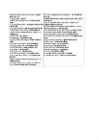
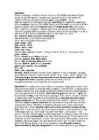
In front of smth so they can't avoid it before to be new or different that encourages u be a breath of their very eyes fresh air to accept smth face it to make someone leave a job cuz they are too old put so to have a lot of things to do be knee deep in out to grass smth to be in a situation when u may make so angry be to not understand smth not make a head or tail walking/skating on thin ice out of smth smth that happens that added to other problems , makes a to be angry or bored fed up to the (back) teeth situastion impssible - the last straw to admit that u were wrong eat humble pie a bad situation that affects other things a vicious circle a place with an exiting mixture of cultures a all over the world to the 4 corners of the globe melti...
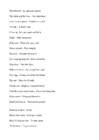
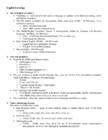
Flea Market - An open-air market The birds and the bees - Sex education Ants in one's pants - Unable to sit still Cat nap - A short sleep Clam up - Become quiet suddenly Fishy - Odd, suspicious Holy cow - Wow, I'm surprised! Horse around - Play roughly Rat race - Struggle for power Let sleeping dogs lie - Not to interfere Dog days - Very hot days. Make a beeline - Go straight for smth Nest egg - Money saved for the future Pig out - Eat a lot of smth Smell a rat - Begin to suspect trickery Until the cows come home - For a very long time Kitty corner - Diagonal direction Hold your horses - Wait and be patient Kick the bucket - To die Mum's the word - To keep a secret Back To Square One - To start again Tie the knot - To get married A field day - A very enjoyable time Over the hill - To be past your prime Spinning a yarn - To lie or exaggerate Under the weather - Feeling ill Bushed - Tired, completely exhausted ...
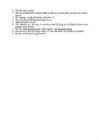
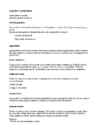
1. The title and the author. 2. The kind of book and the subject (What is it about, e.g. Family life, a mystery, an unusual person) 3. The language (simple,rich,literary, idiomatic etc.) 4. The style (formal,refined,plain,humorous etc.) 5. When and where is it set? 6. The characters (e.g. The main ch-s are Ann-a beatiful young girl and Robert Cleves-an old grumpy school teacher) 7. The plot (only the main events). What happens? (use the present tense) 8. Does the book have a message? Waht is it? Does the author say something important? 9. Reasons for liking/not liking the book
to] [to take care of] Some difficulties with translation of idioms For me, translation is art based on knowledge. Of course, an interpreter must have a good knowledge of the idioms of the two languages as well as take decisions to the best of his (her) knowledge and taste. Suppose one has to interpret the idiom " ( -. )" which is rather frequently used in the Russian press. The interpreter who wants to make his translation idiomatic has to look up a dictionary of Russian idioms to be sure of the idiom's meaning, and then to find in a dictionary of English idioms an adequate English idiom. important Idioms are in such great use by society in general that the ability to understand idioms is essential to being able to comprehend the meaning of what is being communicated. My suggestion how to learn idioms: Get a copy of Scholastic's Dictionary of Idioms by Marvin Terban
Clipping means beginning plus beginning, situation comedy- sitcom Blends blends form if you take beginning plus the end- money plus energy=monergy Clipped compounds compounds formed by clipping. Conversion A type of derivation where no suffix is used to change the word class. Catch as a verb and catch as a noun, break-down as a verb and break-down as an adjective. Compounds Are formed by joining two or more root morphemes. Compounds are often idiomatic in meaning or at least not entirely transparent. Coffe plus pot equals coffeepot Solid, hyphenated, and open compounds An open compound means that the words of the compound are written separately (credit card), a hyphenated compound separates the words by hyphen(s) (brother-in-law), a solid compound is formed when the two words are written as one word (typewriter), solid compounds typically begin as two separate words, then become hyphenated words, and finally become solid compounds.
(a season) winter." Viljandi 2009 Viljandi County Gymnasium 4. Phrasal verbs Many verbs in English are followed by an adverb or a preposition (also called a particle), and these two-part verbs, also called phrasal verbs, are different from verbs with helpers. The particle that follows the verb changes the meaning of the phrasal verb in idiomatic ways: · drop off - decline gradually The hill dropped off near the river · drop off(2) - fall asleep While doing his homework, he dropped off. · drop off(3) - stop and give something to someone Would you drop this off at the post office? · drop out - cease to participate After two laps, the runner dropped out. Some particles can be separated from the verb so that a noun and pronoun can be inserted, and
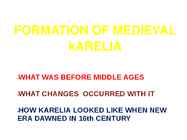
Third level Third level Fourth level Fourth level Fifth level Fifth level KÄKISALMIKORELAKEXHOLM Käkisalmi was karelian centre controlling Swedish name Kexholm probably Ladoga estuary of Vuoksi and trade through it abomination of karelian idiomatic käksalm, kägösalm Click to edit Master text styles Around 11001300 indisputably main Second level town in Karelia Third level Fourth level Fifth level Click to edit Master text styles Second level
de-destroy, dis-dismiss, sub-submarine Suffixes: er- maker, or- actor, eer- mountineer, ier/yer- lawyer, ant- assistant, ent-student, ee- detainee, ist-artist, en-vixen, ess-actress, ine-heroine 9) Coversion A type of dervation where no suffix is used to change the word class. Catch as a verb and catch as a noun, brake-down as a verb and break-down as an adjective. 10) compounds Are formed by joining two or more root morphemes. Compounds are often idiomatic in meaning or at least not entirely transparent. Coffe plus pot equals coffeepot 11) Clipping Clipping ise the wordformation process which consists in the reduction of a word to one of its parts- shortening. Three types of clipping: Foreclipping- retain gthe fial part of the word- racoon-coon, telephone- phone Back-clipping- retains the beginnig crocodille- crock, doctor- doc, gasoline-gas Ambiclipping- middle part is retained- influenza- flu
noblemen/kings). Alliteration consonants at the beginning of words are repeated. Alliteration applied to stressed syllables. Alliteration bound together the two halves of the line. Therefore, the third stressed syllable (first in the second half) had to alliterate with at least one stressed syllable in the first half of the line. Old forms in general survive more easily in 1. compound words (BRIDEGROOM, WEREWOLF), 2. place names (SCARBOROUGH, CANTERBURY), 3. idiomatic phrases (e.g. OVER HILL AND DALE, HALE AND HEARTY), 4. rarely used archaic words with special meanings (e.g. WROUGHT IRON, where "wrought" is the old Past Participle form of "work")
o BUT: his leg was pulled continuously by the other boys Can’t be turned into nouns – gun-jumping Three categories of idioms can be distinguished o Pure – pull sb’s leg, kick the bucket, o Semiliteral – fat chance, take steps, be a stepping stone, jump the gun o Literal – in sum, throw away, according to Elements are not separately modifiable without the loss of the idiomatic meaning. The whole idiom can be modified as a unit. o She pulled her brother’s left leg, she pulled her brother’s leg mercilessly Elements don’t coordinate with genuine semantic constituents o She pulled and twisted her brother’s leg Elements can’t take contrastive stress o It was her brother’s leg that she pulled Elements can’t be referred back to anaphorically
A preposition is a word used to link nouns, pronouns, or phrases to other words within a sentence. Prepositions are usually short words, and they are normally placed directly in front of nouns. In some cases, you’ll find prepositions in front of gerund verbs. preposition vs. adverb particle Many words can be used as both adverb particles and prepositions. There is some difference between an adverb particle and a preposition. While the particle is closely tied to its verb to form idiomatic expressions, the preposition is closely tied to the noun or pronoun it modifies. The following words are used only as particles and never as prepositions – away, back, out, backward, forward, upward, downward preposition vs. conjunction The difference is in the context. A conjunction joins a dependent clause to a sentences. A preposition joins a prepositional phrase to a sentence. Examples: •The families got separated after the war.
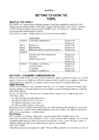
Comprehension 45 minutes Vocabulary 30 questions Reading Comprehension 30 questions SECTION 1: LISTENING COMPREHENSION This section of the TOEFL test your ability to understand spoken American English. You will hear taped conversations to which you will make responses. Part A and B contain samples of informal American English. Idiomatic expressions and two-word verbs are common in these parts. Single Statement In Part A you will hear a single statement made by a man or a woman. In your test booklet, there are four sentences. You must choose the sentence that is closest in meaning to the one you heard. YOU WILL HEAR: To get to the post office, cross the street, go three blocks, and you'll see it right on the corner. YOU WILL SEE: (A) The post office is right on the corner. (B) The post office is at the next corner.
But at each substage of this reasoning, there is plenty of room for error. At one point Searle suggests that there is a convention at work in addition to the purely Gricean reasoning. The words, "Can you . . . ?" do have a sort of conventional ring. But if so, it cannot be such a brute convention that it makes the locution in question amount to an idiom like "kick the bucket" or "bury the hatchet." Requests beginning with "Can you . . . " are, if you like, idiomatic, but they are not idioms, for they admit of literal answers. The hearer could say, "I can, yes, but are you sure you should be putting any more salt on your food?" This could be a smart-aleck answer ("Do you have the time?"--"Yes, I have it"), but it need not be; perhaps the hearer knows the speaker to have high blood pressure. One is at least able to reply to the sentence's literal, compositional content, even if that is not entirely felicitous
 annaabi.ee