Famous people of England Quiz. nimi 2014 1. Name the English mathematician who devised a mechanical calculating machine in 1834 which was the forerunner of modem computers. 2. With what do you associate the names of Mary Read and Anne Bonny, who lived during the eighteenth .century? 3. She was an English heroine who, with her father rescued the crew of the ship Forfarshire which was wrecked on the Fame Islands on the northeast coast of England in 1838. Who was she? 4. What was Casanova's occupation at the time of his death? 5. What was the name of the Hunchback of Notre Dame 6. Which broadcaster, who died in 1985, is most remembered for presenting Desert Island Discs? Vastused: 1. Charles Babbage 2. Piracy 3. Grace Darling 4. Librarian 5. Quasimodo 6. Roy Plomley
DRUGS-your enemy! Drugs-What are they? · Banned by law · Really dangerous and unhealthy · People use them to get high or feel better · Affect our behavior and senses completely · There are natural and chemical drugs What is a drug addiction? · Constant need to have it again and again · Physical addiction · Mental addiction Main reasons to start · Your friends use it · Curiosity-new and interesting · Symbol of independents,rebellious and being an adult · The feeling of being high · Easy to get · Symbol of money and fame What is what? · Ecstasy · Methadone · Meth · Cocaine · Heroin · Crack · Amphetamine · GHB · LSD · Nervines · Cannabis · Glues and varnishes · White Chinese The risky part · Pure or not? · What's in it? · The level of strongness · Making a coctail · Unpredictable ...
Shatelie world "Once upon a time there lived a beautiful young girl whom was called Shatelie..." A nice beginning, isn't it? But the truth isn't so fabulous and spotless as the reality our little heroine had to face. Yes, there is proof that she lived, but beauty? I'm afraid it's just for illustration, because as a matter of fact her father was an ordinary farmer, and logically she had as much beauty as a goat was a cow. It means she was considered quite ugly. One day, after the tiring work in the garden, she felt very dizzy all of sudden and soon fainted under the heating sunlight. When she woke up, she was lying on the floor of a beautiful castle. There were flowers
with laughter gas Fascinating /fæs..ne.t/ joke sth that you say or do that is intended enthralling Fertile /f.tal/ - having many to make people laugh good ideas to joke to say things that are intended to Identity in the fact who you are make people laugh Heroine the main female character of a gather up - to prepare to make a great effort book, film, or a play to do sth Morale state of mind? fuble /fi.bl/ - weak and without energy, exhaustion the state of being extremely strength or power tired red in the face blush? to strain extremely tired state of affairs important government to drain extremely tired
Magna Carta is an English legal charter. The Magna Carta required King John of England to proclaim certain rights, respect certain legal procedures, and accept that his will could be bound by the law. Anglo-Saxon poetic forms:Didactic poems-stories from Bible about saints` lives and moral lessons Chivalric romances-plot is centred around a single knight who fought at tournaments,slayed dragons and underwent a series of adventures in order to win the heart of his heroine. Courtly love-lover idealised and idolised his beloved. Romances are divided:1)the matter of Britain:stories that centre on the pseudo-historical King Arthur2)the matter of Troy:tales of the classical world3)English Breton lays:short poems or songs that tell stories of otherwordly magic. .Humorous beast epics,the lyric .Lyrics were short songs.Expressed thoughts of feelings of a speaker.Religious lyrics expressed sorrow for the Christ on the cross and for Mary.
Exposing the Human Condition in Antigone Heroism entails several things; a selfless act, courage, or the accomplishments of bold and daring expeditions. A hero can also mean courage in the face of death. Others may view this type of hero as stupid, or a martyr. Every hero has faults and these faults along with heroic deeds make the man or woman; a hero, heroine. "Antigone" would be considered a hero in the sense of being a martyr. Because of her love for her family Antigone wanted to give her brother a proper burial, and even though he did evil deeds, she respected him. She believed that all of the dead were in a state of equality. When faced with the decision to obey the King or obey her heart, she says on page 23, in lines 86-90: "I will bury him myself./If I die for doing that, good:/I will stay with him, brother;/and my crime will be devotion."
17. Pikk dialoog, peategelase ja tema ema vahel long dialogue between the main character and his mother 18. Ta alustas oma kõnet Skakespeare tsitaadiga-He started his speech with a quote from Shakespeare 19. Kuulus tsitaat armastuse kohta famous quote about love 20. Kirjeldav tekstilõik descriptive passage 21. Äärmiselt eristuv kirjutamis stiil a vey distinctive style of writing 22. Kangelane ja kangelanna hero ( heroes ) and heroine 23. Lugu toimub pariisis the story is set in Paris 24. Raamat põhineb Hemingway läbielamistele Hispaania kodusõjas the book is based on Hamingway´s experiances in the Spanish cevil war 25. Peamine teema tema kõikides romaanides the main topic in all his novels 26. Kas sa loed palju luulet ? do you read much poetry 27. Kas sa oled kunagi peast luuletust lugenud have you ever recited a poem 28. Raamatukogu ja raamatukogu töötaja library and librarian 29
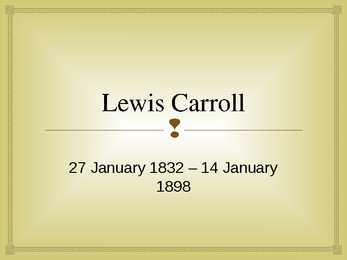
He was for many years widely assumed to have derived his own "Alice" from Alice Liddell. This was given some apparent substance by the fact the acrostic poem at the end of Through the Looking Glass spells out her name, and that there are many superficial references to her hidden in the text of both books. It has been pointed out that Dodgson himself repeatedly denied in later life that his "little heroine" was based on any real child, and frequently dedicated his works to girls of his acquaintance, adding their names in acrostic poems at the beginning of the text. Gertrude Chataway's name appears in this form at the beginning of The Hunting of the Snark, and no one has ever suggested this means any of the characters in the narrative are based on her.
without worries until the first snowfall. It was evening indeed, so the temperature stayed around +5 Degrees only. Heartless was cold, yet she was used to it already. Much worse was walking in the dark. She knew the streets well, and yet there was an unexplainable fear in her little heart. The child didn't look back it wouldn't change the situation, she thought. Soon Heartless reached the Royal Church the place she'd always wanted to visit. The doors were half-open, so our little heroine dared to enter...but that was a big mistake, because as soon as she entered the doors behind her enclosed at once. She tried to open them, but it was useless. She wanted to scream for help, but something stuck in her throat. Terrified by this, she turned around and moved towards the altar, passing the wooden benches on both side the carpeted way, without even paying attention to the 2 decorations
.. I suggest we... .We would then be able to ... I feel strongly that we should ... I trust you will give my proposal your full consideration. REVIEWS x has much to recommend it. X is, at heart, a(n) love/spy/adventure story. It is based on a book by ... It is set in the countryside/the future. The film has a quality cast. The film was directed by ... The film score is enchanting/evocative/scary. The film captures the spirit of ... The hero/heroine/villain is ... I felt/thought it was ... I was impressed by ... What struck me most was ... What I liked most/didn't like was ... The plot was gripping. The characters were very convincing/very well drawn. On reflection, I think it was ... It struck me as being ... What I didn't understand was how ... In spite of these few criticisms, I think ... I would have no hesitation in recommending ... Useful words and phrases
A prefix- is an element placed in the beginnig of the word to adjust or to qualifiy its meaning. A suffix- is an element placed in the end of the word to form a derviative such as ing and fy. Prefixes: be- become, for-forget, with-within, ad-admit, ac-accurse, af-affrax, co-co-operate, de-destroy, dis-dismiss, sub-submarine Suffixes: er- maker, or- actor, eer- mountineer, ier/yer- lawyer, ant- assistant, ent-student, ee- detainee, ist-artist, en-vixen, ess-actress, ine-heroine 9) Coversion A type of dervation where no suffix is used to change the word class. Catch as a verb and catch as a noun, brake-down as a verb and break-down as an adjective. 10) compounds Are formed by joining two or more root morphemes. Compounds are often idiomatic in meaning or at least not entirely transparent. Coffe plus pot equals coffeepot 11) Clipping Clipping ise the wordformation process which consists in the reduction of a word to one of its parts- shortening
good at understanding people. Also, I am definitely not a shy person. I tend to be rather honest, often to the point of being blunt, and express my opinions on different things and criticise them. As I said before, there are not many things to tell about me, so I will have to finish because I've got nothing to say anymore. Digested read No one who had ever seen Catherine Morland in her infancy, would have supposed her born to be a heroine. Her situation in life, the character of her mother and father, her own person and disposition, were all equally against her. Catherine had many interests, but she was never interested enough to be accomplished at anything. She was a cheerful child with a good temper. But she was also something of a tomboy. As she became a teenager, Catherine began to grow more beautiful, and eventually she turned from her athletic pursuits, such as cricket and horseback riding, to reading books.
kindly, honorably, and graciously towards the Dashwoods throughout the novel Mrs. Dashwood - The kind and loving mother of Elinor, Marianne, and Margaret and second wife to Henry Dashwood. She has inherited no fortune of her own but wants the best for her daughters and shares Marianne's romantic sensibilities. Elinor Dashwood - The nineteen-year-old eldest daughter of Mr. and Mrs. Henry Dashwood and the heroine of Austen's novel. Elinor is composed but affectionate, both when she falls in love with Edward Ferrars and when she comforts and supports her younger sister Marianne. Henry Dashwood - The father of John Dashwood and, by a second marriage, of Elinor, Marianne, and Margaret Dashwood. He dies in the opening chapter of the novel and bequeaths his estate at Norland to his son, leaving his wife and daughters impoverished.
Civil War. Sense that past would never return. 1640s. Metaphysical poets were fond of imagery difficult to understand and complicated metaphors, Cavaliers preferred more straightforward expression. Valued elegance, were part of refined, courtly culture, but poetry often frankly erotic. Short lyric poem, favourite theme carpe diem. Very decent, like Charles’s court. Characteristic to Charles I’s court Carew: Sir John Suckling: The Constant Lover Richard Lovelace: celebrates the beauties of heroine, but against very different background. To Althea, from Prison: Song; The Grasshopper: To My Noble Friend, Mr Charles Cotton: Ode Waller: wrote of queen as the queen of love. Cowley: Robert Herrick: The Argument of His Book, Delight in Disorder 6. The Caroline „beauty of holiness” Sermons and religious verse, witty preaching. George Herbert, Caroline piety expressed. His verse is
–ent – president, superintendent, student –ee – lessee, employee, refugee, escapee, devotee, absentee –ist – Marxist, communist, idealist, economist, perfectionist, racist, Buddhist o To form words of feminine gender -en – vixen -ess – princess, actress, seamstress, goddess, lioness, wife of ambassadress, mayoress, -ine – heroine, o Diminuatives -y - nicknames shorty, Johnny, Mummy, doggy -ie – birdie, doggie or independent formations – bookie, movie -en – maiden, chicken (not productive) -ling – darling, sibling, gosling, duckling, -kin – napkin -ock – buttock, hillock, bullock
she, herself, etc. [FEMININE, chiefly PERSONAL] Gender in English nouns is `notional' or `covert' (cf. French, German, Russian). There is no grammatical gender in English. Male entities are referred to masculine pronouns - he; female - she; sexless - it. Some other remarks: - morphologically unmarked for gender: bachelor spinster, uncle aunt, monk nun, king queen, nephew niece, brother sister - morphologically marked for gender: host hostess , prince princess, god goddess, hero heroine - personal dual gender (who she/he): artist, cook, friend, servant, singer, enemy, speaker - common gender (who/which he/she/it): child, cat, dog, monkey (as pets or personified) - collective nouns (it/which they/who): army, board, class, crew, gang, jury, firm, family, party, company, department, government, etc. - higher animals: male/female gender distinction maintained by people with a special concern - lower animals and inanimate nouns (which it)
She is strong in that sense. Her husband's betrayal makes her think she is no longer attractive, but she moves on with her life and stays true to him. Dolly copes with the few options she has in an already defined society. She becomes unhappy but doesn't make everyone feel bad for her. Dolly is the only one who remains a friend to Anna when everyone else deserts her. Tolstoy doesn't focus on Dolly very seriously, but she appears as a unique heroine in her own right. Alexey Alexandrovich Karenin: Karenin starts off as a society man, obsessed with superficial appearances and money. He resists his passions, however, and instead does what is right. That the sexual drive in his marriage fizzles doesn't bother Karenin; he loves Anna because she is his wife and that is how it should be. He is a faithful husband and follows every law. This trait becomes harmful when Karenin learns of his wife's affair
xxi THE WRITER'S JOURNEY ~ THIRD EDITION Christopher Vogler Good work has been done by women to articulate these differences, and I recommend books such as M e r l i n Stone's When God Was a Woman, Clarissa Pinkola Estes' Women Who Run with the Wolves, Jean S h i n o d a Bolen's Goddesses in Everywoman, M a u r e e n M u r d o c k ' s The Heroine's Journey, and The Woman's Dictionary of Myth and Symbols as starting points for a more balanced understanding of the male and female aspects o f the Hero's Journey. ( N o t e to men: If in doubt on this point, consult the nearest woman.) THE C O M P U T E R CHALLENGE S h o r t l y after the first edition o f this book came out, a few people (threshold guardians) jumped up to say the technology of the Hero's Journey is already ob
The mountain climbers faced grave danger on the cliff. He finds it difficult to face his problems. Facet n. element or component adj. faceted Syn. aspect The proposal had many beneficial facets. It was a multi faceted problem that challenged the entire student body. hero n. a person remembered for an act of adv. heroically goodness or bravery adj. heroic Syn. idol n. heroine (female) n. heroics He is a hero in the eyes of his admirers. They gave a heroic effort to no avail. inaccessible adj. something that cannot be reached or n. inaccessibility communicated with adv. inaccessibly Syn. remote The summit of the mountain was inaccessible. The dignitary's inaccessibility frustrated the reporter. obviously adv. in a clear, easy to understand way adj. obvious Syn
understanding and world culture and satirist Hugo Raudsepp (1883-1952) stands out with his comedies. Among the serious plays Anton Hansen Tammsaare’s drama Judith (1921; based on the Old Testament), a profound psychological reflection about Man, humanity, ideal and real, passion and guilt, stands among the most important. It is a drama of ideas, full of strain and contradictions, depicting the main heroine as a woman with strong desires and feelings. The formative period of the musical stage progressed smoothly. Singers perfected their skills at the Tallinn Conservatoire, at private studios and abroad, mainly in Italy. From 1918 onwards, opera would be a firm staple in the Estonia Theatre repertoire. Among the leading lights were the singers: Helmi Einer (1888-1968); Olga Mikk-Krull (1887-1980); Aleksander Arder (1894-1966); Benno Hansen (1891-1952);
 annaabi.ee