 50 punkti
Autor soovib selle materjali allalaadimise eest saada 50 punkti.
50 punkti
Autor soovib selle materjali allalaadimise eest saada 50 punkti.
 ~ 1 leht
Lehekülgede arv dokumendis
~ 1 leht
Lehekülgede arv dokumendis
 2021-09-24
Kuupäev, millal dokument üles laeti
2021-09-24
Kuupäev, millal dokument üles laeti
 0 laadimist
Kokku alla laetud
0 laadimist
Kokku alla laetud
 0 arvamust
Teiste kasutajate poolt lisatud kommentaarid
0 arvamust
Teiste kasutajate poolt lisatud kommentaarid
 412732
Õppematerjali autor
412732
Õppematerjali autor
Do you consider yourself more functionalist or more conflict theorist? Please explain why? Functionalism and conflict theory are very different views of society, but they are not exactly opposites. Both have arguments, that make people think about the society they live in and both have theorists who critize each other. In my opinion, none of the theories are completely wrong but I do tend to agree with people on the conflict theory side. Firstly, functionalism ignores inequality and focuses too much on the positive functions in society. For example racism, functionalists will say that it must be imporant in order to exist as long as it has but in my opinion that sounds quite doubtful. The most problematic part about racism is above all the tension and conflict which comes with it. Seems to me, that functionalists ignore the negative sides which society has on people.
Adults cry "educate our children!" Everyone has opinions about the best way to do the job. It is of urgent importance, and all the numerous factors are much studied, debated, and new (or old) ideas continually tested or retested. Some people say "it's as simple as . . . " and then name their pet peeve or passion. My view is not of an education specialist, but of one who loves sharing what I learn, and owes much to educators. Since I don't have an educational theory neatly worked-out, nor an outline of my perceptions, my intent is to address each educational ingredient that comes to my mind. After I've said what I think about each topic, readers may have a fair comprehension of my philosophy. First comes sensitivity. If a person be insensitive, be it from numbing cold, exhaustion, drugs, genetic makeup, or upbringing, then the process of education is bogged down, and results come only after great efforts
The business of syllogistic was to distinguish valid from invalid forms of syllogisms. Question: How many valid forms of syllogisms are there? The ‘matematization’ of Logic Syllogisms have been the main form of argument studied in logic for 2000 years (from Aristotle to the 19th Century). It was believed that all arguments, even every complex ones, could ultimately be reduced to a series/combination of syllogisms. However, in the 19th Century, the limitations of this theory became clear and new formalisms were developed. The idea was to handle more complicated problems, more efficiently, with the aid of mathematical symbolism. Propositions In Propositional Logic, the fundamental units are statements (propositions). Propositions might be simple or compound. A Simple proposition does not contain any other proposition. It rains Tallinn is the Capital of Estonia A Compound proposition contains at least one simple proposition.
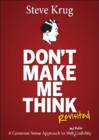
CHAPTER 1Don’t make me think! Krug’s First Law of Usability CHAPTER 2How wereallyuse the Web Scanning, satisficing, and muddling through CHAPTER 3Billboard Design 101 Designing for scanning, not reading CHAPTER 4Animal, Vegetable, or Mineral? Why users like mindless choices CHAPTER 5Omitwords The art of not writing for the Web THINGS YOU NEED TO GET RIGHT CHAPTER 6Street signs and Breadcrumbs Designing navigation CHAPTER 7The Big Bang Theory of Web Design The importance of getting people off on the right foot MAKING SURE YOU GOT THEM RIGHT CHAPTER 8“The Farmer and the Cowman Should Be Friends” Why most arguments about usability are a waste of time, and how toavoid them CHAPTER 9Usability testing on 10 cents a day Keeping testing simple—so you do enough of it LARGER CONCERNS AND OUTSIDE INFLUENCES CHAPTER 10Mobile: It’s not just a city in Alabama anymore Welcometo the 21stCentury
mass media on the society at large. Media tends to influence and it's obvious, there are positive as well as negative influences of mass media. However, it also depends upon the way audiences perceive things. The power of the mass media is by far recognized by everybody in terms of advertising, marketing and as a medium to broadcast information to people at large. Since mass media is used to communicate and interact with people from various walks of life, it can often result in a conflict of options. Print media (magazines, newspapers, brochures, press releases, newsletters etc), electronic media (television, radio etc) and the Internet are all part of mass media. Today, mass media can give a person phenomenal exposure and this can result in various effects of the mass media on the society. However, have you paused to think about the pros and cons of mass media? Well, one cannot blame a particular medium because of outside influences
Assessing writing for Cambridge English Qualifications: A guide for teachers Contents Who this guide is for Contents Who this guide is for................................................................................................................................. 3 Just like official examiners, teachers also spend many hours evaluating learners’ writing. This guide
programming, was indicated in the annoyed and anonymous stanza: In modern thought, (if not in fact) Nothing is that doesn't act, So that is reckoned wisdom which Describes the scratch but not the itch. The same kind of total, configurational awareness that reveals why the medium is socially the message has occurred in the most recent and radical medical theories. In his Stress o f Life, Hans Selye tells of the dismay of a research colleague on hearing of Selye's theory: When he saw me thus launched on yet another enraptured description of what I had observed in animals treated with this or that impure, toxic material, he looked at me with desperately sad eyes and said in obvious despair: "But Selye, try to realize what you are doing before it is too late! You have now decided to spend your entire life studying the pharmacology of dirt!" (Hans Selye, The Stress o f Life)
Durkheim assures that "we defer to society's orders not simply because it is equipped to overcome our resistance but, first and foremost, because it is the object of genuine respect". Thus, commonly generated meaning compels people to maintain social order because it in itself carries meaning for all the individuals in the society. However, as Hechter and Horne (Hechter and Horne, 2003:91) would argue, meaning can not only be seen as a solid ground for social order, but for conflict as well. According to them, social order is not always higher, where common beliefs and language is shared. For example in South America the violence rates are higher than in North America, even though South America generally comprises of more similar ethnical and religious groups. Thus, the quality of shared meaning in explaining social order can be questioned, as the existence meaning does not prevent individuals from committing deviant acts. The importance of a shared
 annaabi.ee








Kõik kommentaarid