Leidsid 33 sarnast õppematerjali, mis on seotud failiga "Estonian people". Need materjalid aitavad sul teemat sügavamalt mõista.
estonians, erki, nool, faith, male, picture, rait, rehemets, finnic, peoples, related, finns, christian, female, description, them, others, again, lazy, famous, 25th, june, years, gold, medals, sourcesEstonia is one of the most sparsely populated countries in Europe with 29 people per one square mile. The estimated population in 2007 was 1.3 million. From approximately the first to fifth centuries AD, resident farming was established and the population grew. A more troubled and war-ridden middle Iron Age followed with dangers coming both from the Baltic tribes and from overseas. Several Scandinavian sagas refer to Estonian pirates. During the wars under foreign rule, the number of Estonians diminished. At one point the population in the whole country was only half a million. Although wars devastated the country, it recovered quickly and its people with it. Under Soviet rule in the 20 th century, many Estonians, Lithuanians and Latvians were deported to the coldest parts of Siberia. Hundreds of thousands of migrants were relocated to Estonia from other parts of the Soviet Union to conduct industrialization and militarization,
kingdom. Sights If you are coming to Estonia, you need to visit: Old Town of Tallinn Kaali Meteorite Craters Jägala waterfall Kumu art museum Kadriorg palace People Estonians are a Finnic people closely related to the Finns and inhabiting, primarily, the country of Estonia. They speak a Finnic language known as Estonian. Although Estonia is traditionally grouped as one of the Baltic countries, Estonians are ethnically and linguistically unrelated to the Baltic peoples of Latvia and Lithuania. Things to do Sunbath on white sandy beaches or at the pools and lakes which abound in the interior of the country. In the north of the country, it's possible to find small coves used for nude bathing, though there are no designated areas for this. Otepää with its lakes and forests, is best for outdoor activities, such as skiing in the winter or canoeing.
Estonia Estonia, officially the Republic of Estonia, is a state in the Baltic region of Northern Europe. It is bordered to the north by the Gulf of Finland, to the west by the Baltic Sea, to the south by Latvia, and to the east by Lake Peipus and Russia. Across the Baltic Sea lies Sweden in the west and Finland in the north. The territory of Estonia covers 45,227 km 2, and is influenced by a humid continental climate. The Estonians are a Finnic people, and the official language, Estonian, is a Finno-Ugric language closely related to Finnish, and distantly to Hungarian and to the Sami languages. The population of Estonia is 1.5 million. Of this number 62 per cent are Estonians. The geography of the land is surprisingly varied. Islands make up 9,2 per cent of Estonian’s total territory, the largest islands are Saaremaa, Hiiumaa and Vormsi. The highest point is Suur Munamägi, which is 317m high.
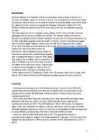
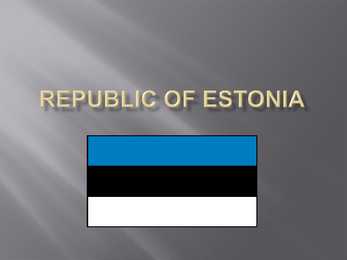
on Latvia. The area of Estonia is 45 100km2, its coastline is 774km long. The geography of the land is surprisingly varied. Islands make up 9,2 per cent of Estonian's total territory, the largest islands are Saaremaa, Hiiumaa and Vormsi. The highest point is Suur Munamägi, which is 317m high. Estonia has a surprisingly mild climate for an area so far north. Sea winds keep the weather from becoming very cold or hot. The population of Estonia is 1.5 million. Of this number 62 per cent are Estonians. Estonians speak the Estonian language, which is closely related to Finnish. Estonia's flag has three horizontal stripes. The blue stripe at the top of the flag represents the sky. The middle stripe of black stands for the land. The white stripe at the bottom symbolizes hope in the future. The president is the most powerful official in Estonia's government. The country's parliament elects the president to a five-year term. The parliament has 101 members, who are elected by the people
Introduction Estonia, officially the Republic of Estonia (Estonian: Eesti or Eesti Vabariik) is a country in the Baltic region of Northern Europe. It is bordered to the north by Finland across the Gulf of Finland, to the west by Sweden across the Baltic Sea, to the south by Latvia (343 km), and to the east by the Russian Federation (338,6 km). The territory of Estonia covers 45,227 km² and is influenced by a temperate seasonal climate. The Estonians are a Finnic people closely related to the Finns, with the Estonian language sharing many similarities to Finnish. The modern name of Estonia is thought to originate from the Roman historian Tacitus, who in his book Germania (ca. AD 98) described a people called the Aestii. Similarly, ancient Scandinavian sagas refer to a land called Eistland, close to the German term Estland for the country. Early Latin and other ancient versions of the name are Estia and Hestia. Until the late
*Estonians conquered by the crusaders 1208 *Reformation 16th century establishments of new school, Estonians first book appeared in 1525 *Tartu University 1632 founded by King Gustavus II Adolphus, classical university, member of the Coimbra group *Abolition of serfdom 1816 *Song festival 1869 in Tartu, an organiser was J.V.Jannsen, 822 singers, men only *Declaration of independence 24th February 1918 *War of independence 1918-1920 during the Russian Civil War, resulted in a victory for Estonia *Deportation 1949 *Estonia becomes independent 20th August 1991
to 7 metres in some places. At least 10 per cent of the Estonian territory is subject to the environment protection. The most important protection areas are resting and recreation areas for migratory birds. Mainly seashore wetlands and chaste woodland and wetland areas. The preservation of traditional cultural landscapes is important as well. 5 History To the Nineteenth Century The Estonians settled in their present territory before the Christian era. They were mentioned by Tacitus 1st century A.D., who called them Aesti. In the 13th cent. the Danes and the German order of the Livonian Brothers of the Sword formed an alliance to conquer the pagan Estonian tribes. The Danes founded Reval (now Tallinn) in 1219 and introduced Christianity and Western European culture to Estonia. While Denmark
In the 18th century Russian Tsar Peter the Great joined Estonia to his empire. The first true political parties emerged(Where established) at the turn of the century, demanding autonomy for Estonia. Following the Russian Revolution of 1917, Estonia declared independence from Russia on Feb. 24, 1918. Independent Estonia made large strides between wars. World War II ended Estonia's independence. The country was occupied by the Soviet Army in June 1940.Thousands of Estonians were killed or deported to Siberia. In 1944, Estonia became part of the Soviet Union. Proindependence guerrilla forces continued to fight against the Soviets into the 1950s. In the "Singing Revolution" of the 1980s, Estonians showed their desire for independence in peaceful mass meetings. In 1989, 2 million people from the three Baltic countries linked hands in a human chain stretching from Tallinn to Vilnius in Lithuania. Independence was proclaimed(declared) on Aug. 20, 1991
Around 870 singers took part, along with 76 musicians. Things have changed a lot, and today, the average festival gathering involves 25,000 participants, including large, joint choirs from all over Estonia. Festivals often close with choirs of around 25,000 taking part in an electrifying finale, in front of an openair audience of about 100,000. The festival takes place at the beginning of July, and it's common for many Estonians to take the week off work and travel to Tallinn to join in the celebrations. Visitors from other countries converge in Tallinn to experience the powerful singing, lively dances and intricate, colourful folk costumes at first hand. If you're interested in seeing this spectacular live performance, or maybe even taking part in a festival, the next event happens in 2004, 2009 and 2013. The song festivals began in 1869, part of the romantic and nationalist movement in Europe
east of Europe. To the east the country borders Russia. Latvia is the countries neighbour to the south. From the west the coast of Estonia is washed by the Baltic Sea and from the north by the Gulf of Finland. The length of the coastline is approximately 3 800 km. The longest distance from east to west is 350 km, while north to south Estonia stretches 240 km. THE NAME The name EESTI was apparently derived from the word AISTI, the name given by ancient Germans to the peoples living northeast of the Vistula River. Tacitius, the Roman historian, was the first one to mention it (AESTI), while the Arab scholar alIdrisi was the first one to mark it on a map (as ASTLANDA). To the ancient Scandinavians the land was known as EISTLAND; to modern Scandinavians it is known as ESTLAND. Most contemporary languages use the Latin name ESTONIA. FLAG The Estonian blueblackandwhite national flag was originally the flag
More than 200 of them breed in Estonia. Due to the vast preserved natural landscapes, large raptorial birds, such as the golden eagle and eagle owl have made Estonia their home. It is the small islets, however, that can really be called bird paradise. Undisturbed by man and protected from most smaller predators by the sea, they are real nesting sanctuaries for a diversity of birds. The first inhabitants came to the area that now forms present-day Estonia some 11 000 years ago. Estonians were one of the last pagan people in Europe. Estonia was incorporated into Christendom at the beginning of the 13th century, under the pressure of crusaders from Denmark and Northern Germany. Estonians were reduced to the status of peasantry until the 19th century. From 1558 onwards, Estonia became the battleground for the Livonian War involving Denmark, Sweden, Russia and Poland. Sweden emerged as the winner and Estonia remained under its influence until the beginning of the 18th century
Estonia is quite small when compared to the other its neighbours with a land of 45.227 square kilometres and a population estimated at 1.3 million. The Estonian people largely speak Estonian but many of them also speak Russian and English, Russian more common as a secondary language. As being Estonian we know that less is always more. Best to be concise and to the point. Talking a lot and taking centre stage is considered rude and disrespectful. Estonians are known as hardworking, responsible, rule-obedient simple people. For example there is law that after 18 years old finished with school, men need to serve military for one year. there is no way out of it and if they refuse they will get a fine and still get a call to come there. No wonder why Estonians can be very serious people after passed the navy. In fact I think it's a plus to Estonia as they will be always ready to defence their freedom with belief that they know what they are doing.
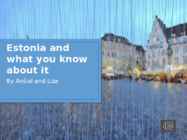
Estonia and what you know about it By Anšiel and Liza National symbols • The flag is blue, black and white horisontal lines, It represents the blue sky, the dirt, purity or snow. • The national bird is a swallow. • The national flower is a cornflower. History • The first settelments in Estonia came by supposedly about 11 000 years ago. • In the past most Estonians worshipped spirits of nature and their beliefs were seen as unholy by christian crusaders. Taara is believed to have been the name of the old Estonian god. • Starting with the Northern Crusades in the Middle Ages, Estonia became a battleground for centuries where many countries fought their wars over controlling the important geographical position of the country as a gateway between East and West, despite this the country has survived.
Olympic hymn was first played in 1896. Medals were made from pure gold until 1912. They are designed by the host city. Nowadays the medals are only covered with gold. The Winter Olympics are held after every four years like Summer Games but they are in different time. 2 years are between the different Olympics. The next Winter Olympics are held in Torino in 2006. The most important event in these Olympics for Estonians is cross-country skiing. It is the art of gliding over snow. There are three types of it alpine skiing, freestyle skiing and cross-country skiing. Alpine skiing is downhill skiing. Skiing has been popular in Nordic countries for a long time. Finns used ski patrols in World War II. Skiing is also popular in Estonia. Especially cross-country skiing. We have some very good skiers. There are three good men who are Jaak Mae, Andrus Veerpalu and Raul Olle who skis longer distances
During Hanseatic times the trade on the Baltic Sea was quite active. The links might be even older. Historians have claimed that already during the second Punic war in 218 BC a northern nation called Esths controlled the north south trade of furs. It is most likely that some furs also reached the area of present day England. Even more likely contacts between Estonia and England date back to the beginning of the second millennium AD. It has been widely acknowledged, that Estonians and Danes often combined forces when attacking larger targets. This would mean that Estonians have made frequent and regular raids to the shores of England. Unfortunately there is no written evidence about these contacts. The only possible source of information is the comparison of coins and pottery found at different excavation sites. 20th century Regular documented contacts between Estonia and English speaking countries begun after Estonia gained its independence in 1918
Report Purpose The purpose of this report is to give an overview of Estonian population, political factors, technological factors, economic factors and the trends in Estonian economy compared to Germany and to briefly discuss Estonian business environment. Estonian population The total population of Estonia is 1 313 271 according to Statistics Estonia, of which 69.1% are Estonians, 25.1% Russians, 4.9% of which are of different nationalities for example Ukrainians, Belarusians and Finns. Rest are of unknown nationality. 68.5% of population speaks Estonian as a mother language, 29.6% speaks Russian as a mother language and 0.6% Ukrainian. Estonia has only one official language which is Estonian. According to information by the Institute of the Estonian Language there are about 75% of Estonian people who speak Estonian. The most common foreign languages learned by
Although jealously guarding their privileges, the knighthoods still never became entirely closed. Between sessions of a Diet, the legislative power of the knighthoods belonged to the Council of the Diet. The towns were governed by the Town Councils, which supplemented their ranks from among the representatives of merchants and lawyers. The citizens and the inhabitants of a town did not coincide -- most of the population had no civic rights. The lower class mainly consisted of Estonians. While an special status secured the supremacy of the Baltic knighthood and the German upper classes in towns, it considerably aggravated the legal and social situation of Estonians. It can be said that the pre-nationhood Landesstaat, with its strict social structure, effectively prevented Estonians from becoming Germans. Considering their relatively small number, the beneficiaries of the Landesstaat were
south by Latvia and to the east by Russia. Across the Baltic Sea lies Sweden in the west and Finland in the north. The territory of Estonia covers 45,227 km2, and is influenced by a humid continental climate. Estonia is a democratic parliamentary republic divided into fifteen counties, with its capital and largest city beingTallinn. With a population of 1.3 million, it is one of the least-populous member states of the European Union. The Estonians are a Finnic people, and the official language, Estonian, is a Finno-Ugric language closely related to Finnish The history of Estonia is a part of the history of Europe. Estonia was settled near the end of the last glacial era, beginning from around 8500 BC. Before the Germans invaded in the 13th century proto-Estonians of the Ancient Estonia worshipped the spirits of nature Starting with the Northern Crusades Estonia became a battleground for centuries where Denmark, Germany, Russia, Sweden and
The first Estonian mentioned in the Guinness Book of Records was a sportsman. In the Olympic Games of 1912 in Stockholm, the Finn Alfred Asikainen and the Estonian Martin Klein wrestled for a record 11 hours and 40 minutes. Klein won, and "Russia" was given as his country of residence. The first chance to rectify this mistake came in 1918 when the Republic of Estonia came into being for the first time. Martin Klein was the first Estonian Olympic medal winner. Among other Estonians, the heavyweight wrestlers Georg Lurich, Aleksander Aberg and Georg Hackenschmidt were famous at the turn of the century. Before independence, Estonians were the best in the whole Russian empire in athletics (16 records out of 29), wrestling and weightlifting. Estonian sport was therefore born before the independent state. Actually, it was an important factor in our national awakening. Several great figures of national politics, among them the
Official name: Republic of Estonia Territory: 45 227 km Population: 1 342 000 Official languafe: Estonian Largest ethnic groups: Estonians 68%, Russians 26%, Ukrainians 25, Belarussians 1%, Finns 1% Capital of Estonia: Tallinn Number of islands: 1 521 Highest point: Suur-Munamagi (Great Egg Hill) 318 m Religion: Lutheran Currency: Estonian Kroon (EEK),1 EUR = 15,65 EEK Estonia has two Independence Days - Estonia first achieved independence from the Soviet Union on the 24th February 1918 and again on the 20th August 1991 after 51 years of occupation. The second date is known as the Restoration of Independence Day
itself from this, to seek after holistic, balanced accounts of the past. Early chronicles of Estonian history illustrate this diversity of perspective. Johann Renner, a Baltic German, held his own people in high esteem, deeming them the people of God. He implied this when he wrote that God would save His people from the hand of Gog. He seems to indicate that Gog was the Muscovite people. Perhaps the Muscovite people truly were vicious towards Baltic peoples, but perhaps not. Whatever the case, his biases colored his writing, likely distorting the truth as to how things actually were and how events actually happened.1 The same can be said of chronicles written by German B. Russow, who praised Swedish rule, and D. Fabricius, a Catholic Pole who favored Polish rule and rendered a Polish perspective of history. Russian history during the imperial period also shows such an ideological influence
the republic is celebrated on February 20. The national flower is cornflower, national bird is barn swallow and national stone is limestone. It is a land of great natural beauty with a long and varied history and rich culture. It has served as a junction of international trade routes for centuries. History. The oldest marks of habitation on the territory of Estonia date from the 8th millennium BC. Fortified settlements were established in the 1 st century BC. The ancestors of Estonians formed several independent states headed by elected elders. Until the beginning of the 13th century Estonia was politically independent. Then began a long chain of occupation and control by foreign powers. In the 1200s the German crusaders converted Estonia into a Christianity by force and took control over South Estonia. In 1219 Denmark conquered Northern Estonia. About a century later, in 1346 Denmark sold its territory to Germany. By the 1500s German nobles owned much of
The people here are mostly engaged in industry- mainly the food industry (23%), trade (16%) and transport and communication (14%). History. Tallinn has a great history. It was first marked on a map of the world by the Arab geographer al-Idrisi in 1154, its name then being Kolyvan. In the 13 th- century chronicle of Henricus de Lettis the town was called Lyndanise. Then it was called Reval for some time and finally Estonians started to call the town Tallinn from Taanilinn (Danish town) after the Danish conquest in the 13th century. The Knights of the Sword took Tallinn from the Danes in 1227 and made Toompea their fortress. In the middle of the 14th century Denmark sold its possessions in Estonia to the German Teutonic Order; Toompea became the seat of German-born gentry. A fortified wall was built between the Toompea (the Upper Town) and the
Tallinn was first marked on a map of the world by the Arab geographer al-Idrisi in 1154, its name then being Kolyvan (probably derived from the name Kalev). In the 13th-century Chronicle of Henricus de Lettis the town was called Lyndanise. Later came Reval (presumably after the old county of Rävala), the name used by the Germans who ruled the country for seven centuries. Russians then modified Reval to Revel. For Estonians, the town came to be called Tallinn from Taanilinn (Danish town) after Danish conquest in the 13th century. Over the course of time, Taanilinn was shortened to Tallinn The place is believed to have been settled by Finno-Ugric peoples about 2500 BC. The Danes, led by King Valdemar II, conquered northern Estonia in 1219. Legend has it that one day, when the Danes were about to lose a bloody battle, the sky suddenly opened and a red flag with a
can hear only Russian. most older and middle aged people can speak in russian. Since there are main language in our society, most jobs inquire speaking them, too. Young Russian- Estonians speak both, so they have advantages there. Thirdly, the situation with religions is a diverse. It is a fact that Estonia is the most atheist country in the world. The biggest religious minorities are lutherans, Russian Orthodox. Some people have faith is very important. It is believed that God is the one who forgives them for their sinful. But in our country are not forced religion against, we have freedom of religion. Finally, In my opinion, it is a problem to some extent in every country of tolerance between different races. In particular, a large grudge against the Russians, Estonians, just because of our past.
In the independent Estonian Republic the Song Festivals were held in every five years (1923 1938). After World War II, the Song Festival tradition began again in 1947. Since 1950 General Song Festivals were held in every five years again. 1969 was an exception though when 100th anniversary of the Song Festival was celebrated. · The foreign authorities have tried to use the Song Festivals in their own interests. During the reign of the Russian czar the Estonians were forced to hold Song Festivals in order to thank the czar, and the Soviet regime always tied the Song Festival to the "red holidays". · In 1988, with the Song Festival as a role model, began the so called "singing revolution" when hundreds of thousands of people gathered in the Song Festival Grounds to make political demands and sing patriarchal songs. · Concerning the Song Festivals there are two beliefs in the Estonian conscience
in the territorial waters of present-day Estonia. The late Russian patriarch, Alexis II, started his priestly ministry in the church. Interior of the Cathedral. The Alexander Nevsky Cathedral crowns the hill of Toompea where the Estonian folk hero Kalevipoeg is said to have been buried according to a legend. (There are many such legendary burial places of him in Estonia.) The cathedral was built during the period of late 19th century Russification and was so disliked by many Estonians as a symbol of oppression that the Estonian authorities scheduled the cathedral for demolition in 1924, but the decision was never implemented due to lack of funds and the building's massive construction. As the USSR was officially non-religious, many churches including this cathedral were left to decline. The church has been meticulously restored since Estonia regained independence from the Soviet Union in 1991. http://en.wikipedia.org/wiki/Alexander_Nevsky_Cathedral,_Tallinn
The area of Estonia is 45 227 sq km it's bigger than Denmark, Switzerland and Holland. Population an estimated 1 364 100 people and 30 people per sq km. Capital of Estonia is Tallinn. Population in Tallinn is about 397 150 people over a third of the nation. The biggest cities are Tartu, Narva and Pärnu. 70% of Estonians live in towns. All of the towns are old. · Estonia has 7000 rivers and streams. · Forests comprise slightly under half on Estonia's territory. · Scots pine, spruce, birch, aspen and alder are the most popular in the forest. · There are also a lot of animals: elks, roe deers, boars, brown bears, wolves etc. · About 10% of Estonia is a nature reserve. Estonians speak Estonian. It is used as a mother tongue by just under 1.1
Modern customs of the holiday include gift-giving, Church celebrations, and the display of various decorations--including the Christmas tree, lights, mistletoe, nativity scenes, and holly. In many countries there are many different types of decorations used depending on the traditions and available resources. However , in Estonia people bring Christmas tree in and decorate it with straw ,glass balls and candles. Estonians eat sauerkraut and black pudding. On the 24th December people leave work early, families gather, Santa Clouse comes , everybody gives gifts. People are very calm at Christmas time and they support each other. New Year's Eve New Year's Eve is on December 31, the final day of the Gregorian year, and the day before New Year's Day. New Year' s Eve is celebrated all around world because it's final day of the Gregorian year.
Soups are also blended with sour cream, milk and yogurt. The Main Course Pork and potatoes accompanied by a rich gravy and often served with sauerkraut or other vegetables has been the traditional Estonian main course. Pork has been the most important meat and is eaten roasted, cured as bacon, in the form of ham, or in pies and sausages.There are many other main dishes too. Black Bread Black rye bread accompanies almost every savory food in Estonia. Instead of wishing "bon appetit", Estonians are prone to say jätku leiba ("may your bread last"). Estonians continue to value their varieties of black rye-based bread. Estonia has not been a land of plenty. If a piece of bread was dropped on the floor, it was good form to pick it up, kiss it to show respect, and eat it.[citation needed] When Estonians live abroad, they often say that they miss black bread the most. Desserts Specific desserts include kissel, curd snack and kama. Rhubarb pies are a favorite. Red currant kissel
HISTORY OF ESTONIA Estonians are one of the longest-settled European peoples, whose forebears, known as the "comb pottery" people, lived on the southeastern shores of the Baltic Sea over 5,000 years ago. Like other early agricultural societies, Estonians were organized into economically self-sufficient, male-dominated clans with few differences in wealth or social power. By the early Middle Ages most Estonians were small landholders, with farmsteads primarily organized by village. With the collapse of the Russian empire in World War I, Russia's provisional government granted national autonomy to Estonia. A popularly elected assembly (Maapaev) was formed but was quickly forced underground by opposing extremist political forces. The Committee of Elders of the underground Maapaev announced the Republic of Estonia on February 24, 1918, 1 day before German troops invaded
crest of national awakening. Its tastes were at first pretty simple, the favourite genres being folk comedy and romantic melodrama, although both also transmitted halfhidden social and political attitudes. In less than forty years, in 1906, the leading amateur companies, the "Vanemuine" in the university town Tartu and the "Estonia" in Tallinn, could become professional, and in 1911 the "Endla" of P ärnu joined them. Theatre became especially popular amongst Estonians in the second half of the 19th century. Before that time, theatre had mostly been staged in German for the benefit of the local nobility and merchants. Theatre in Estonian emerged in various song and drama societies, the strongholds of national thought. In the early 20th century, these societies turned into professional theatres, some of which, the national opera Estonia for example, function even today
Jaanipäev Jaaniõhtu, also called Jaanilaupäev and Jaanipäev are the most important days in the Estonian calendar, apart from Christmas. The short summer seasons with long days and brief nights hold special significance for the people of Estonia. Jaanipäev is celebrated in the night between 23rd and 24th of June, a few days after the summer solstice, when night seems to be non-existent. For Estonians, Jaanipäev celebrations were merged with the celebration of Võidupüha during the War of Independence when Estonian forces defeated the German troops on 23 June 1919. After this battle against Estonia's traditional oppressors, Jaaniõhtu and the lighting of the traditional bonfires became linked with the ideals of independence and freedom. Jaanipäev marks a change in the farming year, specifically the break between the completion of spring sowing and the hard work of summer hay-making.
 annaabi.ee