Leidsid 33 sarnast õppematerjali, mis on seotud failiga "Estonian Independence Day". Need materjalid aitavad sul teemat sügavamalt mõista.
nation, february, soviet, maapäev, republic, päästekomitee, russia, gain, forces, occupation, government, german, committee, during, year, since, again, april, held, support, provisional, member, idea, peace, founded, date, until, around, secretary, sent, states, jaakson, replaced, blue, black, toompea, holiday, anniversary, centuries, foreign· The nationwide Song Festival tradition began with the first Song Festival in Tartu, June 18 20, 1869. · 1860 marks the beginning of the period of the National Awakening. A singing society led by Johann Voldemar Jannsen started and carried through the nationwide idea of Song Festival. · During 1879 1910 six Song Festivals were held that played an important part in the nation's cultural and economical awakening and growth. In the independent Estonian Republic the Song Festivals were held in every five years (1923 1938). After World War II, the Song Festival tradition began again in 1947. Since 1950 General Song Festivals were held in every five years again. 1969 was an exception though when 100th anniversary of the Song Festival was celebrated. · The foreign authorities have tried to use the Song Festivals in their own interests. During the reign of the Russian czar the Estonians were forced to hold Song
Estonians were organized into economically self-sufficient, male-dominated clans with few differences in wealth or social power. By the early Middle Ages most Estonians were small landholders, with farmsteads primarily organized by village. With the collapse of the Russian empire in World War I, Russia's provisional government granted national autonomy to Estonia. A popularly elected assembly (Maapaev) was formed but was quickly forced underground by opposing extremist political forces. The Committee of Elders of the underground Maapaev announced the Republic of Estonia on February 24, 1918, 1 day before German troops invaded. After the withdrawal of German troops in November 1918, fighting broke out between Bolshevik and Estonian troops. On February 2, 1920, the Treaty of Tartu was signed by the Republic of Estonia and Soviet Russia. The terms of the treaty stated that Soviet Russia renounced in perpetuity all rights to the territory of Estonia. Independence lasted 22 years
Independence Day On 24 February, Independence Day is celebrated in the Rebublic of Estonia. This is the day that the Manifesto was declared in Tallinn 91 years ago. In responce to a period of Russification initiated by the Russian empire in the 1890's, Estonian nationalism took on more political tones, with intellectuals first calling for greater autonomy, and later, complete independence from the Russian empire. Following the Bolshevik takeover of power in Russia after the October Revolution of 1917 and German victories against the Russian army, between the Russian Red Army's retreat and the arrival of advancing German troops, the Committee of Elders of the Maapäev issued the Estonian Declaration of Independence in Pärnu on February 24, 1918. after winning the Estonian Liberation War against Soviet Russia and at the same time German Freekorps volunteers (the Tartu Peace Treaty was signed on 2 February 1920), Estonia
Many noblemen of the Baltic provinces had remarkable military careers, the most brilliant being Michael Barclay de Tolly who excelled in the war against Napoleon. Highly-educated and with good language skills, the share of Baltic Germans in the Russian diplomatic corps was considerable; several became ministers and governors general. 3|Page Population and social structure Systematic pillaging by Russian forces at the time of the Northern War, and the 17101711 plague epidemia, caused a huge demographic catastrophe. It is thought that after the Northern War there left no more than 150 000170 000 Estonians. The early 18th-century post-war crisis marked the lowest ebb in the Estonian population. But due to a high natural population growth and partly also to immigration, the number of Estonians began to rise rapidly. In 1725, the Estonian population was 220 000, in 1765, 400 000 and in 1858, 750 000.
The Foundation of Estonia Estonia The history of Estonia The history of Estonia is a part of the history of Europe. Estonia was settled near the end of the last glacial era, beginning from around 8500 BC. Before the Germans invaded in the 13th century proto-Estonians of the Ancient Estonia worshipped the spirits of nature. Since the Northern Crusades Estonia became a battleground for centuries where Denmark, Germany, Russia, Sweden and Poland fought their many wars over controlling the important geographical position of the country as a gateway between East and West. Being conquered by Danes and Germans in 1227, Estonia was ruled initially by Denmark in the north, by the Livonian Order, an autonomous part of the Monastic state of the Teutonic Knights and Baltic German ecclesiastical states of the Holy Roman Empire. From 1418–1562 the whole of Estonia was part of the Livonian
It also has a gazillion photos. here are a few facts about it : 831 choirs with more than 26 000 singers in all 47 orchestras with more than 1600 young orchestrants alltogether almost 100 000 people, that counts for apprx 8% of Estonian population. Estonians (though it's a very small country) have the biggest song festival in the world ! The Singing Revolution tells the extraordinary story of the nonviolent path Estonia took to free itself from Soviet occupation. A documentary film about a nation peacefully standing up for its freedom through song, with the unstoppable dream of reclaiming Estonian independence. http://www.squidoo.com/estonias_singing_revolution The tradition of the song festival was born along with Estonian national awakening. The first national song festival was held in Tartu in the summer of 1869. One of the organizers of the first song festival was Johann Voldemar Jannsen. In the first
The first inhabitants came to the area that now forms present-day Estonia some 11 000 years ago. Estonians were one of the last pagan people in Europe. Estonia was incorporated into Christendom at the beginning of the 13th century, under the pressure of crusaders from Denmark and Northern Germany. Estonians were reduced to the status of peasantry until the 19th century. From 1558 onwards, Estonia became the battleground for the Livonian War involving Denmark, Sweden, Russia and Poland. Sweden emerged as the winner and Estonia remained under its influence until the beginning of the 18th century. During Swedish rule, the first university in Estonia was founded at Tartu in 1632. Tartu University is still widely considered the most important university in Estonia. The period is still often remembered by Estonians as "the Good old Swedish time". In the early 18th century, the Great Northern War left Estonia under Russian rule.
Estonian War of Independence During World War I the greatest colonial power in Europe the Russian Empire seized to exist. On its ruins the formerly enchained nations founded their own states. Among them was the Estonian Republic, officially declared on February 24, 1918. When Germany surrendered to the Western Allies on November 11, 1918 a strategic vacuum arose in Eastern Europe. The new rulers of Russia the Bolsheviks decided to use it as a proper moment to re-conquer their lost territories. The ultimate goal was international communist revolution and Germany was the first standing on their way. Thus on November 13, 1918 the Government of Soviet Russia denounced peace with Germany. On November 16 the Commander-in-Chief of the Red Army, Jukums Vacietis, gave orders to start a massive attack on a long front from the Gulf of Finland to the Ukraine.
at midnight, people usually drink champagne. This day is also the occasion to make bonfires of discarded Christmas trees in some countries. Before new year people gives promises for coming year. Independence Day An Independence Day is an annual celebration commemorating the anniversary of a nation's assumption of independent statehood, usually after ceasing to be a colony or part of another state, more rarely after the end of a military occupation. In Estonia it's celebrated on February 24.Estonia got independence from the Bolshevist Russia in 1918.Estonia regain independence in 1991 from NSVL when it fall a part. People make some preparations before Independence Day, like they look up if they have a flag. Independence Day is celebrated with victory parade, flag raising and speeches , but some famililies have a lavish feast and parents talk to their children that how and when Estonia got independence.Many of
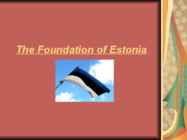
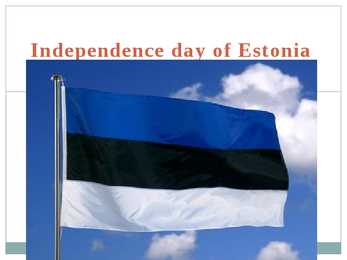
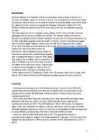
Estonia Topic Tallinn 2007 2 List of Contents page Facts and figures 3 Geography 3 Climate 3 Nature 4 History 5 Economy 6 Culture 6 Biggest towns 7 Language 8 3 Facts and figures The Republic of Estonia is a small country. Covering only 45, 228 sq km it is slightly bigger than Denmark, Belgium or Switzerland. Estonia's population is under 1.4 million. The official language is Estonian but since very many Russians live here Russian is also wide spread. The capital of Estonia is Tallinn. The currency used in Estonia is Eesti kroon. The Estonian national flag is blue-black-white. It was originally the flag of the Estonian Students' Society
Tallinn English College Topic Estonia Tallinn 2008 1. Introduction Estonia is a small country about the size of Switzerland, or New Hampshire and Massachussetts combined. Estonia is named after the people called "Ests" who lived in the region in the 1 st century AD. The Republic of Estonia is one of the three countries commonly known as the "Baltic States". The other Baltic States are Latvia and Lithuania. 2. Geographical position Estonia is situated in northeastern Europe. Estonia is bounded on the north by the Gulf of Finland, on the east by Russia, on the south by Latvia and on the west by the Baltic Sea. In the north it borders on Finland. The coastline of the Baltic Sea in Estonia is characterized by numerous gulfs and bays, the biggest of them
Independence day of Estonia Independence Day, officially known as Eesti Vabariigi aastapäev is a federal holiday in Estonia when it declared independence in 1918 February 24: Independence Day The Republic of Estonia was founded on 24 February 1918, when the Salvation Committee (Päästekomitee) declared the independence of the Republic of Estonia. A Quest for Independence The 1917 revolution and the generally unstable situation in Russia created the opportunity for Estonia to gain its independence. Celebration of the 95th Anniversary of the Proclamation of the State Independence of the Republic of Estonia Saturday, 23 February 11.00 Placing of wreaths on the graves of Estonian state figures 13.00 Handing out of state decorations by President of the Republic Toomas Hendrik Ilves Sunday, 24 February 07.33 Formal flag-raising ceremony on Pikk Hermann tower in Tallinn 09
The modern name of Estonia is thought to originate from the Roman historian Tacitus, who in his book Germania (ca. AD 98) described a people called the Aestii. Similarly, ancient Scandinavian sagas refer to a land called Eistland, close to the German term Estland for the country. Early Latin and other ancient versions of the name are Estia and Hestia. Until the late 1930s, the name was often written as Esthonia in most English speaking countries. Estonia is a democratic parliamentary republic and is divided into fifteen counties. The capital and largest city is Tallinn. With a population of only 1.4 million, it is one of the least-populous members of the European Union. Estonia was a member of the League of Nations from 22 September 1921, has been a member of the United Nations since 17 September 1991, of the European Union since 1 May 2004 and of NATO since 29 March 2004 Estonia has also signed the Kyoto protocol. Economy
"linn" in English meaning both "cities" and "towns". More than 70% of the population lives in towns. History • Estonia was settled near the end of the last glacial era, beginning from around 8500 BC. Before the German invasions in the 13th century proto-Estonians of the Ancient Estonia worshipped the spirits of nature. Since the Northern Crusades Estonia became a battleground for centuries where Denmark, Germany, Russia, Sweden and Poland fought their many wars over controlling the important geographical position of the country as a gateway between East and West. Being conquered by Danes and Germans in 1227, Estonia was ruled initially by Denmark in the north, by the Livonian Order, an autonomous part of the Monastic state of the Teutonic Knights and Baltic German ecclesiastical states of the Holy Roman Empire. From 1418–1562 the whole of Estonia was part of the Livonian Confederation
A limestone cliff runs through the city. It is exposed, for instance, at Toompea and Lasnamäe. However, Toompea is not a part of the cliff, but a separate hill. Coastline is 46 kilometres long.The highest point of Tallinn, at 64 meters above the sea level, is situated in the district of Nõmme, in the south-west of the city. The first human steps, that archeologists found, are about 5000 years old. Tallinn`s first fortress was built in Toompea, in 1050. As an important port for trade between Russia and Scandinavia, it became a target for the expansion of the Teutonic Knights and the Kingdom of Denmark during the period of Northern Crusades in the beginning of the 13th century when Christianity was forcibly imposed on the local population. Danish rule of Tallinn and Northern Estonia started in 1219. In 1285 the city became the northernmost member of the Hanseatic League - a military alliance of German-dominated cities inNorthern Europe. The Danes sold Tallinn along with their other
*Estonians conquered by the crusaders 1208 *Reformation 16th century establishments of new school, Estonians first book appeared in 1525 *Tartu University 1632 founded by King Gustavus II Adolphus, classical university, member of the Coimbra group *Abolition of serfdom 1816 *Song festival 1869 in Tartu, an organiser was J.V.Jannsen, 822 singers, men only *Declaration of independence 24th February 1918 *War of independence 1918-1920 during the Russian Civil War, resulted in a victory for Estonia *Deportation 1949 *Estonia becomes independent 20th August 1991 *Joining EU 1st May 2004 Language: Estonian language, belongs to the Balti-Finnic group of the Finno-Ugric languages, closely realted to Finnish and rather remotely to Hungarian; Latin alphabet with 32 letters , 5 of which occur only in foreign words, the phenomes include 9 vowels and 18 consonants; words are
townapothecary's shop was opened. In Kopli was established ship factories( ,,Vene-Balti's", ,,Noblenesser's" and ,,Bekker's factory"). Tramway was opened in Kopli in 1915 by factories ( ,,Vene-Balti's", ,,Noblenesser's" and ,,Bekker's factory") to they'r workers transport. 4 Independent Estonia (1918-1940) On February 24, 1918 Estonia took advantage of the weakening Bolsheviks and proclaimed independence; already the next day German troops occupied Estonia. Local town government was restored after Germany capitulated in the WW I. The first city council elected during the Republic of Estonia assembled on June 16, 1919. On 2 February 1920, the Tartu Peace Treaty was signed with Soviet Russia, wherein Russia acknowledged the independence of the Estonian Republic
Tallinn The first traces of human settlement found in Tallinn's city center by archeologists are about 5000 years old. In 1050 the first fortress was built on Tallinn Toompea.[3] In 1285 the city became the northernmost member of the Hanseatic League. Medieval Tallinn enjoyed a strategic position at the crossroads of trade between Western and Northern Europe and Russia. On 24 February 1918, the Independence Manifesto was proclaimed in Tallinn, followed by Imperial German occupation and a war of independence with Russia. On 2 February 1920, the Tartu Peace Treaty was signed with Soviet Russia, wherein Russia acknowledged the independence of the Estonian Republic. Tallinn became the capital of an independent Estonia. After World War II started, Estonia was occupied by the Soviet Union (USSR) in 1940, and later occupied by Nazi Germany from 1941–44
New Year is the time at which a new calendar year begins and the calendar's year count is incremented. In many cultures, the event is celebrated in some manner. The New Year of the Gregorian calendar, today in worldwide use, falls on 1 January, as was the case with theRoman calendar. There are numerous calendars that remain in regional use that calculate the New Year differently Independence Day Independence from the Russian Empire in 1918. Independence re-declared from the Soviet Union in 1991 An Independence Day is an annual event commemorating the anniversary of a nation's assumption of independent statehood, usually after ceasing to be a group or part of another nation or state; more rarely after the end of a military occupation. Most countries observe their respective independence days as a national holiday, and in some cases the observance date is controversial or contested. Good Friday Moveable Friday
Estonia. Estonia, officially the Republic of Estonia is a country in Northern Europe. It is the smallest of the three Baltic countries. Estonia has land borders with Latvia (339 km) to the south and Russia (229 km) to the east. It is separated from Finland in the north by the narrow Gulf of Finland and from Sweden in the west by the Baltic Sea. Estonia has been a member of the European Union since May 1, 2004 and of the NATO since March 29, 2004. The area of Estonia is about 45000 square kilometres and the population is about 1.4 million people. The capital of Estonia is Tallinn and the official language is Estonian. The currency is Eesti kroon. The main religion is Lutheran
, the barons were restored their former privileges. Life changed for the better thanks to the opening of a railway line from St. Petersburg to Tallinn in 1870. Tallinn grew into a major port and an industrial centre, with huge shipyards employing a large workforce. Interest in culture grew and Estonians became conscious of their national identity; dreams of independence gained ground. Tartu was the centre of the movement of national awakening. On 24 February 1918, Estonia was proclaimed an independent democratic republic. Tallinn developed into a modern European capital. A period of prosperity followed, but independence only lasted for 20 years. 1 During World War II Estonia was occupied by both German and Russian invaders, and Tallinn suffered heavily. The bombing of the city by the Soviet air force on 9 March 1944 left over 20,000 people homeless. During the Russian occupation
http://warandgame.files.wordpress.com/ 2009/04/ssa.jpg Estonia in the Swedish empire Click to edit Master text styles Second level · Placed itself under Third level Fourth level Swedish rule in 1561. Fifth level · Received protection against Russia and Poland. · Granted the peasantry greater autonomy. http://3.bp.blogspot.com/_S3c33lw2IKU/TUJ7BlJrteI/AAAAAAAA BsM/FK-2Ftvmzbg/s1600/sweden-flag1.jpg Estonia in the Russian empire Click to edit Master text styles Second level Third level · Norther war 1700- Fourth level
4000 years, Meri (1976). 4 First links Although written evidence of regular links between Estonia and England date back only into the beginning of the 20 th century, it is clear that there have been links also earlier. These contacts might be very old. During Hanseatic times the trade on the Baltic Sea was quite active. The links might be even older. Historians have claimed that already during the second Punic war in 218 BC a northern nation called Esths controlled the north south trade of furs. It is most likely that some furs also reached the area of present day England. Even more likely contacts between Estonia and England date back to the beginning of the second millennium AD. It has been widely acknowledged, that Estonians and Danes often combined forces when attacking larger targets. This would mean that Estonians have made frequent and regular raids to the shores of England.
A period of wars began in the 16th century, bringing parts of Estonia under the control of Russia, Denmark, Poland and Sweden. For most of the 17th century, Sweden ruled Estonia. In the 18th century Russian Tsar Peter the Great joined Estonia to his empire. The first true political parties emerged(Where established) at the turn of the century, demanding autonomy for Estonia. Following the Russian Revolution of 1917, Estonia declared independence from Russia on Feb. 24, 1918. Independent Estonia made large strides between wars. World War II ended Estonia's independence. The country was occupied by the Soviet Army in June 1940.Thousands of Estonians were killed or deported to Siberia. In 1944, Estonia became part of the Soviet Union. Proindependence guerrilla forces continued to fight against the Soviets into the 1950s. In the "Singing Revolution" of the 1980s, Estonians showed their desire for independence in peaceful mass meetings
calendar, apart from Christmas. The short summer seasons with long days and brief nights hold special significance for the people of Estonia. Jaanipäev is celebrated in the night between 23rd and 24th of June, a few days after the summer solstice, when night seems to be non-existent. For Estonians, Jaanipäev celebrations were merged with the celebration of Võidupüha during the War of Independence when Estonian forces defeated the German troops on 23 June 1919. After this battle against Estonia's traditional oppressors, Jaaniõhtu and the lighting of the traditional bonfires became linked with the ideals of independence and freedom. Jaanipäev marks a change in the farming year, specifically the break between the completion of spring sowing and the hard work of summer hay-making. Understandably, some of the rituals of Jaanipäev have very strong folkloric roots. The best-known
Estonia lies on the eastern shores of the Baltic Sea on the level northwestern part of the rising east European platform. Estonia is a flat country covering 46 226 square kilometers.Estonian's neighbours are Finland, Sweden, Latvia and Russia. Estonia is rich in islands. The two largest are Saaremaa and Hiiumaa . Saaremaa is famous for its big meteorite crater called Kaali and Hiiumaa is famous for its nature and plants. The countries highest point Big Egg hill ( Suur- Munamägi) reaches 318 meters above sea level. Estonia has many uplands too. The uplands are: Pandivere upland, Otepää upland, Vooremaa upland, Karula upland Haanja upland, Sakala upland. Estonia is covered by about 18 000 square kilometers of forest
Estonia Tjorn Treu KP-31 Information · Area- 45,227 km2 · Population- 1,282,963(2011 july) · Location- Baltic Region of Northern Europe · Capital- Tallinn · Main cities- Tallinn,Pärnu,Tartu,Narva · Official Language- Estonia · Political structure- democraic republic National symbols Flag- Coat of arms- Anthem-"My Fatherland, My Happiness and Joy,, Plant-cornflower Bird-chimney swallow Stone-slate Tree- Oak History DATES Independence Day (Iseseisvuspäev) - February 24 May Day (kevadpüha) - May 1 National Flag Day (Eesti lipu päev) - June 4 Victory Day (võidupüha) - June 23 St. John's Day (Jaanipaev) - June 24 Day of Restoration of Independence (taasiseseisvumispäev) - August 20 history EVENTS
Few hours before and after midnight, people usually party and eat a nicer dinner, often three courses. New Year's Eve is celebrated with large fireworks displays throughout the country, especially in the cities. Independence Day An Independence Day is an annual celebration commemorating the anniversary of a nation's assumption of independent statehood, usually after ceasing to be a colony or part of another state, more rarely after the end of a military occupation. In Estonia it's celebrated on February 24.Estonia got independence from the Bolshevist Russia in 1918.Estonia regain independence in 1991 from NSVL when it fall a part. St John`s Day (jaanipäev) In Estonia, aside from Christmas, St John's Day is the most important days in the calendar. The short summer seasons with long days and brief nights hold special significance for the people of Estonia. St John's Day is celebrated in the
Born: February 23rd, 1874 (Tahkuranna Parish) Died: January 18th, 1956 (Kalninin, Russia) Lawyer (University of Tartu) First president of Republic of Estonia Päts was born in Tahkuranna Parish to a family of Jakob Päts and Olga Tumanova. He started learning in local school. Continued in Riga's seminar and then went to Pärnu's Gymnasium. He graduated in Tartu University In 1898, Päts graduated from the faculty of Law of Tartu University. From 1901 to 1905 he worked as an editor in newspaper "Teataja". Päts had to escape from Estonia, because he was found guilty for rebellious activity.
The Estonian War of Independence The Estonian War of Independence began with the attack of the Red Army of the Soviet Russia on Narva on the 28 November 1918 and lasted until a ceasefire on the 3 January 1920 (juridically until the 2 February 1920). In the War of Independence, Estonia received support from the UK, Finland, Latvia and the White Russian Northwestern Army. In the defence of the independent statehood of Estonia in the battlefield participated at least 130 students and 11 teachers of the Gymnasium for Boys, which was the name for Gustav Adolf Grammar School at that time. Johan Laidoner has said that it was the schoolboys who brought "the belief, that we would win and that is the greatest gift they have given to the
Tallinna Inglise Kolledz Estonia Topic Alice Tärk, 9b Tallinn 2007 FACTFILE Area: 45 228 sq km Poplulation: under 1.4 million Capital: Tallinn Language: Estonian Currency: Eesti kroon (EEK) Main religion: Lutheran National holiday: 24 February (anniversary of the republic) National flower: Cornflower National bird: Barn Swallow National stone: Limestone LOCATION The Republic of Estonia is the northernmost and smallest of the three Baltic States. It is located on the eastern shores of the Baltic Sea in the north east of Europe. To the east the country borders Russia. Latvia is the countries neighbour to the south. From the west the coast of Estonia is washed by the Baltic Sea and from the north by the Gulf of Finland. The length of the coastline is approximately 3 800 km. The longest distance from east to west is
Estonian Defence League The Estonian Defence League is part of the Defence Forces. The task of the Estonian Defence League is to enchance, by relying on free will and self-initiative, the nation's readiness to defend the independence of Estonia and its constitutional order. There are over 13 000 members in the Estonian Defence League. Together with affiliated organisations Women's Home Defence, Young Eagles and Home Daughters, the Estonian Defence League has more than 21 000 volunteers in action. There are also public figures in the organisation. The
Tallinn English College English Sergo Vainumäe 9A TALLINN Report Supervisor: Inge Välja Tallinn 2006 Order of contents: 1.Introduction 2.Toompea 3.Lower Town 4.Kadriorg and Pirita 5.Museums 1. Introduction Tallinn, the capital of Estonia, lies on the Baltic Sea. It is on almost the same latitude east St. Petersburg in Russia, Stockholm in Sweden and Stavanger in Norway, and covers 158 sq km. Tallinn was first marked on a map of the world by the Arab geographer al-Idrisi in 1154, its name then being Kolyvan (probably derived from the name Kalev). In the 13th-century Chronicle of Henricus de Lettis the town was called Lyndanise. Later came Reval (presumably after the old county of Rävala), the name used by the Germans who ruled the country for seven centuries. Russians then modified Reval to Revel
 annaabi.ee