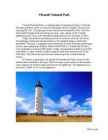
visitors, particularly from Finland. Before World War II, Vilsandi had 33 farms, with a population of around 200 people. Today, the population numbers around 30 individuals. To date, several wooden windmills have been rebuilt as well as the Tolli farm. The Tolli farm was a favorite vacation spot for several Estonian writers. Of interest to geologists, the islands of Vilsandi and Vaika consist of 400 million year old dolomite outcrops. These outcrops can be viewed on the northern coast, opposite of Vesiloo island, and close to the lighthouse. The lighthouse was first built in 1809. So it's an old lighthouse.
located in the Baltic Sea 2673 km2 populatin over 35000 ihabitants density 13 inhabitants/km2 16 municipalities- next year 14 The capital of Saaremaa is Kuressaare Saaremaa - an exciting island Saaremaa - the biggest island of Estonia is known as a good recreation place with unique nature and a lot of sights Saaremaa has retained its uniqueness due to its location and insulation Junipers, dolomite, windmills and the famous local home-brewed beer are considered the symbols of Saaremaa A lot of sights Among the numerous sights of Saaremaa, several are worth calling special attention to, e.g. Angla windmill hill, Mustjala cliff, manor house at Loona, ruins of Maasi castle of order, and Mihkli Farm Museum at Viki. The most important tourist sight in the only town of the county, Kuressaare (up to 1917 Arensburg)
Gaelic football- The game Hurling Similiar to hockey is like a mix of a soccer and but played on a field. rugby. Flag and religion o Irish flag is a vertical tricolour of green, white, and orange. o About 90 % of the people are Roman Catholics St. Patrick's Cathedral The Irish flag Natural resources The primary natural resources of Ireland, include natural gas, petroleum, peat, copper, lead, dolomite, barite, limestone, gypsum, silver and some zinc Ireland has no coal. Gypsum mine Limestone pavement Presidents of Ireland Ireland has had 8 presidents , current president is Mary Patricia McAleese. Mary Therese Winifred Mary Patricia McAleese Robinson Food and drinks
The Bishropic Castle of Kuressaare Location The castle locates in Kuressare in the center of Saaremaa county. Exterior/interior The castle is a good example of late Gothic style because of it´s strict exterior and tasty architectual elements. It´s made from big blocks of dolomite and has a big yard in the center.There are two towers on the northen side of the building: The Watch Tower, also called Tall Herman, and the Defence Tower. The entrance to the castle is also situated on the northen side. The castle has many parts. One part is basement, what was used as store and household room. That included kitchen, brewing room and furance. The second part is the main floor. It was built very elaborately, because there situated the most important rooms
islands. From the north flat and from the east is Estonia hilly. It's highest peak is Suur Munamägi(318 m). Sometimes flooding occurs in the spring in Estonia. It's biggest lakes are Lake Peipsi and Lake Võrtsjärv. It's biggest islands are Saaremaa and Hiiumaa. In Estonia there is 26.5% arable land, 0.35% permanent crops and 73.15% other land. Natural resources in Estonai are oil shale, peat, phosphorite, clay, limestone, sand, dolomite, arable land, sea mud. The population of Estonia is about 1,341,000 people. Estonia, as a new member of the World Trade Organization, is steadily moving toward a modern market economy with increasing ties to the West, including the pegging of its currency to the euro. The economy benefits from strong electronics and telecommunications sectors. Estonia has been a member of the European Union from May 2004. The economy is greatly influenced by
The county of Saaremaa Siiri Tabri Kaia Vask Saaremaa - an exciting island Saaremaa - the biggest island of Estonia is known as a good recreation place with unique nature and a lot of sights. Saaremaa has retained its uniqueness due to its location and insulation. Junipers, dolomite, windmills and the famous local home- brewed beer are considered the symbols of Saaremaa. Rich nature. Because of its mild maritime climate and soil rich in lime, Saaremaa has very rich flora and fauna. In Saaremaa a great number of Roman snails, rare butterflies and beautiful orchids can be found. Each year hundreds of thousands of migratory birds visit Saaremaa and a great number of them are under protection, e.g. barnacle goose and mute swan.
Personal income tax in Estonia is 26% and it is the same for all the people with different incomes. Corporate income tax is also 26% but comes only from profit so nothing is deducted from wages/salaries. Value added tax is the country's main income. It is not noticeable as it is already added to prices and no papers have to be filled. Economy. Estonia is not rich in mineral resources. The main natural resources are: building materials such as clay, sand, gravel, dolomite, oil shale, phosphorite and peat. Oil shale is mined in the northeast (Kohtla-Järve) and it is used as fuel in thermal power stations. Dolomite is found in Saaremaa. Economy is primarily based on light industry and the service sector i.e. tourism, banking, trade, textile and sewing industries give work to many people. Paper and timber industries also employ many workers. Paper was first produced in Estonia in 1677 and it has retained its important role
The Stronghold together with the settlement formed next to it was destroyed in the Livonian War (15581583). On the ruins if the stronghold there is a singing ground today and from here a beautiful view opens onto the surrounding area. · Kuressaare Bishop Stronghold is probably the bestpreserved medieval stronghold in all the Baltic States, being erected in the second half of the 13th century. In the center of the building from tooled dolomite bricks is a square courtyard, which is on the second and third floors surrounded by a closed cloister. There is an exposition of the Saaremaa Museum in the Stronghold that introduces the history and local nature of Saaremaa and Kuressaare. · Vilsandi National Park of international importance, belonging to the highest category of the birds' reserves, has been derived from one of the first nature
common nationality. The statistics say that about 90 % of the Republic's populace is Roman Catholic, 3% identify themselves as Protestants, and the remainder claim no religious beliefs, or belong to the small communities of believers such as Muslims, Jews and Jehovah's Witnesses The St. Paul's cathedral was dedicated to St. Patrick, the patron saint of Ireland. natural resources The primary Natural resources of Ireland, include natural gas, petroleum, peat(turvas), copper, lead(plii), dolomite, limestone(lubjakivi), gypsum, silver and some zinc Ireland has virtually no coal deposits, even though it's just 60 miles from Wales, one of the world's richest coal fields. On the left picture you can see a limestone pavement situated in the west coast of Ireland. and on the right picture you can see a gypsum mine. Presidents There have been 8 presidents in Ireland. Mary Therese Winifred Robinson was the first female
that time were only halfway down. Intense steam generation then spread throughout the whole core causing a steam explosion and releasing fallout to the atmosphere. The second explosion threw out fragments from the fuel channels and hot graphite. The graphite and fuel started a number of fires, causing the main release of radioactivity into the environment. From the second to tenth day after the accident, some 5000 tonnes of boron, dolomite, sand, clay and lead were dropped on to the burning core by helicopter in an effort to extinguish the blaze and limit the release of radioactive particles. Immediate impact Most of the released gases and fallouts were deposited close by as dust and debris, but the lighter material was carried by wind over the Ukraine, Belarus, Russia and to some extent over Scandinavia and Europe. The casualties included firefighters who attended the fires. All these were put out in a few
a god", whereas 54% answered that "they believe there is some sort of spirit or life force" and 26% that "they do not believe there is any sort of spirit, god, or life force". According to the survey, it would have made Estonians the most non- religious people in the then 25-member EU. 12. Economy Estonia is not rich in mineral resources. The main natural resources are: building materials (such as clay, sand, gravel and dolomite), oil shale, phosphorite and peat. Oil shale is mined in Kohtla-Järve and it is used as fuel in thermal power stations. Peat is also used as fuel. Dolomite is found in Saaremaa. Economy is primarily based on light industry and the service sector i.e. tourism (one of the most popular branches of the economy), banking, trade, textile and sewing industries give work to many people. The most important branches also include machinery and equipment. Paper and timber industries also employ many
The majority of its workforce is involved in industry, which also includes shipbuilding, phosphate mining, and the manufacture of electronics and telecommunications equipment, electric motors, excavators, cement, furniture, and textiles and clothing. Its efficient agricultural sector employs some 20% of the labor force and produces meat (largely pork), dairy products, potatoes, flax, and sugar beets. Fishing is also important. Peat, limestone, dolomite, marl, clays (for cement and earthenware), sand (for the glass industry), phosphorite (for fertilizer), and timber are important natural resources. The nation exports light industrial products, machinery, food, wood products, textiles, and electric power. In 1993 Estonia signed a free-trade agreement with its fellow Baltic states, Latvia and Lithuania; the three nations became members of the European Union in 2004.
 annaabi.ee