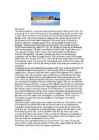
oldest lighthouse in the world that has had the light continuously burning. The other big island that belongs to Estonia is Saaremaa. Saaremaa is approximately as big as Tenerife in Spain. The island is full of exciting sights and beautiful places. Theres very rich nature with hundred of species of various organisms. The most important sight on Saaremaa is in the town called Kuressaare, which is the only town on the island. The bishopric castle dates from the 13th century and it is unique for the Baltic countries. Kuressaare is also known for its well preserved old town. I think it is worth going to those islands and they are very beautiful and unique places.
local home-brewed beer are considered the symbols of Saaremaa A lot of sights Among the numerous sights of Saaremaa, several are worth calling special attention to, e.g. Angla windmill hill, Mustjala cliff, manor house at Loona, ruins of Maasi castle of order, and Mihkli Farm Museum at Viki. The most important tourist sight in the only town of the county, Kuressaare (up to 1917 Arensburg) is the bishopric castle dating from the 13lh century Kuressaare is also known for its beautiful and well preserved old town. A lot of sights The meteorite crater at Kaali is the biggest in Europe and easily accessible to visitors Events Cultural events bring thousands of visitors to Saaremaa each summer You can take your pick from Kuressaare Opera Days, Kuressaare Maritime Festival,
Haapsalu Castle Haapsalu Episcopal Castle, is a castle with cathedral in Haapsalu, western Estonia. It was founded in the thirteenth century to be a center for Bishopric of Ösel-Wiek. When there is a full moon in the month of August, it is said that an image of a maiden, the White Lady, appears on the inner wall of the chapel. On full moon nights in August an image of a maiden, The White Lady, is said to appear on the inner wall of the chapel. In 1228, the Archbishop of Riga formed a new diocese consisting of Läänemaa, Saaremaa and Hiiumaa and designated Gottfried, an abbot of Dünamünde Cistercian monastery, as the bishop
States that has not undergone considerable alterations and due to that is an internationally important architectural monument. This castle is built of limestone. The roof is made of red stone. The construction of the stronghold was closely connected with the Estonians fight against the German feudals. The first documented data about Kuressaare castle originate only from 1380s. Kuressaare castle remained the residence for the bishops of Saare-Lääne Bishopric until the beginning of the Livonian War. At the end of the XIV and the beginning of the XV century the castle was surrounded by a new mighty 625 m long and 7 m high belt of walls, erected around the old belt of walls dating from the XIII century. The necessity to improve the defence of the castle was due to the invention and usage of firearms. The old parts of the walls have been preserved in the new earthwork and bastions even today. In the middle of
The eastern border of Livonia was mainly formed already in the first half of the 13th century and the first belt of fortresses here was probably ready by the end of the 13th century. The first fortresses were not built on the border but further inland. The first decades of the 14th century brought no changes in the situation. Early in 1340 the relationship with Russians deteriorated again. Provincial master Burchard von Dreileben planned a campaign against Pskov and demanded the help of Tartu bishopric. The provincial master began to build another belt of border fortresses. On the Annunciation Day, March 25, 1342, the building of fortresses in Marienburg and Vastseliina began. The latter was called the fortress of the Virgin Mary, but it soon acquired the name of New (vastse) Town (Castrum Novum, Neuhausen, Nyhusen, Nowogrodek). The name is probably the result of a chronological comparison with the older Kirumpää fortress. The first written records of Kirumpää
g. Angla windmill hill, Mustjala cliff, bell tower built in the 17Ih century at Kihelkonna, manor house at Loona, ruins of Maasi castle of order, and Mihkli Farm Museum at Viki. The medieval churches of Saaremaa have remarkable archaic architecture, e.g. churches of Poide and Karja. The oldest of them - the church of Valjala - was built in the 13th century. The most important tourist sight in the only town of the county, Kuressaare (up to 1917 Arensburg) is the bishopric castle dating from the 13lh century. This castle is unique in the Baltic countries. Kuressaare is also known for its beautiful and well preserved old town. Kaali meteorite crater Eighteen kilometers from Kuressaare towards Kuivastu is the location of Estonia's most unique geological object, Kaali lake. The meteoric origin of the lake basin was first suggested by J. Kalkun-Kaljuvee in 1922. The crater walls are covered with trees and vegetation. A path
The first floor has been completely redesigned. In addition to the pharmacy there were also bank rooms. Smaller changes have been made on the second floor. Despite these changes, the town hall has maintained its historic appearance. Till this day the Tartu Town Council and Town Government are housed in the town hall an indication of Tartu's conservativeness. Tartu's coat of arms is derived from the medieval town stamp. The key and sword above the gate are the attributes of the Tartu bishopric as well as the town's patron saints Peter and Paul. At the end of the 16th century southern Estonia was under Polish rule. In 1584 King Stefan Batory gave Tartu its flag. Every day at 12, 6, and 9 o'clock p.m. a tune sounds from the town hall's bell tower. Main Building of Tartu University The main building of Tartu University is one of the most outstanding examples of classical architecture in Estonia. The main building was built in 1804-1809 according to university
Tallinn into the centre of the ecclesiastical state, and were defeated. According to the records, the battle had spread to the interior of the church and the bodies of the fallen knights had piled at the altar. The resettling of the Dominican monks from Toompea to downtown was one of the results of the battle. Having acquired North Estonia again in 1238, King Valdemar of Denmark appointed the Toompea church the cathedral of the Tallinn bishopric, which was formed in 1240, and subordinated to the archdiocese of Lund. The cathedral chapter was established at the cathedral consecrated to St. Mary the Virgin and a school was formed at the church in 1319 at the latest. The reconstruction of the initally one-nave and relatively modest church into a three- nave one started at the beginning of the 14 th century and lasted approximately a hundred years
Under the leadership of wealthy merchants the towns began to challenge the power of the nobles who ruled the countryside. The merchants often supported the regional ruler in his campaigns against unruly vassals, at the same time exacting from him privileges designed to promote commerce and to strengthen the town and the position of the merchant class. (3) In the early Middle Ages such political entities as the counties of Flanders and Holland, the bishopric of Utrecht, and the duchies of Brabant and Gelderland were established. In the far north, however, the Frisians did not submit to a regional ruler but continued to obey their local headmen. The association of the Netherlands with the Holy Roman Empire remained largely nominal throughout the Middle Ages. Some trade was conducted with German coastal cities to the east, such as Bremen and Hamburg, but the major cultural influence came from France. (3) 2.4 The Renaissance
In Early Modern European tradition, witches have stereotypically, though not exclusively, been women. Witch-hunts first appeared in large numbers in southern France and Switzerland during the 14th and 15th centuries. The peak years of witch-hunts in southwest Germany were from 1561 to 1670. One writer has estimated the number of executions at an avarage of 600 a year for certain German cities or two a day. Nine-hundred witches were put to deathh in a day. In the Bishopric of Trier, in 1585, two villages were left with only one female inhabitant each. Many writers have estimated the total number killed to have been in the millions. Women made up some 85 percent of Athose executed old women, young women and children. In locale and timing, the most virulent witch hunts were associated with periods of great social upheaval shaking feodalism at its roots mass peasent uprising and conspiracies, the beginnings
The feast of Saint Andrew is held on November 30 in both the Eastern and Western churches, and is the national day of Scotland. *St David He is the patron saint of Wales. He was a model monk ad he established 12 monasteries in Wales. David contrasts with the other national patron saints of the British Isles, because he is a native of the country of which he is patron saint. He became known as a teacher and preacher, founding monastic settlements and churches. He rose to a bishopric, and and went on pilgrimages to Jerusalem and Rome. St David's Cathedral now stands on the site of the monastery he founded in the remote and inhospitable valley of 'Glyn Rhosyn' in Pembrokeshire. *The Synod of Whitby 664 The Roman monks who were sent to convert the "English" to Christianity, found that the missionaries from Ireland observed Easter at a different time from that which had been appointed by the Roman church. King Oswy, who was seriously
 annaabi.ee