Galileo Galilei Rauno Tapner 10M 2017 Basic information Galileo was born in Pisa, Italy, on 15 February 1564. He was an Italian polymath: astronomer, physicist, engineer, philosopher, mathematician He has been called the: father of observational astronomy father of modern physics father of scientific method father of science Education At the age of 4, Galileo told his father that he wanted to be a monk. This was not exactly what father had in mind, so Galileo withdrew from the monastery.
1. Ernst Julius Öpik was born in Oct. 23 1893 in Kunda, Estonia. He was a noted Estonian astronomer and astrophysicst. He went to University of Moscow to specialize in the study of minor bodies, such as asteroids, comets, andmeteors. He completed his doctorate at the University of Tartu. 2. After 4 years at Moscow Observatory he became Director of the Astronomy Department. From 1921-1944 he was an Associate Professor at Tartu University, and from 1930-34 visiting scientist at Harvard University. 3
necessity-vajadus kohtunik-judge laborant-lab assistant adminstraator-receptionist spordikohtunik-referee dirigent-conductor müürisepp-bricklayer sekretär-secretary tootja, valmistaja-producer vedurijuht-engine driver kosmeetik-cosmetician maalikunstnik-painter kassapidaja-cashier arst-physician kohanäitaja-usherette söekaevur-coal-miner vaimulik-clergyman juuksur-hairdresser kokk-cook kirurg-surgeon trükitöötaja-printing worker astronaut, täheteadlane-astronomer ilusalong-beauty parlour kohus-law court kaevandus-mine operatsioonisaal-operating-theatre tööpuudus-unemployment tööhõive-employment töötu-unemployed tööl käiv,tööle võtma-employed tööjõud, töötajate arv-work-force lasti lahti-sacked shift-vahetus odd jobs-juhutööd töötuabiraha-unemployment benefit kodused tööd-chores töökogemus-experience väärtustama-value lihttöö-menial toimetama-delivering
280-282). There are many aspects of Saturn that make it one of the most extraordinary planets in this solar system. Galileo Galilei was the first to view Saturn's system of rings in the year 1610. Because he happened to be viewing their edge, he failed to recognize them as rings. In fact, he mistakenly interpreted the rings to be two moons similar to those he had discovered near the planet Jupiter. In 1655, a Dutch astronomer named Christiaan Huygens was able to discern what Galileo had thought to be moons as rings. Huygens benefited from a much improved telescope than that used by Galileo. A second moon of Saturn called Iapetus was found by the Italian astronomer Cassini in 1671. He also discovered, in 1675, that Saturn had more than one ring, i.e. a concentric pair of rings. A third ring was discovered by Johann Franz Encke in 1837 using a telescope at the Berlin observatory. Until Pioneer II
Isaac Newton School: Nyo Science School Class 10b Supervisor: Meeli Lepisk Author: Brita Lodi Sir Isaac Newton 16431727 · 25 December 1642(4 January 1643, New Style) , in England · Died 20 March 1727 (aged 84) Sir Isaac Newton 16431727 He is the greatest and most influential scientist who ever lived · Physicist · Mathematican · Astronomer · Natural philosopher · Alchemist · Theologian Early life · He was more interested in making mechanical devices than in studying. · Sundial · Educated at The King's School, Grantham. · In June 1661, he was admitted to Trinity College, Cambridge As a students, we know him because.. · He was the first person who invent the 3 laws of motion · Theory of gravitation · Newtonian fluid, nonNewtonian fluid · Newton's theory of color
for blowing things up. Growing up in the late 1950s in Texas, "I did everything you could do with potassium nitrate, perchlorate, and permanganate, mixed with a lot of other things," he says. "If you mixed potassium nitrate with sulfur and charcoal, you got gunpowder. If you mixed it with sugar, you got a lot of smoke and a nice pink fire." He tested his explosive concoctions on a Fort Worth golf course: "I screwed the jar down tight and ran like hell." "kaboomWoosley", now an astronomer at the University of California at Santa Cruz, has graduated to bigger explosions--much bigger. Woosley studies some of the most powerful explosions since the birth of the universe: supernovae, the violent deaths of stars. The universe twinkles with these cataclysms. They happen every second or so, usually in some unimaginably remote galaxy, blazing as bright as hundreds of billions of stars and creating a fireball that expands and cools for months.
were to be struck on a 14 ton bell. Barry invited Benjamin Lewis Vulliamy, a clockmaker of reputation, to submit a design and price for constructing such a clock. No doubt Vulliamy was pleased to be the clockmaker of choice for what was then to be the largest clock in the world, but other enterprising firms were not happy with the manner in which they had no opportunity to compete for the contract. Subsequently, the Astronomer Royal, Sir George Airy, was appointed as referee for the new clock and produced a specification in 1846. A key requirement of the specification was that the clock was to strike the first blow of each hour correct to one second in time. Tenders were invited and were received from three makers, Dent, Vulliamy and Whitehurst. Dent was Airy' s favourite and soon he had to make the clock himself. In 1852 Dent was awarded the contract. There were many troubles during building the tower
prosin officer advertising people dentist actor politican doctor taxman nurse,midwife fireman musician teacher personnel officer social worker manger marketing press officer professional footballer salesman stockbroker busdriver psycholoogist publisher diplomat farmer solder vet covil servant accountant engineer estate agent hairddresser local goverment officer secretary solicitor postman statician lab techinian banker computer specialist occupational therpaist linguist beauty therapist vicar astronomer nursery nurse museum worker liberarian ------------------------------------- Job advertisement-tkuulutus letter of application-avaldus to require-nuda requirement-nue include-sisaldama ability to work on your own good skills-head oskused expirence-kogemused an asset-eelis v soodumus. salary/average-palk/keskmine modern working conditions-kaasaegsed ttingimused to reply-vastata application-taotlus at least-vhemalt school learning certificate-kooli ppe serftifikaat(tunnistus)
There are arts, monarchs, the sciences and sports. The arts: Vladimír Holan (19051980) -- poet; born, lived and died in Prague . Bohumil Hrabal (19141997) -- writer; lived and died in Prague . Lída Baarová (19142000) -- actress; lived and died in Prague. Wolfgang Amadeus Mozart (17561791) -- composer; some of his best opera successes were during his time in Prague. · Hans Hampel (18221884) -- composer. The sciences: · Tycho Brahe (15461601) -- astronomer; spent end of life near Prague. · Johannes Kepler (15711630) -- astronomer. · Albert Einstein (18791955) -- physicist, served as professor at the German part of the Charles University in Prague (19111912). In sports: · Frantisek Plánicka (19041996) -- football goalkeeper, captain of the Czechoslovakia national football team. · Emil Zátopek (19222000) -- athlete; lived and died in Prague. Other fields:
the English up to his own day Old English Cædmon ,,The Father of English Hymn" Cædmon's Hymn is the oldest recorded Old English poem, and also one of the oldest surviving samples of Germanic alliterative verse The Hymn itself was composed between 658 and 680, recorded in the earlier part of the 8th century Middle English Geoffrey Chaucer 13431400 Known as the ,,Father of English literature", the greatest English poet of the Middle Ages An author, philosopher, alchemist and astronomer, diplomat Wrote The Book of the Duchess, the House of Fame, the Legend of Good Women and Troilus and Criseyde Best known today for "The Canterbury Tales" Crucial figure in developing the legitimacy of the vernacular, Middle English, at a time when the dominant literary languages in England were French Modern English William Shakespeare 26 April 1564 23 April 1616 The Elizabethan Era English poet and playwright, widely regarded as the greatest writer in the
The Scientific Revolution was nothing less than a revolution in the way the individual perceives [ tajub ] the world. As such, this revolution was primarily an epistemological revolution it changed man's thought process. It was an intellectual revolution a revolution in human knowledge. Even more than Renaissance scholars who discovered man and Nature, the scientific revolutionaries attempted to understand and explain man and the natural world. Thinkers such as the Polish astronomer Nicholas Copernicus(14731543), the French philosopher René Descartes(15961650) and the British mathematician Isaac Newton(16421727) overturned the authority of the Middle Ages and the classical world. And by authority I am not referring specifically to that of the Church the demise of its authority was already well under way even before the Lutheran Reformation had begun. The authority I am speaking of is intellectual in nature and consisted of the
He does, however, use meter in masterful and innovative ways, often to mimic natural speech. In these ways, he is able to demonstrate that he has mastered traditional poetry but is no longer subservient to it, just as democracy has ended the subservience of the individual. The innovations in the poetic technique and subject matter in Whitman's Leaves of Grass (seminar). Leaves of Grass: Democratic Themes When I Heard the Learn'd Astronomer I Hear America Singing In his Preface to Leaves of Grass, Whitman states, "The United States themselves are essentially the greatest poem". Whitman was the ultimate Transcendentalist/ Romantic. He united democratic themes and subject matter with free verse form. In Leaves of Grass, Whitman celebrates unity of all life and people. He embraces diversity of geography, culture, work, sexuality, and beliefs. Whitman's impact solidifies American dreams of independence, freedom, and
water turned into steam. This steam filled the empty space of a closed tank of water with the only opening as a pipe from the depth of the water. The water was forced out because of the pressure of the expanding warm air. In the 1600's several scientists continued work on steam powered pumps. Robert Boyle proposed the steam engine in 1678. During the 1680's a gunpowder explosion was used to heat water. Jean de Hautefeuille tried to up water, and Dutch astronomer Christiaan Huygens tried a piston in a cylinder. These experiments were the beginnings of a nuclear power-like process. In 1712, Thomas Newcom and John Calley built their first successful steam engine. Nicholas Cugnot built the first mechanically propelled road vehicle in 1769. Cugnot's vehicle was powered through a two - cylinder piston connected steam engine. It used high pressure steam as the power source. Watt patented late in 1781 a connection from the piston to a rotating gear
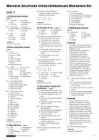
2 He is alleged to have murdered 10A Space page 83 Students' own answers his wife. 1 Down Across 3 He is said to have moved to the 1 constellation 5 astronomer 10C Science fiction page 85 USA. 2 asteroid 6 comet 1 1 news bulletin 4 s candal, 4 Terrorists are believed to have 3 capsule 7 gravity fictional
For example, if you use a 40-watt light bulb 5 hours a day, you have used 200 watthours, or 0.2 kilowatthours, of electrical energy. See our Energy Calculator section to learn more about converting units. SOLAR ENERGY The sun has produced energy for billions of years. Solar energy is the sun's rays (solar radiation) that reach the earth.Solar energy can be converted into other forms of energy, such as heat and electricity. In the 1830s, the British astronomer John Herschel used a solar thermal collector box (a device that absorbs sunlight to collect heat) to cook food during an expedition to Africa. Today, people use the sun's energy for lots of things. Solar energy can be converted to thermal (or heat) energy and used to: · Heat water for use in homes, buildings, or swimming pools. · Heat spaces inside greenhouses, homes, and other buildings. Solar energy can be converted to electricity in two ways:
2 Eduard Tubina elust ja loomingust (Eduard Tubin’s Life and Works), Eesti loomig: kirjanduslik koguteos (Estonian Creation), vol. 4 (Stockholm: Välis-Eesti Kirjastustoimkond, 1946) 103. 3 Ibid, 103-104. 4 Carl G. Brinkmann, Revaler Zeitung 18 Apr. 1944. Sciences; Gustav Ränk (1902-1998), ethnologist; Oskar Loorits (1900-1961) historian and folklorist, greatly appreciated for research into the ancient religions of the Estonians and Livonians; Ernst Öpik (1893-1985), astronomer, founder of the Estonian School of Astronomers, author of a theory concerning the evolution of comets; Edgar Kant (1902-1978), economist and geographer, the last war-time Rector of Tartu University; Jüri Uluots (1890-1945), lawyer and statesman, the last Premier of the Estonian Republic; Johan Kõpp (1874-1970), Bishop of the Estonian Lutheran Church; Arthur Võõbus (1909-1988), clergyman, church historian and Orientalist. Tartu University lost 190 of its lecturers and professors1
 annaabi.ee