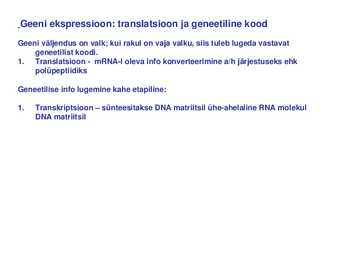
tRNA aktiveerimine(aminoatsüleerimine) 1. A/h ühineb tRNAs aminoatsüültRNA süntetaasi abil 2. Kasutab ATP energiat. 3. 20 erinvat different aminoatsüültRNA syntetaasi (igal a/h oma) 4. tRNAs on ensüümi spetsiifiline sait ATP and amino acid bind to aminoacyltRNA synthetase, to form aminoacylAMP + 2 phosphates. tRNA binds to aminoacylAMP. Amino acid transfers to tRNA, displacing AMP. Amino acid always is attached to adenine on 3' end of tRNA by its carboxyl group forming aminoacyltRNA. Initsiatsioon: 1. mRNA 2. Ribosoom 3. Initsiator tRNA (fMet tRNA prokarüootides) 4. 3 Initsiatsiooni faktorit (IF1, IF2, IF3) 5. Mg2+ 6. GTP (guanosiin trifosfaat) Elongatsioon: 1. Aminoatsüül tRNA seob ribosoomiga (aktiveeritud) 2. Peptiidside 3. Ribosoom uue koodoni juurde Peptiid side (peptidüül transferaas) Umbes 10 ribosoomi korraga töötab (polüsoom):
collectively called ligands, or more specifically, protein ligands -- form a chemical bond. 3. TATA-box is a DNA sequence (Cis-regulatory element) found in the promoter region of most genes in eukaryotes. It is the binding site of either transcription factors or histones and is involved in the process of transcription by RNA polymerase. It has the core DNA sequence 5'- TATAAA-3' or a variant, which is usually followed by three or more adenine bases and has been highly conserved through evolution. The TATA box is usually located 25 base pairs upstream to the transcription site. 4. Nimeta peamised DNAd siduvad domäänid, mis on iseloomulikud transkript-sioonifaktoritele (vähemalt 3) a. Homedomään valgud, tsink-sõrm valgud (zinc-finger), leutsiin lukud, heeliks-ling-heeliks (helix-loop-helix). 5. Mis roll on histoondeatsetülaasidel (HDAC) ja mis funktsioon on histoon-atsetülaasidel (HAT)? a
järjestuse (sarnaneb idees lämmastikaluste arvutiprogrammile) järjestus Geneetiline "keel" · Genoomis asub info ("retsept mitte sai") · Geneetiline info kajastab 20 amiinohappest ehituselemendi kasutust valkude loomiseks · Genoomis on ainult 4 "erinevat tähte" 20 AH kirjeldamiseks miljardite eluvormide loomisel · Uusi "infolauseid" on kombineeritud viimased 3 miljardit aastat DNA · Kahekordne ahel · Adenine= A · Thymine= T · Guanine= G · Cytosine= C · A on paaris T · C on paaris G Pärilikkuse info kodeerimine Transkriptsioon ja translatsioon · Geeni info mahalugemine transkriptsioon (DNA-DNA; DNA- RNA) · Info kvalitatiivne teisenemine (valgu süntees) - translatsioon · 20 amiinohapet · kolmekaupa 4 lämmmastikalust ehk 43 = 64 kombinatsiooni · Koodon = triplet · Molekulaarbiokeemia keksne dogma* - Valgust ei saa kodeerida DNA'd, s
In these cases the methyl groups are added to the 2' OH groups of the ribose sugar. The cap protects the 5' end of the primary RNA transcript from attack by ribonucleases that have specificity to the 3'5'phosphodiester bonds.[4] [edit]3' Processing Main article: Polyadenylation [edit]Cleavage and Polyadenylation The pre-mRNA processing at the 3' end of the RNA molecule involves cleavage of its 3' end and then the addition of about 250 adenine residues to form a poly(A) tail. The cleavage and adenylation reactions occur if a polyadenylation signal sequence (5'- AAUAAA-3') is located near the 3' end of the pre-mRNA molecule, which is followed by another sequence, which is usually (5'-CA-3'). The second signal is the site of cleavage. A GU-rich sequence is also usually present further downstream on the pre-mRNA molecule. After the synthesis of the sequence elements, two
In these cases the methyl groups are added to the 2' OH groups of the ribose sugar. The cap protects the 5' end of the primary RNA transcript from attack by ribonucleases that have specificity to the 3'5'phosphodiester bonds.[4] [edit]3' Processing Main article: Polyadenylation [edit]Cleavage and Polyadenylation The pre-mRNA processing at the 3' end of the RNA molecule involves cleavage of its 3' end and then the addition of about 250 adenine residues to form a poly(A) tail. The cleavage and adenylation reactions occur if a polyadenylation signal sequence (5'- AAUAAA-3') is located near the 3' end of the pre-mRNA molecule, which is followed by another sequence, which is usually (5'-CA-3'). The second signal is the site of cleavage. A GU-rich sequence is also usually present further downstream on the pre-mRNA molecule. After the synthesis of the sequence elements, two
Look for both ticks and crosses. If a table consists of ticks ONLY or crosses ONLY, then assume that the blank spaces are the other symbol. If a table consists of ticks, crosses and blanks then the blanks represent no attempt at the answer. Nucleotides line up along an exposed DNA strand. ; The whole of the double helix ‘unzips’. ; Uracil pairs with adenine. ; A tRNA triplet pairs with an exposed codon. ; Both DNA polynucleotide chains act as templates. ; Adjacent nucleotides bond, forming a sugar-phosphate backbone. ; The original DNA molecule is unchanged after the process. ; Adenine pairs with thymine
Chemistry and Biochemistry of Meat 9 nin complex and the resulting conformational Central to the existence of the muscle cell changes within troponin cause tropomyosin is the production of adenosine triphosphate to move away from sites on actin to which (ATP), the energy currency of the cell. ATP myosin binds and allows myosin and actin to consists of adenosine (an adenine ring and a interact. ribose sugar) and three phosphate groups (tri- For contraction to occur, the thick and thin phosphate). Cleavage of the bonds between filaments interact via the head region of the phosphates (Pi) and the rest of the mole- myosin. The complex formed by the interac- cule provides energy for many cellular func- tion of myosin and actin is often referred tions, including muscle contraction and the
 annaabi.ee