History of Great Britain Prehistory (55BC) no written records 6th 3rd c. BC the Celts came to British isles hill figures, hill forts, stone circles ( Stonehenge ) RomanBritain (55BC 400AD) Julius Caesar, named the country Albion Hadrian's Wall, villas, roads, the town of Bath The AngloSaxon, Danish and Norman invasions Germanic tribes settled and stayed Anglia Christianity was brought, religion became important, churches were built 8th century = raids by the Vikings and the Danes 1016 1042 : Under Danish rule ( York was the capital ) 1042 : local AngloSaxons regain their rule 1066 : Normans arrive ( the Norman conquest ) Medieval Britain (106615th c.) the Battle of Hastings William the Conqueror a new AngloNorman state the feudal system introduced the rule of the king and church strengthened centralised country, military rule Scotland, Wales and Ire...
1) General facts The UK: * the United Kingdom of Great Britain and Northern Ireland was formed in 1801 * it covers 243,610 sq km * everybody from the UK is called British * the capital city is London * is made up of four constituent countries: England, Scotland, Wales and Northern Ireland which in turn are divided into counties * the flag is called the Union Jack which is a combination of the flags of England, Scotland and Northern Ireland * the population is about 60,000,000 people, the population density is 242 people/sq km * its coasts are washed by the Atlantic Ocean, the North Sea, the English Channel, the Celtic Sea, Saint George's Channel, and the Irish Sea. It is linked to France by the Channel Tunnel * the United Kingdom is a constitutional monarchy. The current monarch is Queen Elizabeth II, who is also the Queen and Head of State of fifteen other Commonwealth Realms, such as Can...
History exam *Stonehenge - is a monument located in England. It is one of the most famous prehistoric sites in the world and is composed of earthworks surrounding a circular setting of large standing stones. The surrounding circular, earth bank and ditch, have been dated to about 3100 BC. Stonehenge was produced by a culture with no written language. Many aspects of Stonehenge remain subject to debate. There is little or no direct evidence for the construction techniques used by the Stonehenge builders. *The Celts in Britain and their legacy The Cets lived in Britain in The Iron Age. They were warring tribes who were battleful amongst themselves as well as inter-tribal war. They were not centrally governed. The Celts brought iron working, iron ploughs and metal swords, horses, wheels and chariots - all these things gave them an instant superiority over the native tribes. The Celts built a number ...
Rudyard Kipling - One of the most memorable English writers of all time Family of Joseph Rudyard Kipling Mother- Alice MacDonald Kipling. Alice Kipling (one of four remarkable Victorian sisters) was a vivacious woman about whom a future Viceroy of India would say, "Dullness and Mrs. Kipling cannot exist in the same room."[3] Father - John Lockwood Kipling. Lockwood Kipling, a sculptor, an illustrator, museum curator and pottery designer, was the principal and professor of architectural sculpture at the newly- founded Sir Jamsetjee Jeejeebhoy School of Art and Industry in Bombay. Later in life Kipling illustrated many of Rudyard Kipling's books, and other works. Kipling also remained editor of the Journal of Indian Art and Industry, which carried drawing works from the students of the Mayo School. COUPLE named their son after the place they had first met Rudyard Lake. Alice Kipling Fleming - Sister of British author Rudyard Kipling w...
Kordamisküsimused. 1. Tööstuslik revolutsioon ja tööstusühiskond. Tekke põhjused, olemus, mõju ühiskonna arengule. Tähtsaimad 19. s leiutised ja nende tähtsus. Tööstusliku revolutsiooni olemus 18. sajandil leidsid aset põhjalikud muutused tehnoloogilises arengus. 1 põhjus: Uute kaupade toomisel hakati inimese töö asemel senisest enam kasutama masinaid. 2. põhjus: Seni tootmise veduriks olnud manufaktuurid hakkasid järg-järgult asenduma vabrikutega. See murranguline pööre tootmises kujuneski tööstusrevolutsiooni aluseks. Lisaks masinatele oli tootmise uuendamiseks vaja raha ning inimesi, kes masinatega tööle hakkaksid. Tootmise uuendamiseks oli vaja ka raha ning inimesi. Ühtlasi hakkasid vabrikute- ettevõtete omanikud järjest enam huvi tundma ka uute tehniliste leiutiste vastu ning nende väljatöötamist vähemalt osaliselt rahastama. Üleminek vabrikutootmisele nõudis hulgaliselt tööjõudu, mida saadi enamasti maalt. Ühiskonna tehn...
Stonehenge One of the best known ancient wonders of the world, 5000 years old Megalith monument, built by western mediterraneans during 3000-1600 BC Circular structure, large standing stones, aligned with rising sun at teh solstice Attlers and bones were sued to dig pits that hold the stones The Celts in Britain and their legacy 700-200 BC celts invade Britain Gaels or Goehls(Ireland and Scotland),Cymri(Wales) and Brythons(gave name to Brittany) Fierce fighters,superb horsemen.Most of them farmers, lived in thatched houses Good at art, craftmanship, used iron Divided into tribes, ruled by kings, only in face of danger would they choose a single leader Legacy- hill-forts, farms, churches, field system, woodland, pasture, weapons, iron objects, langugae, culture Caesar in Britain The great Roman Emperor Firts came 55 BC to gather information, celts ...
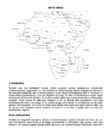
Aafrika ajalugu 1. Sissejuhatus Teooriate seas, mis soodustasid Euroopa riikidel ülejäänud maailma koloniseerima, domineerisid evolutsiooniteooria, progressiidee etc, mis mõjutasid ka Aafrika-Euroopa suhteid. Progressi all mõistetakse tihti peamiselt tehnoloogia, aga ka kultuuri arengut ja sellest tulenes koloniaalajastul müüt, et Troopilisel- ja Lõuna-Aafrikal puudub ajalugu – selle ütles lõplikult välja Hegel. Ta väitis, et aafriklased pole andnud mingid erilist panust inimühiskonna ajalukku. See seisukoht mõjutas pikka aega suhtumist teisesusse ja Aafrika ajaloo uurimisse. Sellest kujunes ka üldlevinud mõttekäik, et see on ideaalne paik eurooplastele, kuhu tuua tsivilisatsioonitõrvikut ja teha ajalugu. 19. saj Aafrika ajalugu eriti ei tuntud – need teadmised, mis olid olnud keskajal, olid moondunud. Kui varem oli tuntud Lääne-Aafrike suuri impeeriume nagu Ghanat ja Malid, siis 19. s...
Some of the things you will learn in THE CODEBREAKERS • How secret Japanese messages were decoded in Washington hours before Pearl Harbor. • How German codebreakers helped usher in the Russian Revolution. • How John F. Kennedy escaped capture in the Pacific because the Japanese failed to solve a simple cipher. • How codebreaking determined a presidential election, convicted an underworld syndicate head, won the battle of Midway, led to cruel Allied defeats in North Africa, and broke up a vast Nazi spy ring. • How one American became the world's most famous codebreaker, and another became the world's greatest. • How codes and codebreakers operate today within the secret agencies of the U.S. and Russia. • And incredibly much more. "For many evenings of gripping reading, no better choice can be made than this book." —Christian Science Monitor THE ...
 annaabi.ee