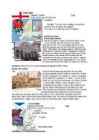
Second level Third level Fourth level Fifth level Goals To protect nesting, moulting and migratory birds Unique landscapes-floodplains, reed bed, coastal meadows, wooded meadows and islets Current situation Area-50 000 hectares, of which 30 000 hectares is covered with water There are 282 species of birds 49 species of fish 47 species of mammals 772 species of vascular plants 6500 hectares of semi-natural landscapes are maintained by local people 5368 ha is traditional farmlands Millions of migratory birds stop on our coast on their way from western Europe to breed in Arctic regions Most of the Long-Tailed Ducks stay in väinameri
public parks. The area is 3.4 km². It has many bridges, lakes, ponds, plants, trees and in brief, it's just a nice and beautiful place to spend your time and enjoy the beauty of nature. The park gets 35 million visitors every year and it is the most visited urban park in the United States. The park even has its own ''Central Park Carousel'' and ''Central Park Zoo''. There are also : playgrounds , Swedish Cottage Marionette Theatre, rock climbing, ice skating, boathouse cafe, boating and a wooded section of the park called "The Ramble'', where bird lovers can observe many interesting bird species . Central Park, which has been a National Historic Landmark since 1962, was designed by landscape designer and writer Frederick Law Olmsted and the English architect Calvert Vaux in 1858 after winning a design competition. The park might appear natural , but in fact it is almost entirely landscaped. Every tree, plant, lake and pond has been planted and made by human hands
Estonia Estonia is a little country in Northen Europe. Estonia is borderd by the Baltic Sea and Gulf of Finland, it's between Latvia and Russia. Its geographic coordinates are 59 North 26 Eeast. Estonias capital is Tallin, it is situated in the North of Estonia. Estonias mainland terrain is flat, boggy, and partly wooded, offshore lie more than 1,500 islands. From the north flat and from the east is Estonia hilly. It's highest peak is Suur Munamägi(318 m). Sometimes flooding occurs in the spring in Estonia. It's biggest lakes are Lake Peipsi and Lake Võrtsjärv. It's biggest islands are Saaremaa and Hiiumaa. In Estonia there is 26.5% arable land, 0.35% permanent crops and 73.15% other land. Natural resources in Estonai are oil shale, peat, phosphorite, clay, limestone, sand, dolomite, arable land, sea mud
sign of poor health. This plant is very easy to grow, and it will spread under favorable conditions. This wildflower will adapt to lawns, especially if they are not mowed too often during the spring or cut too low. HABITAT & RANGE The native Common Blue Violet occurs in every county in Illinois and it is very common (see Distribution Map). Natural habitats include moist to mesic black soil prairies, open woodlands, woodland edges, savannas, and wooded slopes along rivers or lakes. Indeveloped areas, it can be found in lawns, city parks, moist waste areas, and along hedges or buildings. Sometimes the Common Blue Violet is grown in flower gardens. Varieties of blue violets PHOTOGRAPHIC LOCATION The photographs were taken at the webmaster's wildflower garden in Urbana, Illinois, Crystal Lake Park of the same city, and at the edge of an agricultural field outside of the same city in Champaign County, Illinois.
5. Natural dystrophic lakes and ponds 6. Semi-natural dry grasslands and scrubland facies on calcareous substrates (Festuco-Brometalia) (* important orchid sites) 7. Fennoscandian lowland species-rich dry to mesic grasslands 8. Hydrophilous tall herb fringe communities of plains and of the montane to alpine levels 9. Northern boreal alluvial meadows 10. Lowland hay meadows (Alopecurus pratensis, Sanguisorba officinalis) 11. Fennoscandian wooded meadows 12. Active raised bogs 13. Degraded raised bogs still capable of natural regeneration 14. Transition mires and quaking bogs 15. Depressions on peat substrates of the Rhynchosporion 16. Alkaline fens 17. Western Taïga 18. Fennoscandian herb-rich forests with Picea abies 19. Coniferous forests on, or connected to, glaciofluvial eskers 20. Fennoscandian deciduous swamp woods 21. Bog woodland 22
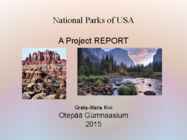
6. 15.02.15 • Finished my project. 7. 16.02.15 presentation in Class 15.2.15 Form 8, Greta-Maria Kivi, 6 National Parks of USA National Parks: introduction (A few most important facts) The United States has 59 protected areas, known as national parks. These magnificent areas of countryside include high mountains, dry deserts, sandy coasts, grassy prairies and wooded mountains full of wild animals. 15.2.15 Form 8, Greta-Maria Kivi, 7 National Parks of USA National Parks: history 1 https://www.youtube.com/watch? v=bIrG3Ykqwmw The first national park in the world, Yellowstone,
Apartments, once the residence of English viceroys and now the focal point for government ceremonial functions, including the inauguration of Ireland's presidents. Blarney Blarney, known as 'the biggest little village in Ireland', is one of Ireland's most picturesque villages. Set in beautiful wooded countryside, just 8km (5 miles) from Cork City, it is an ideal base to visit the many wonderful sights of Cork and Kerry. NORTHEN IRELAND Capital: Belfast Flag: Area: 5,345 sq mi (13,843 km2) Location: Symbols: Interesting plase: White Park Bay
varustab neid täiendsissetuleku ning küttega. Alternatiivkütuse puudumine raskendab illegaalse metsaraie peatamise riigi metsades. Metsanduse areng on olnud aeglane tarvilike masinate ja tehnika puudumise ning halbade teeolude tõttu. Tabel metsanduse kohta Türgis: Area (1000 hectares) FRA 2005 categories 1990 2000 2005 Forest 9,680 10,052 10,175 Other wooded land 10,905 10,728 10,689 Forest and other wooded land 20,585 20,780 20,864 Other land 56,378 56,183 56,099 ...of which with tree cover - - - Total land area 76,963 76,963 76,963 Inland water bodies 519 519 519 Total area of country 77,482 77,482 77,482 Area (1000 hectares) FRA 2005 categories
lynxes, bears and wolves. Estonia, along with Finland and Sweden are the countries with the greatest percentage of forest. Forest management and wood production are particularly important for the Estonian economy. Meadows Meadows in Estonia are much richer in different species than western Europe, and in summer foreign tourists travelling around the countryside can discover for themselves the variety and colour of the roadside meadows. The type of meadow richest in species is the wooded meadow. Marshes and bogs About one fifth of Estonia is covered with marshes and bogs, and most of these are to be found in the central and eastern parts of the country. The best place to see marshes is in the Soomaa National Park in Western Estonia. Soomaa indeed means "Bogland" in Estonian and impressive bogs cover the majority of the park with the thickness of the peat layer reaching up to 7 metres in some places.
morning the thermometer might read 12ºC and by afternoon it may already be 10ºC. Although it doesn't always snow in winter, there tends to be about 10 cm of snow on the ground consistently from late December through to the beginning of March. The sky over Estonia is cloudy for about half the year, and the hilly southeast region experiences up to 750 mm of precipitation due to Estonia's maritime climate. Nature While seven thousand rivers and streams carry rainwater to the sea, bogs and wooded swamplands of different types cover over one fifth of the country -- a world index topped only by the northern neighbour, Finland. Various kinds of forests comprise slightly under half of Estonia's territory. Wetlands, together with primeval forests, represent preserved communities which have for the most part been destroyed in Europe. More than 1000 lakes (5 per cent of the Estonian territory) dot the countryside, which is relatively flat -- almost two thirds of the territory lies less than
dynamics of its different meadows in Soomaa National Park during the years 1905-2002. The general trend on the whole studied area and on its parts (the northern, middle and southern parts of Halliste flood-plain meadow) has been the gradual decrease of flood-plain meadow due to forestation. Predominantly, forestation has increased on higher parts of relief and advanced at the forest edges. In 1959 the botanic reserve `Halliste wooded meadow' was founded, and in this region the nature protection methods were applied for the first time. The foundation of the reserve could not restrain the overgrowth of flood-plain grasslands with forests in the area. In the 20th century the grassland community in the particular region decreased by 76%. Within the frame of the European Union programme LIFE-Nature, 1994 hectares of flood-plain meadows are planned to be restored in Soomaa National Park by the year 2009.
's and 796 officers. (This figure excludes cryptologic personnel serving under theater commanders overseas.) Nevertheless, the personnel supply never caught up to the demand. In April, 1944, for example, the agency had more than 1,000 civilian positions empty. But its growth soon made more space necessary. Like the Navy, it found a former girls' school ideal for its purposes. During the summer of 1942, it moved from the Munitions Building to Arlington Hall, whose brick buildings stood on 58 wooded acres fronting on Glebe Road in Arlington, Virginia, about three miles from downtown Washington and away from the eyes of enemy agents. The agency soon outgrew even this, and in the late fall of 1942 began expanding into Vint Hill Farms, an old estate in the Virginia horse country about 50 miles from Washington. Giant intercepting towers and half a dozen ugly barracks-like buildings soon disfigured the lovely Blue Ridge foothills, and here, in rooms filled with desks with tilted tops,
 annaabi.ee