Which I consider to be more important: education or upbringing? I can not even define which is more important to say, education or upbringing. For me are both very important. About education: Education is provided by the school, and whose existence will be checked. Education is a prerequisite for personal development, purpose and resources. Education is a purposeful process. Education is a prerequisite for communication, rather than treatment. Educational effects will turn out truthfully, in a problematic choice of situation. Education makes or tries to make the human body from the''normal''bodies, people who see
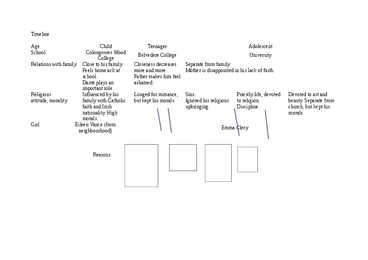
Father makes him feel Dante plays an ashamed. important role. Religious Influenced by his Longed for romance, Sins. Priestly life, devoted Devoted to art and attitude, morality family with Catholic but kept his morals. Ignored his religious to religion. beauty. Separate from faith and Irish upbringing. Discipline. church, but kept his nationality. High morals. morals. Girl Eileen Vance (from Emma Clery neighbourhood) Reasons:
Mary was born in 8th December 1542. Also known as Mary Stuart or Mary I of Scotland She became queen when her father, James V died six days after her birth. First marriage Mary was sent by her mother, Mary of Guise, to be raised at the court of the French king Henry II. She was married in 1558 to Francis II. When Francis died Mary returned to Scotland. Francis II and Mary Stuart Scotland She was distrusted because of her Catholic upbringing. In 1565 the red-haired queen married her ambitious cousin Lord Darnley She became a victim of intrigues among the Scottish nobles. Darnley murdered Mary's confidant David Riccio. The murder of Riccio Third marriage Lord Darnley was murdered in 1567. The suspect was Bothwell. Ignoring objections by the jealous Scottish nobility, Mary married Bothwell. England Mary Stuart had to take refuge in England.
25.helpful, loyal- abivalmis, lojaalne=truu 26 kind, nice,polite- lahke, kena, viisakan 27.patient, reliable- rahulik, usaldusväärne 28.sociable, tactful- hea suhtleja, taktitundeline 29.wise, witty- tark, vaimukas 30.courageous, punctual- julge, vapper 31.grateful, imaginative- tänulik, ette kujutlusvõimeline 32. trustful- usaldav 1.a man of character- tugeva iseloomuga inimene 2.be characteristic to smb- olema kellelegi iseloomulik 3.a person with good upbringing- hea kasvatusega inimene 4. a review of character- kirjalik iseloomustus Negative traits of character 1.agressive, dishonest- 2.ambitious, lazy- 3.arrogant, proud- 4.pompous, boastful- 5.selfish, self-centered- 6.snobbish, narrow-minded- 7.petty, mean- 8.stubborn=obstinate- 9.two-faced , greedy- 10.rude, violent- 11.moody, bad-tempered= ill-tempered- 12.indifferent, boring- 13.brutal, pathetic- 14.intrusive, capricious- 15.impolite, spoilt- 16
she should behave. Therefore, she often imitates her mother or somebody else to be taken seriously. Once she attempted to impose herself among workmen, but failed miserably and lost face. Namely she attempted to mimic her mother`s voice in an unconvincing way by saying "Good morning" to workmen. Afterwards she felt very much ashamed. Nevertheless, she gives her all to live up to the same social standards and values as she is raised to follow. Because of her upbringing she frequently wonders how disrespectfully some people dare to speak or act. Yet she really wants to become a part of the grown-ups world. She secretly admires older people and wants to be around them. For instance, she admires workmen and once she even forgets herself to think how she would like to have workmen for her friends rather than the silly boys she danced with and who came to Sunday night supper. She believes she would get on much better with men like these
Bennet. When Darcy first proposes to Elizabeth, than she refuses. He is stunned and mortified to be rejected. I think Elizabeth believed more the prejudice she had about Darcy and she did not believe at first that Darcy could be generous and even friendly and kind. The ending is really beautiful and I like it. Darcy proposes Elizabeth again and this time she accepts. They have a double wedding with joy and love. A major theme is the importance of environment and upbringing on the development of young people's character and morality. Social standing and wealth are not necessarily advantages. Pride and Prejudice, employs the narrative technique of free indirect speech. Austen invites the reader to follow events from Elizabeth's viewpoint, sharing her prejudices and misapprehensions and being surprised along with her when events prove these to be mistaken. In my oppinion, the book was really good and I liked it a lot. Though the language
flashbacks and his appearance on the show. The audience knows Jamal doesn't know the answer because the climax of the film occurs when Jamal is faced with the final question. The flashbacks have shown us what Jamal has had to overcome and the stage is set for the triumph of love. In conclusion, the theme of `Love conquers all' was an idea worth learning about, and was made easy to learn about through cinematography, dialogue & gesture, and flashbacks. Jamal's upbringing and his conflict with Prem made me as the audience understand the theme of "Love conquering all". Boyle was trying to show that love is a powerful tool, and can drive people to do anything, like win a game show. As Boyle said, "What matters to the characters in the film is who they love, who they hate, what their ambitions are, and what their aims are." Also, the fact that Latika had almost given up on her and Jamal ever being together again, which is proven when she says "I thought we
from his comments, explaining that he was not praising totalitarianism. He said: "I just wanted to say that Spain is better that Italy in some respects and provide a political context. I would never dream of praising dictatorships. My father conceived me after having been imprisoned in Nazi concentration camps." Born in 1946 in a village in the northern Italian province of Gorizia, near the border with the then Yugoslavia, Capello insists a hardworking upbringing and the encouragement of his father to pursue his footballing dreams are the roots of his success. His father played for an Italian third division side and an uncle was so good that he played for the national side. Not only was football in the genes but it also provided an escape from the Cold War pressures in a part of Italy where there was constant fear that the borders could be redrawn and his family forced from their home. Citing the
indeterminacy, and unknowability, about them. The bare facts are always laughably inadequate to the complexity of "real" people. Anton Pavlovich Chekhov was born on 29 January (New Style), 1860, in Taganrog, a small port on the Sea of Azov, in southern Russia. As the son of a grocer and grandson of a serf, Chekhov was a first-generation intellectual. His modest background and upbringing are crucial to his development as a writer. Chekhov always felt that he missed out on childhood. It was a very hard lifeand it may have contributed to his poor health: he succumbed later on to the"family disease", tuberculosis, which led to his early death at the age of 44.His mother was a quiet, gentle soul who was full of stories of her early life. In later years, Chekhov would say that "we inherited our talent from our father,but mother gave us soul"
much to educators. Since I don't have an educational theory neatly worked-out, nor an outline of my perceptions, my intent is to address each educational ingredient that comes to my mind. After I've said what I think about each topic, readers may have a fair comprehension of my philosophy. First comes sensitivity. If a person be insensitive, be it from numbing cold, exhaustion, drugs, genetic makeup, or upbringing, then the process of education is bogged down, and results come only after great efforts. Sensitivity in my integrated meaning is broad, covering literally the senses, so that deaf and blind people are less sensitive, as well as people whose senses work perfectly, but whose receptivity or thought processes are blunted for whatever reason. A person can be insensitive in one way, such as blind, and extraordinarily sensitive in another way, such as in hearing
treat (v) treatment (n) trek (n) trendy (adj) trickle (v) trip over (v) triumph (n) troops (n pl) tropical (adj) troubled (adj) truffle (n) truly (adv) trumpet (v) trust (n unc) tube (n) turmeric (n) turned up (adj) twin (n) twitch (v) UFO (n) unbeatable (adj) unconventional (adj) underestimate (v) undergo (v) undertake (v) ungrateful (adj) unidentifiable (adj) unique (adj) unmanned (adj) unmissable (adj) unnervingly (adv) unpredictable (adj) unveil (v) unwitting (adj) up to date (adj) upbringing (n) update (v) 30 upright (adv) urban (adj) utterly (adv) vacation (n) valley (n) value (n) van (n) vandalise (v) vast (adj) vegan (n) vegetation (n unc) venison (n) venture (n) venue (n) version (n) via (prep) victim (n) victorious (adj) villain (n) vinegar (n) vineyard (n) violin (n) virus (n) visa (n) visibly (adv) vision (n) visualise (v) vivid (adj) volume (n) volunteer (n) wade (v) wages (n pl) waist (n) wallpaper (n) wardrobe (n) waterfall (n) weapon (n)
wept on his face lamenting that one so young and innocent looking could not be evil. She pleaded with the doctor and her aunt to not do harm to Oliver, or put him in prison. They agreed that nothing would be decided about what to do with him, until he woke up and they could judge if he had an evil character. Hours later, Oliver woke and grateful that he was being taken care of, told them the story of his upbringing. The listeners of the tale were in tears, and when he was finished, he quickly fell back to sleep. They left the room and went down to the kitchen to question Mr. Giles to make certain that Oliver was the boy he shot that night in the cellar. Both Giles and Brittles could not give their oaths that Oliver was the boy they saw, and as they were concluding the interview, someone came to the door. They were horrified to find out it was the Bow Street Runners there to investigate the break in.
who belongs to a minority group or who is indigenous; (e) Encourage the development of appropriate guidelines for the protection of the child from information and material injurious to his or her well-being, bearing in mind the provisions of Articles 13 and 18. Article 18 1. States Parties shall use their best efforts to ensure recognition of the principle that both parents have common responsibilities for the upbringing and development of the child. Parents or, as the case may be, legal guardians, have the primary responsibility for the upbringing and development of the child. The best interests of the child will be their basic concern. 2. For the purpose of guaranteeing and promoting the rights set forth in the present Convention, States Parties shall render appropriate assistance to parents and legal guardians
Discuss how social or cultural factors affect one cognitive process. Cognitive researchers have traditionally constructed research in western countries. It was assumed that cognitive processes follow universal laws, and that the same cognitive test could apply to everyone, but that is not the case. Cross-cultural psychologists are now aware of the social and cultural factors on cognitive processes. Culture influences memory. Our cultural upbringing shapes the schemas that we acquire and use to perceive the world and ourselves. People in northern Europe and North America tend to see the world in an individualistic way and people in Asian, African and South American countries see the world in a more collectivistic framework. Qi Wang held a study considering our earliest memories. He asked college students from Harvard University and Beijing University to recall their earliest memories
with alien life forms are extremely sport Mum's not sporty, but she small because of the enormous Use of English was happy to take me to training distances between the stars, and · Encourage students to read whole sessions and drive me around. the amount of time that it would sentences before choosing words, We didn't have a normal upbringing; take to travel from one part of the as they may seem to require one we didn't have dinner on the table galaxy to another. However, this word before the gap, but after the at 6pm. Mum worked weekends and doesn't alter my view that it's highly gap, the sentence may change taught pottery and macrame. likely that life exists somewhere in direction. Students re-read their Our relationship is a little
formal, she was close only to her female relations. The glittering social life and extravagance of the Queen's Household was replaced by a strict and concervitive one. She gave birth to a son, the future King Edward VI of England. She herself died giving birth. It is said that Henry recognised her as his true wife, for she gave birth to a male heir. Henry was buried next to her. *Anne of Cleives - She was the Queen of England and the fourth wife of Henry VIII. Anne lacked education in her upbringing, but she was skilled in needlework, and was quite good at card games. Nevertheless, Anne was considered gentle, virtuous. However, Henry disliked from the moment they met and in a short time, Anne was asked for her consent to an annulment, to which she agreed. The marriage was annulled and she received a generous settlement. Henry and Anne became good friends and he later made her a Princess of England. Anne remained in England for the rest of her life.
myself. CONTENT AND STRUCTURE OF THE EGO The egoic mind is completely conditioned by the past. Its conditioning is twofold: It consists of content and structure. In the case of a child who cries in deep suffering because his toy has been taken away, the toy represents content. It is interchangeable with any other content, any other toy or object. The content you identify with is conditioned by your environment, your upbringing, and surrounding culture. Whether the child is rich or poor, whether the toy is a piece of wood shaped like an animal or a sophisticated electronic gadget makes no difference as far as the suffering caused by its loss is concerned. The reason why such acute suffering occurs is concealed in the word “my,” and it is structural. The unconscious compulsion to enhance one’s identity through association with an object is built into the very structure of the egoic mind.
T h e Ordinary W o r l d is the most appropriate place to deal with exposition and backstory. Backstory is all the relevant information about a character's history and background — what got her to the situation at the beginning of the story. Exposition is the art o f gracefully revealing the backstory and any other pertinent 94 T H E ORDINARY W O R L D information about the plot: the hero's social class, upbringing, habits, experiences, as well as the prevailing social conditions and opposing forces that m a y affect the hero. Exposition is everything the audience needs to know to understand the hero and the story. Backstory and exposition are among the hardest writing skills to master. Clumsy exposition tends to stop the story cold. Blunt exposition draws attention to itself, giving the backstory in the form o f a voiceover or a " H a r r y the
 annaabi.ee