full of new opportunities for everybody. In the middle of the 19th century many British people started they journey to America from Liverpool. A great number of settlers were the Irish who left their country after the Irish Potato Famine on 1845-1849, when families lost their main food, the potato crop. During the journey, many people suffered from illnesses or died. When the boats arrived at Ellis island, new settlers often had to wait a medical examination. As many Irish immigrants were uneducated, the man worked at building bridges, canals and women became maids, cooks. Poor living conditions, lack of food and medical care led to illnesses and an early death. The population of the USA is more than 300 million. The biggest national groups today are of German ,Irish and English descent. About 30 millions African Americans live in the USA.They are the descendants of Africans brought to America as slaves in the 17th century
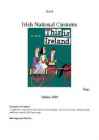
Enthusiasts of horse racing flock to the Galway Races in the summer and early fall. Holidays and Celebrations The Irish celebrate New Year's Day on 1 January. Saint Patrick's Day on 17 March is a national holiday and is marked by parades, shamrock decorations, and sometimes the wearing of clothing that is green (the national color). Legend has it that resourceful Saint Patrick made use of the three-lobed shamrock as a diagram to explain the Holy Trinity to his uneducated congregation. However, the pre-Christian Irish had long associated the shamrock with Trefulngid Tre-eochair ("The Triple Bearer of the Triple Key"), the spring fertility god manifestation, whose symbol can be a shamrock or three legs spiraling together (as seen on the flag of the Isle of Man). The Irish celebrate Easter, and Easter Monday is a public holiday. Christmas is celebrated on 25 December, but celebrations may last until New Year's Day. An old
Edulugude võistlus Success-story competition „Small Town Inhabitants – Educated or Uneducated People“ To begin with, my childhood was quite ordinary, I spent a lot of time in my country home, spending most of my time playing. I have been raised by my mother. As I grew older, I got more and more interested in different things. At one point it occured to me that when I want to be successful in some field, then I really have to educate myself in that filed.When my friends have characterised me then they have mainly mentioned that I am an active person, who has been successful in
connecting world (usually who or that). This is regarded bad grammar and this is characteristic of irregular oral speech (dialogue). NT: I am the first one saw her. 1 2 The main effect is to suggest the careless or uneducated nature of somebody's speech. NT: It was I was a father to you. NT: It is your unfairness disgusts me. NT: There is no one enjoys good food than he does. THE GAP-SENTENCE LINK THE GAP-SENTENCE LINK is seemingly illogical construction of a sentence that connects its parts in such a way that the reader himself must reconstruct the gap between them. The device is usually introduced by dots and followed by the conjunction "and" or "but".
71. Chav/ Chavette- Another, more recent stereotype is that of the Chav. According to the Oxford English Dictionary, the word was first used in a Usenet forum in 1998 and made its first appearance in conventional media in 2002. By 2004, the word was in common usage. The origin of the word is unknown, but it is most often thought to have originated in the Romany word chavi, meaning child. It has become a widely used derogatory word for young people of working-class origin, who are depicted as uneducated, uncultured and prone to antisocial or immoral behaviour. 72. Sloane Ranger/ Sloanies- Sloane Rangers have been around since the 1980ies. The term refers to young, upper class or upper-midsloane ranger ahndbookdle-class fashion-conscious but conventional young people, living in the more expensive parts of West London. The term was popularised by The Official Sloane Ranger Handbook (1982) written by Peter York and Ann Barr
added to "bad", "good", "many". Sometimes even double forms are used. VERBS: the Historical Present (present tense) in the author's narrative is used to render past events, creating the illusion of things happening at the present moment. Continuous tenses may express surprise, disbelief, indignation. Sometimes continuous tenses are more polite and mild. In the dialogue we may come across ungrammatical instances: I says; we says; times has changed. These cases reflect ungrammatical, uneducated, original, or excited state of mind. Archaic verbal forms may be used to create the historical background or make the narrative more elevated. On the other hand they may suggest the colloquial speech, because these forms are preserved in dialects (e.g. ending st (you live you livest (second person Singular). ADVERBS: are expressive when used as intensifiers (e.g. terribly smart, horribly polite, awfully pleased, etc.). Such adverbs give a colloquial touch and their
During civil war no export of cotton. Estonia came the world's biggest exporter of flex (linase taime). VI Reconstruction · 13th Amendment to the Constitution The Southern states based their business upon slavery Abraham Lincoln for President (he's against slavery) South Carolina + 10 other states separated from the USA =>the Confederal state of America => Civil War 1865 slavery was abolished everywhere but Missisippi · The role of Abraham Lincoln Uneducated, but still considered the best President Nominated for precidency in 1860 Renomination during the Civil War Emancipation Proclamation (slaves free) Wrote Habreas Corpus (court decides if government can detain smt) 6 The Homestead Act (Anyone who had never taken up arms against the U.S. Government, including freed slaves, could file an application and get land) · The role of Andrew Johnson Vice president of the Unites States Became the 17th President after Lincoln's assassination
(students, schoolteachers). The type of context is important for creating adherent connotations. Negative connotation 1 The sentence may contain grammatical negotiation (has not) e.g science (neg.meaning) hasn't got a soul. Can't help itself. 2 The closeness of words with inherent negative connotations. Adj: obscene, corrupt, filthy, vulgar, ignorant Verbs: hate, opress, loath Nouns: stupidity, vice, fool, etc e.g I saw myself as Hummy would see me, uneducated and vulgar and working-class. (neutral) 3 The neighbourhood of vulgar words: e.g And you couldn't forget your bloody principles for one night. 4 With the use of certain intensifiers: merely, only, too, too much, horribly, perfectly, even, so. e.g They were too clean, too neatly arranged, too new. 5 Repetition of a word in a sentence, e.g You are sitting here, comfortably preaching about it everlasting preaching, preaching, words, words, words. 6 Graphic presentation
Continuous tenses may express surprise, disbelief, indignation (e.g. "One day, when I am no longer spending time running a sweet stool, I am to write a book about us all."). Sometimes continuous tenses are more polite and mild (e.g. "He is not feeling too well today."). In the dialogue we may come across ungrammatical instances: we, I, he + ain`t; I says; we says; times has changed; he done me harm; etc. These cases reflect ungrammatical, uneducated, original, or excited state of mind. Archaic verbal forms may be used to create the historical background or make the narrative more elevated. On the other hand they may suggest the colloquial speech, because these forms are preserved in dialects (e.g. ending st (you live you livest (second person Singular); -eth (indicates the 3rd person singular); -st (Past) (do did (didst). ADVERBS:
When the Anglo-Saxons were brought to Christianity in the seventh century, hundreds of Latin and Greek words were adopted into Old English, words such as hymn, priest, school, cook. In the ninth and tenth centuries the Viking invaders added their own Norse words: skirt, skin, get, leg, same, wrong. The Normans brought French with them. It became the language of the educated classes for the next two or three centuries. English continued to be spoken mainly by ordinary, uneducated people but was no longer written. By the end of the fourteenth century, however, English was once again a written language, because it was used instead of French by the ruling classes. During the Hundred Years’ War Edward III (1327–1377) actually forbade the speaking of French in his army. It was a way of making the whole army aware of its Englishness, which was important during the war. Two writers, above all others, helped in the rebirth of English literature: William
New Zealand much earlier than this. *The British expansion in South Africa When Dutch mercantile power began to fade, the British moved in to fill the vacuum. They seized the Cape to prevent it from falling into the hands of Napoleonic France. British sovereignty of the area was recognized at the Congress of Vienna. A pattern soon emerged whereby English-speakers became highly urbanised, and dominated politics and trade while the largely uneducated Boers were relegated to their farms. The gap between the British settlers and the Boers further widened with the abolition of slavery. South African Wars between the British and the Boers concluded in the Treaty of Vereeniging. Under its terms, the Boer republics acknowledged British sovereignty, while the British in turn committed themselves to reconstruction of the areas under their control. *The Great Trek and the foundation of the two independent Boer republics The Great
ccc_tracy_fm_i-xviii.qxd 7/7/03 3:23 PM Page xiv xiv ➤ INTRODUCTION desire to live a wonderfully healthy, happy, prosperous life, when you read those words, your doubts and fears arose immediately to remind you of reasons why these dreams and goals may not be pos- sible for you. Well, join the crowd! This is exactly how I felt many years ago. Even though I wanted to be a big success in life, I was unskilled, uneducated, and unem- ployed. I had no idea what I could do to improve my situation. I felt trapped between big ideas on the one hand and limited resources and opportunities on the other. Then I discovered a series of re- markable principles that have been responsible for all the great suc- cesses and achievements of the ages, and my life changed forever. After proving these laws and principles in my own life, I began
Yes, "What caused it?"-the critical question. How are we to account for this most astounding of compliant acts? Various explanations have been offered. Some have focused on the charisma of Jim Jones, a man whose style allowed him to be loved like a savior, trusted like a father, and treated like an emperor. Other expla- nations have pointed to the kind of people who were attracted to the People's Tem- ple. They were mostly poor and uneducated individuals who were willing to give up their freedoms of thought and action for the safety of a place where all decisions would be made for them. Still other explanations have emphasized the quasi- religious nature of the People's Temple, in which unquestioned faith in the cult's leader was assigned highest priority. No doubt each of these features of Jonestown has merit in explaining what happened there, but I do not find them sufficient. After all, the world abounds
 annaabi.ee