Tibet Tibet is a plateau region in Asia, north of the Himalayas, and the home to the indigenous Tibetan people and some other ethnic groups. With an average elevation of 4,900 metres, it is the highest region on Earth and has in recent decades increasingly been referred to as the "Roof of the World". In the history of Tibet, it has been an independent country, divided into different countries, and a part of China each for a certain amount of time. Tibet was first unified under King Songtsän Gampo in the seventh century. A government nominally headed by the Dalai
* The right of the strong * In 1915- visited the front as a reporter * Lost his son in WWI * Died in 1936, buried in the poets' corner "Kim" Rudyard Kipling * Died of a hemorrhage (internal bleeding) * Was written in 1901 * Spy novel * About orphaned son of an Irish soldier and his adventures * Takes place at the time of The Great Game * Kimball "Kim" O'hara- Spy courier mainly for Mahbub Ali * Kimball - "Chela" of Teshoo Lama, clever and charmful * Teshoo Lama - a Tibetan Lama on a spiritual journey, spiritual teacher of Kim, religious and smart * Mahbub Ali- horsetrader and spy for the British, good friend of Kim , clever and selfish * Hurree Babu- dumb and easily foolable * Colonel Creighton- British army officer, superior of Kim, disciplined and strict * Reverend Arthur- the Church of england * Takes place in different places of India, 1893-1898 * Kim grows up independently in the streets of India
reziimi eest, ning kel on võimalik seda erinevalt Tiibeti tiibetlastest igapäevaselt praktiseerida ilma sõjaväe järelvalveta. Tiibetist teab kogu maailma, ning ka see võib sundida kultuuri säilima. 7 Allikaloend Eesti-Tiibeti kultuuriselts 2008. Tiibeti toetustõrvik Suurel Munamäel. http://www.tibet.ee/munamagi/Tiibeti_toetustorviku_infovoldik.pdf Forbes, Andrew, David Henley 2011. 'The First Tibetan Empire' in: China's Ancient Tea Horse Road. Chiang Mai: Cognoscenti Books Marks, Thomas A. 1978. "Nanchao and Tibet in South-western China and Central Asia." The Tibet Journal. Vol. 3, No. 4. Winter 1978, pp. 1316. Richardson H. E. 1985. 'A Corpus of Early Tibetan Inscriptions. Royal Asiatic Society. pp. 10643. www.bbc.com http://www.bbc.com/news/world-asia-pacific-16689779 Herkel, Andres 2013. Märts, arvamus. Herkel: Tiibeti olukord on kultuurilises mõttes
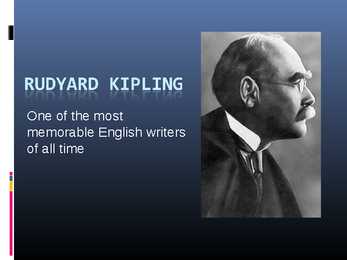
One of the most memorable English writers of all time Family of Joseph Rudyard Kipling Mother Alice MacDonald Kipling Father John Lockwood Kipling Sister Alice Kipling Fleming Early Life 30 December 1865 in Bombay, in British India Captain and Mrs. Holloway - Lorne Lodge Paradise at Aunt Georgie's and her husband 1878 - admitted to the United Services College Bombay in 1865 Travels & First writings 1883 - visited Simla thirty-nine stories appeared in the Gazette included in Plain Tales from the Hills Kipling's first prose collection 1887 Allahabad in the United Provinces published six collections of short stories 1889 sold the rights to his six volumes of stories Life London published a novel - The Light that Failed and on the 18 January 1892 Carrie Balestier (29) and Rudyard Kipling (26) were married in London United States didn't find a country that lived up to his expecta...
Living a vagabond existence in India under British rule in the late 19th century, Kim earns his living by begging and running small errands on the streets of Lahore. He occasionally works for Mahbub Ali, a horse trader who is one of the native operatives of the British secret service. Kim is so immersed in the local culture, few realise he is a white child, though he carries a packet of documents from his father entrusted to him by an Indian woman who cared for him. Kim befriends an aged Tibetan Lama who is on a quest to free himself from the Wheel of Things by finding the legendary 'River of the Arrow'. Kim becomes his chela, or disciple, and accompanies him on his journey. On the way, Kim incidentally learns about parts of the Great Game and is recruited by a British officer to carry a message to the British commander in Umballa. Kim's trip with the Lama along the Grand Trunk Road is the first great adventure in the novel.
This group also includes the Chinese diaspora, especially in relation to Southeast Asia. Japan, considered a hybrid of Chinese civilization and older Altaic patterns. The civilization of Sub-Saharan Africa is considered as a possible 8th civilization by Huntington. The Buddhist areas of Bhutan, Cambodia, Laos, Mongolia, Myanmar, Sri Lanka, Thailand, Arunachal Pradesh, Kalmykia, parts of Nepal, parts of Siberia, and the Tibetan government-in-exile are identified as separate from other civilizations, but Huntington believes that they do not constitute a major civilization in the sense of international affairs. Instead of belonging to one of the "major" civilizations, Ethiopia, Haiti, and Turkey are labeled as "Lone" countries. Israel could be considered a unique state with its own civilization, Huntington writes, but one which is extremely similar to the West.
chocolate. The Singhalese was allowed to be bred to either Balinese or Himalayan and the progeny could be registered as Singhalese. It was judged to the Balinese standard with allowances made for its different coat type. Over time, it appears to have lost out to the Balinese. BIRMAN The Birman has the colourpoint pattern with the addition of white bootees/gauntlets. The Birman arrived in Europe around 1920 and has also been known as the Tibetan Temple Cat and the Sacred Cat of Burma. Modern Birmans are descended from a pair brought to Europe by Mr. Vanderbilt. It is also reported that 2 Englishmen, Major Gordon-Russell and August Pavie, then living in France, received a pair of Birmans from the Kittah people in 1919 as gratitude for their part in saving the temple from being overrun by invaders. The remainder of the tale is the same: the male unfortunately died during the voyage, but the female was pregnant
Malaya -Polynesian (includi ng Hawaiian, Prlipmo) · Sino -Tibetan (incl uding Chine se, Burmese) Ame rindi an (Includin g Inuit, lroquoian. O uechua) Ural-Asiat ic (incl ud ing Finnish, Hungana n, Turkrsh) Dravidian D O the r
The composer calls his synthetic works “poems”, for example Breaths (1979-1980). These are sound canvases, reflecting nature and the Universe without any direct and planned development, where thought often proceeds through variants. Grünberg feels, like several other contemporary Estonian composers (Peeter Vähi, b. 1955), profound respect for Oriental philosophy and has tried to express it in sound in his poem OM (1987). That sacred Indian and Tibetan syllable expresses the all-embracing oneness with all living or lifeless, with the past, present and future all included. OM may exist as physically very real but extremely abstract at the same time. In Grünberg’s poems the elements of pop and rock music with the standard means of expression may be heard. Due to this the music cannot be considered something totally novel that presents some sublime quality. But, no doubt, Grünberg has enriched the Estonian musical landscape.
 annaabi.ee