 10 punkti
Autor soovib selle materjali allalaadimise eest saada 10 punkti.
10 punkti
Autor soovib selle materjali allalaadimise eest saada 10 punkti.
 ~ 5 lehte
Lehekülgede arv dokumendis
~ 5 lehte
Lehekülgede arv dokumendis
 2012-10-09
Kuupäev, millal dokument üles laeti
2012-10-09
Kuupäev, millal dokument üles laeti
 3 laadimist
Kokku alla laetud
3 laadimist
Kokku alla laetud
 0 arvamust
Teiste kasutajate poolt lisatud kommentaarid
0 arvamust
Teiste kasutajate poolt lisatud kommentaarid
 Gottlob
Õppematerjali autor
Gottlob
Õppematerjali autor
Table of contents............................................................................................................................2 Introduction....................................................................................................................................3 Chapter 1........................................................................................................................................4 The Netherlands.............................................................................................................................4 Chapter 2........................................................................................................................................7 The history of the Netherlands.......................................................................................................7 Conclusion..................................................................................
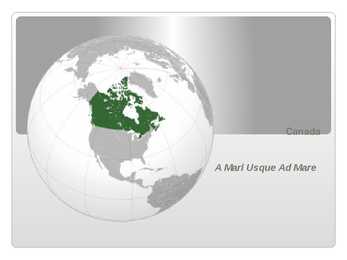
Languages in Canada North American country consisting of ten provinces and three territories located in the northern part of the continent, it extends from the Atlantic Ocean in the east to the Pacific Ocean in the west, and northward into the Arctic Ocean spanning over 9.9 million square kilometers, Canada is the world's second largest country by total area its common border with the United States is the longest land border in the world. Some facts The land that is now Canada was inhabited for millennia by various groups of Aboriginal peoples beginning in the late 15th century, British and French France ceded nearly all of its colonies in North America in 1763 after the Seven Years' War Historical Background in 1867, with the union of three British North American colonies through Confederation, Canada was formed as a federal dominion of four provinces
initiation in January 1999. In the 21st century, the key features of Finland's modern welfare state are a high standard of education, equality promotion, and national social security system currently challenged by an aging population and the fluctuations of an exportdriven economy (Central Intelligence Agency, 2012, ISSN 15538133). 2.1.2 Geography Location: Northern Europe, bordering the Baltic Sea, Gulf of Bothnia, and Gulf of Finland, between Sweden and Russia Area: total: 338,145 km2 land: 303,815 km2 and water: 34,330 km2 Coastline: 1250 km Climate: cold temperate; potentially subarctic but comparatively mild because of moderating inf luence of the North Atlantic Current, Baltic Sea, and more than 60,000 lakes Terrain: mostly low, f lat to rolling plains interspersed with lakes and low hills Natural resources: timber, iron ore, copper, lead, zinc, chromite, nickel, gold, silver, limestone Land use: arable land: 6.54%, permanent crops: 0.02%, other: 93.44% (2005)
THE U.K Different Parts The United Kingdom is a short way of saying the United Kingdom of Great Britain and Northern Ireland. The UK is the political name for those countries which share a parliament in London. All of them were at one time independent kingdoms with their own monarch. Now they are all part of the same kingdom and share the same monarch. The UK consists of Northern Ireland, Scotland, England and Wales. The peoples of these countries are British subjects; they hold British passports and therefore their nationality is British. The british Isles is the geographical name for all the islands off the west coast of Europe. These islands also include The Republic of Ireland, which is politically independent of the Britsh government
2001 February: Treaty of Nice signed, reforming the institutional structure of the European Union to allow for eastward expansion. - Increase of EP seats - Aim to reduce number of commissioners (only aim) - Sanctions against Member states - Proclamation of Charter of Rights 2002 January 1: euro coins and notes enter circulation in the 12 participating member states: Austria, Belgium, Finland, France, Germany, Greece, Ireland, Italy, Luxembourg, the Netherlands, Portugal and Spain. 2004 May: European Union’s biggest enlargement ever as 10 new countries join - Cyprus, the Czech Republic, Estonia, Hungary, Latvia, Lithuania, Malta, Poland, the Slovak Republic, and Slovenia. October: the Heads of State and Government and EU foreign ministers sign the Treaty establishing a Constitution for Europe Four parts – Simplification – Constitutional style – No pillar structure.- lisbon treaty 2009 2007
The United Kingdom The United Kingdom consists of England, Scotland, Wales and North Ireland and it is situated in the Atlantic Ocean near the mainland of Europe. The population of the UK is 58.6 million and area is 244,110 sq km. Britain has a temperate humid climate. Its characteristic features are mild winters, warm summer, no temperature extremes, abundant rain all year round and frequent changes of weather. The mild climate is partly due to the warm Gulf Stream and partly to the south westerly winds
2% of GDP 12.3 13.0 10.3 11.3 11.4 Trade balance: -7.1% of GDP 9.2 2010 2011 2012 2013 2014 2015 Source: bnb.bg, worldbank.org www.investbg.government.bg FOREIGN DIRECT INVESTMENT FDI Inflow, 2010 - 2015 ( mln.) FDI by host country, 2010 - 2015 ( mln.) Netherlands 3688.0 2015 1593.4 Russian Federation 905.0 2014 1339.1 Luxembourg 574.0 Switzerland 541.0 2013 1383.7 Belgium 426.0 USA 389.0 2012 1320.9
1) General facts The UK: * the United Kingdom of Great Britain and Northern Ireland was formed in 1801 * it covers 243,610 sq km * everybody from the UK is called British * the capital city is London * is made up of four constituent countries: England, Scotland, Wales and Northern Ireland which in turn are divided into counties * the flag is called the Union Jack which is a combination of the flags of England, Scotland and Northern Ireland
 annaabi.ee









Kõik kommentaarid