2 tsp oil 100g smoked baco 1 pc Onion 2 cloves of garlic 400g minced beef 500 g of tomato puree 1 tablespoon of oregano (dried) salt Black pepper 1 teaspoon sugar From 1 to 2 dl of bouillon AFTER 50 g (grated) Parmesan teaspoon Prepared Heat the oil in a saucepan. Add the chopped bacon, onion and garlic and cook for a few minutes. Add the minced meat and continue frying for 5 minutes. Finally, extra tomato sauce, broth and oregano. Simmer over a low fire under the lid for 50 minutes, stirring occasionally. Season with sugar, salt and pepper. Cook the spaghetti in salted water until tender, drain and mix with the sauce. Serve with pasta, succulent sauce over-molded with grated Parmesan cheese.
receives its acidic taste from vinegar. People of Estonia like sauerkraut very much. They definitely a great dish for Christmas, because it`s really good to eat it with potatoes or something like that. To make sauerkraut yourself you need to have: 1 kg sauerkraut, 700 g slightly salted pork, 100 g barley grits, 2 tomatoes, salt. This is how you can do it: Boil the sauerkraut in a little water, on the top place the washed barley and the meat. Stew until soft, stirring now and then. Add salt. Place the sauerkraut with the sliced meat into a bowl. Garnish with the tomatoes and chopped herbs. Serve with boiled potatoes.
Unit 8: vocabulary 1. slap-up meal (n) a fancy and expensive meal 2. carnivore (n) meat eater 3. succulent (adj) - juicy 4. mouth-watering (adj) tasty-looking 5. raw (adj) - uncooked 6. rare (adj) barely cooked 7. well-done thoroughly cooked 8. to boil (v) to prepare food in boiling water 9. to stir (v) to mix 10. to scramble (v) to cook while stirring 11. tender (adj) soft and delicate 12. utensil (n) tool used for eating 13. cooker (n) - stove 14. oven (n) a chamber for baking, roasting etc 15. chopping board (n) cutting board 16. to forage (v) to look for food in a forest 17. recipe (n) a list of ingredients and instructions for a meal 18. ingredients (n) something that enters as an element into a mixture 19
Despite being written in the beginning of the 1950s, for me “The Catcher in the Rye” is a novel that many youngsters to this day can relate to. The book tells the story of a troubled teenager Holden Caulfield, who sets off on a short trip to New York, after being expelled from yet another private school, to avoid facing his parents. His dark and at times depressive thoughts and emotions have been mixed with humour and brutal reality, making this book stirring to read. The novel is a fantastic example of the coming of age genre, thanks to its various themes of rebellion, emotional and mental growth and indifferent, “I couldn’t care less” attitude. The themes are apparent throughout the novel, giving the reader a clear view of what it’s like to be a teenager, who has no idea what to do with their life. The rebellious tone of the novel and its characters shines out right from the beginning, not only through the actions, such as getting
Is that enough to take a look?" "Sure," said the farmer. And with that he let out a whistle,"Here,Dolly!" he called. Out from the doghouse and down the ramp ran Dolly followed by four little balls of fur. The little boy pressed his face against the chain link fence. His eyes danced with delight. As the dogs made their way to the fence, the little boy noticed something else stirring inside the doghouse. Slowly another little ball appeared; this One noticeably smaller. Down the ramp it slid. Then in a somewhat awkward manner the little pup began hobbling toward the others, doing its best to catch up.... "I want that one," the little boy said, pointing to the runt. The farmer knelt down at the boy's side and said, "Son, you don't want that puppy. He will never be able to run and play with you like these other dogs would."
· failure to do this resulted in heavy fines · Results: more cases brought to trial, a greater degree of law and order, the king made money from court revenues · Henry II remembered for his marriage to Eleanor of Aquitaine · Her lands gave him control over one-third of France · Problems: Philip II of France (much weaker, but technically Henry II's overlord for his French lands) was stirring up trouble and revolts · Henry II had problems with the Archbishop of Canterbury, Thomas Becket · Once his close ally · Several disagreements · The bishop tragically murdered by four overly eager knights (1170) Richard I · Henry II's older son · Ruled 1189-1199 · Known as Richard the Lionheart · Reputation as a great military leader and warrior · A central Christian commander during the Third Crusade
The great literary figures of the 18th cent were Benjamin Franklin (1706-1790), Thomas Paine (1737-1809) and Thomas Jefferson (1743-1826). The common sense and witty aphorisms of Franklin's popular Poor Richard's Almanac series appealed to colonial readers. Franklin also wrote effectively on the question of allegiance to the British crown but it was his protégé, Thomas Paine, who inspired colonists during the dark days of the Revolution with his stirring pamphlet Common Sense (1776), which sold over half a million copies, and American Crisis Papers (1776-1783). Thomas Jefferson was also an influential political writer. He made important contributions to the 85 essays of The Federalist papers, which effectively outlined the Am governmental system and the basic principles of republican theory. Jefferson also wrote the Declaration of Independence (1776), which identifies the moment in which
(c) difficulty maintainin g a constant temperature ; one mark for ref to difficulty of difficulty maintainin g a constant pH ; controllin g environmen tal factors heating / cooling, qualified; foaming; blocking of, inlet / outlet, tubes; difficulties with, mixing / stirring; contamination / keeping it sterile; conditions need to be continuously monitored; nutrient requirements may change; AVP; AVP; e.g. algal growth on glass difficulties in providing sufficient light errors lead to loss of several days production of Chlorella max 4
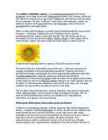
protection. Once the seed is dried, it can be rubbed easily from seed heads. Humidity levels must be kept low to prevent spoilage. Roasting Seeds Raw mature seeds may easily be prepared at home by covering unshelled seeds with salted water (2 qts. of water to 1/4 to 1/2 cups salt). Bring to a boil and simmer two hours or soak in a salt solution overnight. Drain and dry on absorbent paper. Put sunflower seeds in a shallow pan in a 300 degree F oven for 30 to 40 minutes or until golden brown, stirring occasionally. Take out of oven and add one teaspoon of melted butter or margarine to one cup of seeds. Stir to coat. Put on an absorbent towel. Salt to taste. Sunflower Species Common Sunflower (H. annuus) - Includes the cultivars H. bismarkianus's, single yellow flower, 6 to 8 feet tall; H. citrinus, primrose yellow flowers, 6 to 8 feet tall; H. giganteus, Russian Giant, large, single yellow flower grown mainly for seeds, 10 to 12 feet tall. Silverleaf Sunflower (H
take care of, and somewhere along the process he will have to meet with Princess Sorokina. When Anna realizes this, she throws a fit. The next day Anna refuses to go to the country. Vronsky receives a letter from Stiva saying that Karenin won't divorce Anna. Vronsky tries to comfort Anna by telling her she and the children are important in his life. But Anna, being cold and difficult as ever, says that Vronsky mentioned the children because he doesn't ever think of her alone. She is stirring the caldron here, but Vronsky remains collected. Once he leaves, Anna convinces herself that Vronsky has said cruel things to her. She tells a servant to inform Vronsky that she'd like not to be disturbed while she sleeps, as she's about to go to bed. But then she tells herself that if Vronsky really loves her he'll come to her room and see to her. How could Vronsky know to do such a thing? Respecting her desires to be undisturbed, Vronsky goes to sleep in his study
Christopher Vogler T h e Call to Adventure may come in the form of a message or a messenger. It may be a new event like a declaration of war, or the arrival of a telegram reporting that the outlaws have just been released from prison and will be in town on the noon train to gun down the sheriff. Serving a writ or warrant and issuing a summons are ways of giving Calls in legal proceedings. T h e Call may simply be a stirring within the hero, a messenger from the unconscious, bearing news that it's time for change. These signals sometimes come in the form of dreams, fantasies, or visions. Roy Neary in Close Encounters of the Third Kind gets his Call in the form of haunting images of Devil's Tower drifting up from his subconscious. Prophetic or disturbing dreams help us prepare for a new stage of growth by giving us metaphors that reflect the emotional and spiritual changes to come.
his collar. "My website has the hours. You should come by and watch, see if it's for you." "I'll definitely think about it." "Do that." He extended his hand again, and his grip was solid and confident. "I hope to see you." The apartment smelled fabulous when I got back home and Adele was crooning soulfully through the surround sound speakers about chasing pavements. I looked across the open floor plan into the kitchen and saw Cary swaying to the music while stirring something on the range. There was an open bottle of wine on the counter and two goblets, one of which was half-filled with red wine. "Hey," I called out as I got closer. "Whatcha cooking? And do I have time for a shower first?" He poured wine into the other goblet and slid it across the breakfast bar to me, his movements practiced and elegant. No one would know from looking at him that he'd spent his childhood
BERNARDO Who's there? FRANCISCO Nay, answer me: stand, and unfold yourself. BERNARDO Long live the king! FRANCISCO Bernardo? BERNARDO He. FRANCISCO You come most carefully upon your hour. BERNARDO 'Tis now struck twelve; get thee to bed, Francisco. FRANCISCO For this relief much thanks: 'tis bitter cold, And I am sick at heart. BERNARDO 4 Have you had quiet guard? FRANCISCO Not a mouse stirring. BERNARDO Well, good night. If you do meet Horatio and Marcellus, The rivals of my watch, bid them make haste. FRANCISCO I think I hear them. Stand, ho! Who's there? Enter HORATIO and MARCELLUS HORATIO Friends to this ground. MARCELLUS And liegemen to the Dane. FRANCISCO Give you good night. MARCELLUS O, farewell, honest soldier: Who hath relieved you? FRANCISCO Bernardo has my place. Give you good night. Exit MARCELLUS 5 Holla
see why he and my mother had jumped too quickly into an early marriage. Most of the young romantic he'd been in those days had faded before I'd known him, as the curly brown hair -- the same color, if not the same texture, as mine -- had dwindled, slowly revealing more and more of the shiny skin of his forehead. But when he smiled I could see a little of the man who had run away with Renée when she was just two years older than I was now. I ate breakfast cheerily, watching the dust moats stirring in the sunlight that streamed in the back window. Charlie called out a goodbye, and I heard the cruiser pull away from the house. I hesitated on my way out the door, hand on my rain jacket. It would be tempting fate to leave it home. With a sigh, I folded it over my arm and stepped out into the brightest light I'd seen in months. By dint of much elbow grease, I was able to get both windows in the truck almost completely rolled down
encouragement, a caution against the very Jane he had fixed on. "As to her younger daughters, she could not take upon her to say--she could not positively answer--but she did not know of any prepossession; her eldest daughter, she must just mention--she felt it incumbent on her to hint, was likely to be very soon engaged." Mr. Collins had only to change from Jane to Elizabeth--and it was soon done--done while Mrs. Bennet was stirring the fire. Elizabeth, equally next to Jane in birth and beauty, succeeded her of course. Mrs. Bennet treasured up the hint, and trusted that she might soon have two daughters married; and the man whom she could not bear to speak of the day before was now high in her good graces. Lydia's intention of walking to Meryton was not forgotten; every sister except Mary agreed to go with her; and Mr. Collins was to attend them, at the request of Mr. Bennet,
phoned a friend to ask if he wanted to come along, I came to understand some- thing that changed my decision just as quickly. After declining the invitation, my friend wondered why I seemed so intent on a visit. I was forced to admit that, no, I had never been inclined toward the idea of a temple tour before, that I had no questions about the Mormon religion I wanted answered, that I had no general interest in church architecture, and that I expected to find nothing more spectacular or stirring than what I might see at a number of other churches in the area. It became clear as I spoke that the special lure of the temple had a sole cause: If I did not experience the restricted sector soon, I would never again have the chance. Something that, on its own merits, held little appeal for me had become decidedly more attractive merely because it was rapidly be- coming less available. Less Is Best and Loss Is Worst I count myself far from alone in this weakness
It traversed the 7,000 miles to Tokyo in an hour. But it took ten hours to get from the Central Telegraph Office to the American embassy. As the President was addressing a message of peace to the Emperor, the men of the Japanese strike force were listening to a message of war. Shortly before, Admiral Nagumo had topped off the fuel tanks of his combat ships for the final dash. His crews waved farewell to the slow- moving tankers. Now the officers read a stirring message from Yamamoto to all hands: "The moment has arrived. The fate of the empire is at stake. Let every man do his best." Banzais rent the air. Up the mast of Akagi fluttered the very flag that had flown at Japan's great naval victory over Russia in 1905. It was a moment of great emotion. Nagumo altered course to due south and bent on 26 knots. Through a mounting sea, the battle force plunged toward its target. Lovely, peaceful, that target lay "open unto the fields, and to the sky,"
chemical and physicochemical properties of the cleaning agent at the concentration, tem- D Rinse with water perature, and exposure time used; (3) the Check mechanical energy applied (impact of water- E Application of jet, manual work, stirring effect, etc); and (4) sanitizer the condition of the surface to be cleaned. In meat plants, the type of residues to be Post-rinse with removed are mainly organic matter (proteins F water and fats) and, to a lesser extent, inorganic Check
 annaabi.ee