Olympiastadion Berlin Rene Prans 9A Die Fakten Das Olympiastadion ist ein Sportstadion in Berlin, Deutschland. Olympiastadion ist zweitgrößte Stadion in Deutschland. Das Olympiastadion ist die Heimstätte des Fußballclubs Hertha BSC. Das Olympiastadion wurde von 1934 bis 1936. Olympiastadion wurde für die Olympischen Sommerspielen 1936. Olympiastadion war die Lage des FIFA World Cup Finale zwischen Frankreich und Italien und dem Gelände des Zinedine Zidane Kopfstoß Die Bilder Video http://www.youtube.com/watch?v=QzFi9Ei55ZE Veranstaltungen Olympische Sommerspiele
millega? (koos) mit dem Vater nach pärast nach der Schule bei juures bei dem Onkel beim Onkel seit alates seit (dem) Montag von kellelt? millelt? von dem Freund vom Freund aus seest aus der Klasse außer peale (v.a. selle peale) außer der Mutter zu juurde zu der Oma zur Oma zu dem Onkel zum Onkel entgegen kellelegi vastu tulema der Mutter entgegen gegenüber vastas gegenüber dem Stadion dem Stadion gegenüber Präpositsionen mit Akkusativ durch läbi durch den Park für jaoks für die Mutter für 20 Kronen ohne ilma ohne (die) Mutter um ümber um das Haus gegen vastu gegen den Baum bis kuni bis zum Montag entlang piki die Straße entlang
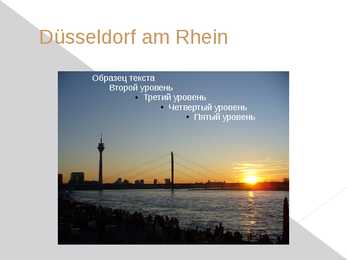
*Bevölkerungsdichte: 2710 Einwohner je km² Lage der Landeshauptstadt Düsseldorf in Nordrhein- Westfalen Fußballclub Fortuna Düsseldorf Der Fortuna Düsseldorf spielt im Esprit stadion Der Rheinturm Der Marktplatz Die Königsallee Oberlandesgericht
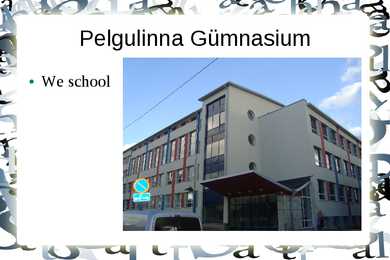
We school Canteen There is good food. Computer classes Computer class we learn about computers Chemistry class Chemistry class There are studied the chemical elements We do chemistry experiments in class Chemistry is a class a two chemical elements in the table Library The library can borrow books There you can also read news Art class School stadium We school stadion Our school physical education classes at the stadium Small posters They are in the library
I think it is unequal, because some parents do not have enough money. So, what are the advantages and disadvantages of state and private schools. Firstly, there are many different facilities in private schools. For example, there are swimming pools, skating rinks, libraries, etc. I have heard that one school has its own drama class. Of course, state schools cannot afford such things like drama classes and swimming-pools. I am very happy because we have a stadion, a gym, and a finess studio. Secondly I would like to bring out free-of-charge textbooks, exercise books and free In conclusion, it is a very good choice to go to a state school. Firstly, there are no fees. Secondly, you will get a high quality aducation. Furthermore lunch in a state school. Our school food tastes as good as some expensive private school´s food. One important aspect is that private schools can afford all
oceans, canals, and names or nouns with ,,of" · Musical instruments, dances · Names of families, nationalities ending in -sh, -ch or -ese, other plural nationalities are used with or without ,,the" · Titles , ,,The" is ommited before titles with proper names · Adjectives used as plural nouns and the superlative degree of adjectives/adverbs · Ülivõrre- the most beautiful · Seasons, beach, cinema, city, coast, country(side), earth, ground, jungle, radio, pub, sea(side), sku, stadion, shop, theatre, village, weather, world · Morning, afternoon, evening, night · Historical reference/events · Only, last, first
XI Meine Freizeit und Hobbies Ich bin kein Sportfan. Ich mag keine Sportnachrichten. Ich treibe wenig Sport. Sport ist ein gutes Hobby. Ich machte Sport nur in Sport stunden. Wir haben zwei Sportstunden pro Woche in der Schule. Im Herbst und im Frühjahr spillen wir Fußball, Volleyball, Basketball oder laufen im Wald oder im Stadion. Im Winter laufen wir Ski auf dem slügel Latiku. Im Sommer kann ich schwimmen gehen. Ich kann sehr gut schwimmen. Im Sommer schwimme ich meistens im See Pühajärve und Pülme. Im Sommer kann ich auch Rad fahren. Ich mag volleyball sielen. Ich habe keinen Lieblingssportler. Ich treibe Sport wenn ich in guter Lust dazu habe. Die Leute lesen wenig Bücher. Wir lesen Pflichtliteratur in der Schule. Jetzt lesen wir den ersten Teil von Anton Hansen Tammsare ,,Recht und Wahrheit"
3 Hier dürfen keine Autos fahren. b dürfen 5 individuelle Lösung 6 Lösungsvorschlag: Tina darf keinen Hund und auch keine Katze haben. Tina darf keine Comics in die Schule mitnehmen. Tina darf keine Partys machen. Tina darf am Wochenende nicht bei Freundinnen bleiben. Tina darf nicht in ihrem Zimmer essen. Tina darf einmal im Monat ins Kino gehen. 7 individuelle Lösung 8 die Ecke, die Ampel, der Kiosk, der Park, das Stadion, das Kaufhaus, die Kreuzung, das Schwimmbad, die Kirche, der Supermarkt 9a B3C4D1 b bis zum Ende bis zur Kreuzung bis zu den Tennisplätzen 10 bis zu den Häusern bis zum Stadion bis zur Ampel bis zum Supermarkt bis zu den Tennisplätzen bis zur Kirche bis zum Kaufhaus bis zur Ecke bis zum Kiosk bis zur Kreuzung Beste Freunde A2.1, Lehrerhandbuch © 2016 Hueber Verlag
nümfeioni eeskujul, aja jooksul muutus koos ümbritseva saluga (hiiega) rahva avalikuks kogunemiskohaks: sööma- ja pidukohaks. • Heroon ise polnud tempel vaid ehitis, kuhu kultusruumidele lisaks kuulus ka katusega sammaskäikudest moodustatud õu – peristüül. • Priene peristüül oli istutusteta, kuid hellenismis alustatud juba istutusi Egiptuse ja Mesopotamia eeskujul. Hilishellenismi perioodi Priene linn haljastusest ümbritsetud gümnasion´i ja stadion´iga (pildil esiplaanil) Priene paiknemine maastikus 4.-3. saj. eKr. • Aristoteles muutis Homerose mütoloogilise suhtumise veidi tõsisemaks uurimuseks. Huvi taimede vastu rajanes toiduks ja raviks tarvitatavatel. • Hippokrates (400-370 eKr) arendas Kosi saarell praktilist meditsiini. • Aristotelese järglane Theophrastos (u. 370- 287 eKr) kirjutas teose „Uurimus taimedest“, lõi suure osa tänapäeva botaanika teadusharudest oma uurimustega.
development of the sanctuary as a Panhellenic centre, the "sacred truce" was agreed. That is to say ceasing of fighting in all of the Freek world for as long as the Olympic Games were on. The Olympic Games were held, after the completion of four years during the month of July or August. The time between two competitions was called the Olympiad. In the beginning the games lasted for only one day and comprised only one event, the running of one Stadion, but gradually more events were added resulting, towards the 5th century B.C., in the games lasting for 5 days. In total the Olympic Games consisted of 10 events: running, the pentathlon (viievõistlus), jumping, discus, "ekebolon" javelin, wrestling, boxing, the pancration, chariot racing and horse racing. All Greeks who were not criminals had the right to take part in the games. Women were not allowed to compete, they could not even watch the competition.
The city is located in western Greece. The games were held every four years. It is also presumed that such competitions pleased the spirits of the dead and were organized as part of funeral ceremonies for important people. Later games became part of religious festivals of honouring the gods but mostly they honoured the king of the gods Zeus. The ancient stadium in Olympia could accommodate more than 40,000 spectators. The only event in the first 13 games was the stadion which is a running-race of 192 metres. As the years passed, longer running races and other types of competition became a part of the games wrestling, the pentathlon, boxing and chariot-racing. The pentathlon was a combination of long jump, running, discus, and javelin throwing and wrestling. The games were so important that truce was called out between the fighting city-states. Olympic winners were greatly honoured. They were given olive wreaths as prizes and were treated like true heroes.
Kneipen und Pubs, Bars, Discotheken, Cafés, Snack-Stations und diverse Shops, aber auch Live-Clubs angesiedelt, in denen seinerzeit schon die Beatles spielten. Für die Liebhaber des seriösen Entertainments finden sich vom Schauspielhaus über die Schmidt's-Theater, das Café Keese mit dem 'Quatsch Comedy Club' bis zum Wachsfigurenkabinett zahlreiche Möglichkeiten, den Abend unterhaltsam zu genieen. Und last but not least: Direkt 'mittendrin' liegt das Stadion des FC St. Pauli des legendären und unkonventionellen Kiez-Clubs, der herzerfrischenden, weil leidenschaftlichen Fuball spielt und dies auch immer wieder gegen Liga-Gröen und in Benefiz-Turnieren zelebriert. 6. Jungfernstieg Für viele Hamburger und Besucher ist er das Herzstück der Innenstadt: der Jungfernstieg vielfältige Verbindung zwischen der Binnenalster, umliegenden Geschäften und Sehenswürdigkeiten.
 annaabi.ee