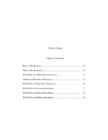
Home assignment 1 : Margus Martsepp 121843IAPM Propositional logic and simple predicate assignments Advanced Course of Applied Logics ( ITV0081 ) Task 1: Code Task 1: Results Task 2: Code Task 2: Result Task 3: Code Task 3: Result Task 3: Proof - distribution of intersection over union. Task 3: Extra proof - distribution of union over intersection. Task 4: Code Task 4: Result Task 5: Code
Propositional logic and simple predicate assignments Home assignment 2 : Margus Martsepp Advanced Course of Applied Logics ( ITV0081 ) Overview Setting up · zChaff · glucose · BerkMin Collecting problemset · trivial problem · benchmark Using problemset zChaff Installing compiler $ sudo apt-get install build-essential zchaff {download, unarhive, make executable} $ wget http://www.princeton.edu/~chaff/zchaff/zchaff.2008.10.12.zip $ unzip zchaff.2008.10.12.zip $ cd zchaff /zchaff$ make glucose (Re)installing zlib $ sudo apt-get install --reinstall zlibc zlib1g zlib1g-dev glucose {download, unarhive, make executable} $ wget https://www.lri.fr/~simon/downloads/glucose2.1.tgz $ tar -xvzf glucose2.1.tgz $ cd glucose_2.1 /glucose_2.1$ sh build.sh Note: glucose contains SatElite Preprocessing BerkMin installing shared libs $ sudo apt-get install libstdc++6-4.5-dbg berkmin {download, unarhive, set as executable} $ wget ...
Word Order Table of Contents Types of Sentences ..................................................................................2 Parts of the Sentence ..............................................................................2 Word Order in Affirmative Sentences ...................................................3 Position of Adverbs of Frequency .........................................................5 Word Order in Negative Sentences......................................................6 Word Order in General Questions.........................................................7 Word Order in Special Questions ..........................................................8 Word Order in Subject Questions ..........................................................9 Types of Sentences There are four basic types of sentences in English. AFFIRMAT...
LEXICAL STYLISTIC DEVICES Based on: interaction of lexical and interaction of denotational interaction of primary circumlocution other cases contextual meaning and emotional meaning and secondary meaning 1. EPITHET 1. METAPHOR indicates individual 1. ZEUGMA 1. PERIPHRASIS 1. BATHOS based on similarity of 2 evaluation of sth. Logical "to join" w-d is use of longer spoiling the lofty effect. Function notions, hidden comparison at...
1 System development • Modelling in early system development stage corrects design errors before construction. • Beneficial modelling reasons (– Insight: in the design and operation of a system – Completeness: detection of missing parts for simulation and a better understanding of the system requirements – Correctness: errors and flaws are usually detected, problematic scenarios can be reproduced, systematic error investigation) 2 Introduction CPN • CPN is a graphical language for concurrent system design and analysis and also general-purpose modelling environment and also applicable for industrial projects and high level programming. • Petri nets provide(– graphical notation– modelling concurrency, communication, synchronisation) • CPN application domains that are typical(– communication protocols, data networks, distributed algorithms) • ...
Questions for the First Philosophy Test a. Introduction 1. How would you characterize Modern philosophy? Commanding outlook, power, will, Man is God. 2. How would you characterize Classical philosophy? Contemplative outlook, truth, intelligence, God is truth. b. Descartes 3. What is the main question that Descartes is trying to answer? How can I be certain [sure] that I am in the truth? 4. Which are precepts of Descartes' method? Only accept what is self-evident. Analysis. Synthesis. Enumeration. 5. Descartes will only accept one specific kind of ideas: which and why? He will only accept clear and distinct ideas that are indubitable. Because the complex ideas could then be constructed using the simple ideas. 6. How does Descartes call his method and why is it not skeptical? Methodic doubt. Because the goal of this doubt is not to be skeptical but to prove that some things can not be doubted. 7. “...
1. Be ready to explain the terms (lecture 1): language, linguistics, synchronic approach to language, diachronic approach to language, linguistic competence, linguistic performance, what is grammar?, prescriptive grammar vs. descriptive grammar; phonology, phonetics, phone, allophone, phoneme; morphology, morphemes (types of morphemes), morphs, allomorphs, types of affixes, derivational affixes, inflectional affixes; open vs closed class words; syntax. Language: a systematic, conventional use of sounds, signs or written symbols in a human society for communication and self-expression. - human language at all levels is rule- or principle-governed. Linguistics: the scientific study of human natural language Synchronic approach to language: Diachronic approach to language: Linguistic competence: Linguistic performance: What is grammar?: "The sounds and sound patterns, the basic units of meaning, such as words, and the rules to combine them...
1. STYLE The term "style" is polysemantic (has many meanings): a Latin word "stilus" originally meant a writing instrument used by ancient people. Already in classical Latin the meaning was extended to denote the manner of expressing one's ideas in written or oral form. Jonathan Swift defined style as "proper words in proper places". In present day English the word "style" is used in about a dozen of principle meanings: 1. the characteristic manner in which a writer expresses his/her ideas (e.g. style of Byron) 2. the manner of expressing ideas, characteristic of a literary movement or period 3. the use of language typical of a literary genre (e.g. the style of a comedy, drama, novel). 4. the selective use of language that depends on spheres / areas of human activity (e.g. style of fiction, scientific prose, newspapers, business correspondence, etc.). STYLISTICS Stylistics is the study of s...
FGI 1081 Stilistika (Irina Ladusseva) Kab. 420 2 AP Ends with an exam; lasts only for 1 semester. At the exam you get 2 questions and an exercise (50 sentences: establish the device used, recognize it, and name it). Care about the pronunciation of the terms. Books: - I. Galperin "Stylistics" - I. Ladusseva "Rhythm and Text" - I. Ladusseva "Vocabulary and Style" - I. Ladusseva "Stylistic practice: Book I, Book II" - I. Ladusseva "A Guide to Punctuation" EXAMINATION TOPICS: 1. Style, stylistics, a survey of stylistic studies ...
Philosophy of Language Philosophy of Language: a Contemporary Introduction introduces the student to the main issues and theories in twentieth and twenty-first-century phi- losophy of language, focusing specifically on linguistic phenomena. Topics are structured in four parts in the book. Part I, Reference and Referring, includes topics such as Russell's Theory of Descriptions, Donnellan's distinction, problems of anaphora, the description theory of proper names, Searle's cluster theory, and the causalhistorical theory. Part II, Theories of Meaning, surveys the competing theories of linguistic mean- ing and compares their various advantages and liabilities. Part III, Pragmatics and Speech Acts, introduces the basic concepts of linguistic pragmatics, includes a detailed discussion of the problem of indirect force and surveys approaches to metaphor. Part IV, new to this edition, examines the four theories of metaphor. Features...
Tallinna Polütehnikum Automation Author: TomTom2 Group :AA-09 Instructor: Marina Zotikova Tallinn 2010 Contents Introduction......................................................................................................................3-4 Person Knowledge Technologies supports......................................................................4-6 Online Essay Evaluation Service.....................................................................................6-7 WordNet lexical database................................................................................................7-8 Practice Online (TPO)................................................................................................
Some of the things you will learn in THE CODEBREAKERS • How secret Japanese messages were decoded in Washington hours before Pearl Harbor. • How German codebreakers helped usher in the Russian Revolution. • How John F. Kennedy escaped capture in the Pacific because the Japanese failed to solve a simple cipher. • How codebreaking determined a presidential election, convicted an underworld syndicate head, won the battle of Midway, led to cruel Allied defeats in North Africa, and broke up a vast Nazi spy ring. • How one American became the world's most famous codebreaker, and another became the world's greatest. • How codes and codebreakers operate today within the secret agencies of the U.S. and Russia. • And incredibly much more. "For many evenings of gripping reading, no better choice can be made than this book." —Christian Science Monitor THE ...
SEMANTILINE KOLMNURK: TEEMA 1!! 1 1. LOOGIKA PÕHIREEGLID. SEMANTILINE KOLMNURK Loogika määratlemisest Sõna loogika näib olevat kujunenud kreeka väljendist logik¾ tšcnh, mis tähendab mõtlemise või arutlemise kunsti. Kui püüda mõista, mis on loogika, siis üks võimalus on lähtuda selle sõna kasutamisviisidest tavakeeles. Eesti keelt kõneldes saab sõna loogika Kasutada erinevates tähendustes: • sündmuste, asjade või süsteemide loogika, s.o sisemine korrapära, mis võimaldab sündmustest, asjadest või süsteemidest aru saada, selleks võib olla ka millegi tööpõhimõte; • mõtlemise loogika, s.o mõtlemises esinev korrapära, mis võimaldab teha järeldusi, sh selliseid, mida varem ei teata; • teksti või jutu loogika (loogilisus), see iseloomustab lisaks mõtlemise loogikale (mida kõne väljendab) ka seda, kui süsteemselt kõnelejal õnnestub oma mõtteid väljendada; • loogika kui teadus (õpetus, filosoofia vms), mis uurib keeles väljenduva mõtlemise kõige...
1 1. LOOGIKA PÕHIREEGLID. SEMANTILINE KOLMNURK Loogika määratlemisest Sõna loogika näib olevat kujunenud kreeka väljendist logik¾ tscnh, mis tähendab mõtlemise või arutlemise kunsti. Kui püüda mõista, mis on loogika, siis üks võimalus on lähtuda selle sõna kasutamisviisidest tavakeeles. Eesti keelt kõneldes saab sõna loogika Kasutada erinevates tähendustes: · sündmuste, asjade või süsteemide loogika, s.o sisemine korrapära, mis võimaldab sündmustest, asjadest või süsteemidest aru saada, selleks võib olla ka millegi tööpõhimõte; · mõtlemise loogika, s.o mõtlemises esinev korrapära, mis võimaldab teha järeldusi, sh selliseid, mida varem ei teata; · teksti või jutu loogika (loogilisus), see iseloomustab lisaks mõtlemise loogikale (mida kõne väljendab) ka seda, kui süsteemselt kõnelejal õnnestub oma ...
 annaabi.ee