Italy Sicily Capital: Rome Size: 301,230 sq km Population: 57,6 million San Marino The Vatican City Highest point: Mont Blanc (4,807 m) The Alps in the north and the Apennines in the center of Italy The north of Italy: cold, harsh winters but hot and humid summers Central Italy: smaller temp. difference between summer and winter The south of Italy: warm and hot summers, mild winters Click to edit Master text styles Second level Sicily- Tonnara di Scopello Third level Gargano Fourth level Fifth level Sicily The biggest Italian island Breathtaking landscapes Nature Volcanoes Archaeological sites tell the story of Trinacria
4th century BCE. He wrote a poem that spoke of using "top quality and seasonal" ingredients. He said that flavors should not be masked by spices, herbs or other seasonings. He placed importance on simple preparation of fish. This style seemed to be forgotten during the 1st century CE when De re coquinaria was published with 470 recipes calling for heavy use of spices and herbs. The Romans employed Greek bakers to produce breads and imported cheeses from Sicily as the Sicilians had a reputation as the best cheese makers. The Romans reared goats for butchering, and grew artichokes and leeks. Middle Ages With culinary traditions from Rome and Athens, a cuisine developed in Sicily that some consider the first real Italian cuisine. Muslims invaded Sicily in the 9th century. The Arabs introduced spinach, almonds, rice and perhaps spaghetti. During the 12th century, a Norman king surveyed Sicily and saw people making long
Italy Robi kivi LGA18 Italy, officially known as the Italian Republic (Repubblica Italiana in Italian), is a country in Europe. Italy is situated on a boat-shaped apennine peninsula 800 km in the Mediterranean. In the north form the natural boundary of the Alps. Italy includes Sicily, Sardinia and a number of smaller islands. Rome, a settlement around a ford on the river Ancient Rome Tiber conventionally founded in 753 BC, was ruled for a period of 244 years by a monarchical system, initially with sovereigns of Latin and Sabine origin, later by Etruscan kings. The tradition handed down seven kings: Romulus, Numa Pompilius, Tullus Hostilius, Ancus Marcius,
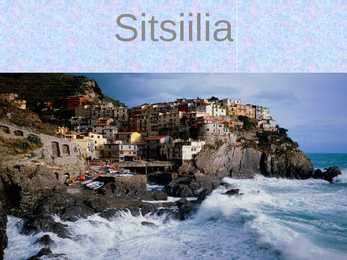
Sitsiilia Asukoht · Sitsiilia on Vahemeres asuv saar, Ita alia suurim saar. ·Saare pindala on 25 662 km². · Sitsiilia koordinadid on 38° N, 14° E. · Sitsiilia asub lähistroopilises kliimavöötmes · Sitsiilia suurim linn ja seega ka pealinn on Palermo Reljeef · Valdav osa saarest on mägine. · . Sitsiiliat katavad mitmed mäestikud: Alpenniinid, Hyblea kõrgendik · Siin on Euroopa tuntumad vulkaanid: Etna, Stomboli ja Vulcano · Sitsiilia kõrgeim tipp on Etna vulkaan 3350m · Rannajoon on umbes 1000 km Kliima · Sitsiilias valitseb Lähistroopiline vahemereline kliima · Seda kliimatüüpi iseloomustavad vahemerelised igihaljadmetsad ja põõsastikud. · Sitsiiliale on iseloomulik niiske ja soe talv (+10 °C) ning ...
Alexander the Great, expedition returning to India. Around the year 300BC the mother Nearchos sailed along the Persian Gulf to the Indus river, on the river side by side but the wind rising sugar canes. Nearchos picked one of the plants, taste it, and said: "Indian dish, which gives the sugar without the aid of bees." Western Mediterranean Arabs brought sugar. Having occupied the south of Spain and Sicily, there they raised sugar cane. During the Middle Ages was the major sugar importer-exporter of Venice. Raw cane sugar imported from India and refined in Venice prior to export to the rest of Europe. White gold Sugar was very expensive, and it was known as "white gold" name. The rich collections of people, even if sugar is a precious asset. It is said that one of the bishop of the Portuguese merchants bought for many years in the sugar and kept it in its chamber
Pärnu City Themes 1. History 2. Attractions 3. About Pärnu 4. Notable Residents 5. Citizens of Honuor 6. Pictures of Pärnu 1. History The people who chose to live at the river mouth thousands of years ago stayed here permanently. It is known that in 1154 the Arabian traveller and geographer Abu Abdallah Muhammed al-Idrisi serving the King of Sicily mentioned a river named Bernu. Embecke ("Emajõgi" in Estonian) is the same River Bernu referred to by al- Idrisi and later renamed as the River Pärnu. Pärnu's first period of prosperity was the time from the beginning of the 14th century up to the end of the 15th century while it was a port on the route to the Hanseatic City of Novgorod. 2. Attractions Places to visit: ● Rannapark (Beach Park) & Vallikäär
Names of companies, airlines etc. are usually without the: Fiat Sony Kodak British Airways IBM We do not use the with names of people (Ann, Ann Tylor etc.). In the same way we do not normally use the with names of places. For example: Continents Africa, Europe, South America Countries France, Japan, Switzerland States, regions etc Texas, Cornwall, Tuscany, Central Europe Islands Corsica, Sicily, Bermuda Cities, towns etc Cairo, New York, Madrid Mountains Everest, Etna, Kilimanjaro But we use the in names with 'Republic', 'Kingdom', 'States' etc: The United States of America (the USA) the United Kingrom (the UK) The Dominican Republic Compare: · We wisited Canada and the United States. When we use Mr / Mrs / Captain / Doctor etc + a name, we do not use the. So we say: Mr Johnson / Doctor Johnson / Captain Johnson / President Johnsn etc.
cathedral. All Christian Europe was shocked and Becket became the saint of Church. The Beginnings of Parliament King John has signed the Magna Carta unwillingly and it was pretty clear he wasn't going to keep to the agreement. His Son Henry III was only 16 when John died and during the first 16 year of being king he was under the control of the nobles and tied to Magna Carta. When he became 25, he spent his time with his foreign friends and became involved in expensive wars supporting Sicily. That upset the nobles. 1258 the nobles took over the government and elected a council which was called the Parliament. 1265 Henry was able to take back his full royal authority. After his death his son Edward I took the throne. He brought together the first real parliament the House of Commons. In 1275 he commanded each shire and town to send two representatives to his parliament. Dealing with the Celts William I had allowed his lords to win lands by conquering
http://www.iea.org/dbtw-wpd/Textbase/stats/pdf_graphs/ITPROD.pdf 20. märts 2006 ITELEC.pdf (application/pdf Object) http://www.iea.org/dbtw-wpd/Textbase/stats/pdf_graphs/ITELEC.pdf 20. märts 2006 Reformierakond http://www.reform.ee/ee/huvitavat/seisukohad/rahvastikupoliitika 21. märts 2006 FAO Forestry Department country pages http://www.fao.org/forestry/site/countryinfo/en/ita/ 21. märts 2006 An Energy Summary of Italy http://www.cslforum.org/italy.htm 22. märts 2006 Italy-Sicily-vineyard-near-Agrigento-AJHD.jpg http://mirror-uk-rb1.gallery.hd.org/_exhibits/places-and- sights/_more1999/_more04/Italy-Sicily-vineyard-near-Agrigento-AJHD.jpg 23. märts 2006 Italy Facts http://wwp.greenwichmeantime.com/time-zone/europe/european-union/italy/facts-about- italy.htm 23. märts 2006 Italy FORESTRY http://www.nationsencyclopedia.com/Europe/Italy-FORESTRY.html 24. märts 2006 factory_08.jpg (JPEG Image, 640x417 pixels) http://clabedan.typepad.com/photos/uncategorized/factory_08
40 / 444.36 EEK Valencia Hoya de Cadenas Reserva Tempranillo 75 cl 11.50 / 179.94 EEK Hoya de Cadenas Reserva Privada 75 cl 13.50 / 211.23 EEK Ribera del Duero Spiga, O. Fournier 75 cl 46.40 / 726.00 EEK Blason de San Juan Reserva 75 cl 38.90 / 608.65 EEK ITAALIA / ITALIAN Toskana Zonin Chianti Classico DOCG 2006 75 cl 17.90 / 280.07 EEK Toskana Ripa delle Mandorle 75 cl 27.50 / 430.28 EEK Sicily Planeta La Segreta Rosso 75 cl 25.40 / 397.42 EEK PRANTSUSMAA / FRANCE Languedoc B&G Cabernet Sauvignon 75 cl 12.50 /195.58 EEK Bordeaux Legende Pauillac 75 cl 35.40 / 553.89 EEK Chateau Moulin Riche, Saint Julien 75 cl 55.30 / 865.26 EEK Bourgogne Comtes De Chartonge Pinot Noir 75 cl 27.00 / 422.46 EEK Cote de Beaune Villages, A. Rodet 75 cl 37.40 / 585.18 EEK
Le vie del Signore. God's ways. Giuriamo far libero We swear to liberate Il suolo natio: the native soil: Uniti, per Dio, United, for God, Chi vincer ci può? Who can beat us? Stringiamci a coorte! Let us unite! Siam pronti alla morte; We are ready to die; Italia chiamò. Italy called. Dall'Alpe a Sicilia, From the Alps to Sicily, Dovunque è Legnano; Everywhere is Legnano; (ref 3) Ogn'uom di Ferruccio Every man of Ferruccio (ref 4) Ha il core e la mano; has the heart and the hand; I bimbi d'Italia the children of Italy Si chiaman Balilla; are called Balilla; (ref 5) Il suon d'ogni squilla The sound of every church bell I Vespri suonò. calling for evening prayers. Stringiamci a coorte! Let us unite!
Antud essees on kogutud ainul mõned faktid, mis tõendavad seda, et Salvatore reputatsioon jääb igavesti vaieldavaks. Inimesed võivad pidada arutlused tema kuju kohta toetudes ajalooliste faktidele, kuid need arutlused on iga inimese jaoks erinevad. Võib kindlalt väita ainult ühe asja: Salvatore Giuliano on legendaarne ja meeldejääv Sitsiilia kuju. Bibliografia 1) Graphics 2015. Salvatore Giuliano: The Robin Hood of Sicily. The Italian Tribune, http://www.italiantribune.com/salvatoregiulianotherobinhoodofsicily/ (09.01.2019) 2) EKKS = Eesti keele seletav sõnaraamat. http://www.eki.ee/dict/ekss/index.cgi?Q=bandiit&F=M http://www.eki.ee/dict/ekss/index.cgi?Q=kuritegija&F=M http://www.eki.ee/dict/ekss/index.cgi?Q=kangelane&F=M 3) Dickie, John 2014. A Word at War: The Italian Army and Brigandage 18601870, (11.01.2019), http://www.jstor.org/stable/4289136
1660 to ca. 1725. Many examples of Baroque architecture and town planning are found in other European towns, and in Latin America. Town planning of this period featured radiating avenues intersecting in squares, which took cues from Baroque garden plans.In Sicily, Baroque developed new shapes and themes as in Noto, Ragusa and Acireale "Basilica di San Sebastiano". Another example of Baroque architecture is the Cathedral of Morelia Michoacan in Mexico. Built in the 17th century by Vincenzo Barrochio, it is one of the many Baroque
separate organization within an army or an army group, though parts of it were sometimes specially assigned. In 1943, for example, the commander of Fernmeldeaufklarung 7 ("Radio Intelligence 7"), reported to Field Marshal Albert Kesselring. Fernmeldeaufklarung 7 consisted of radio intelligence companies and platoons and direction-finding stations widely scattered over the central Mediterranean area—in western Crete, southern France, northern Africa, Sicily, Sardinia, and Italy. These units reported their intelligence results via their own radio net to the headquarters at Rocca di Papa, south of Rome; the original intercepts were then forwarded to headquarters for more comprehensive evaluation. Fernmeldeaufklarung 7 distributed radio intelligence of tactical importance to the lower commands by broadcasting it in a special cipher. While much of this intelligence came from conversations or radio
 annaabi.ee