Rahvusvaheline äritegevus (0)
Базарная экономика
Bazaar Economy by Clifford Geerz 1978.pdf
https://studfile.net/preview/4366825/page:6/
В рамках первого подхода базар видится как институт реального мира,
наиболее близкий к чисто конкурентному рынку неоклассической
экономической теории — своего рода «пенни капитализм»1 . Во втором базар
рассматривается как институт, настолько укоренённый в социокультурном
контексте, что он полностью исключается из сферы современного
экономического анализа. Эти противоположные подходы стали основой для
длительных дебатов между экономическими антропологами, так
называемыми формалистами и субстантивистами, — дебатов, которые уже
изрядно утомили всех, кроме самых упорных спорщиков
Это особая система социальных отношений, котораявыстраивается вокруг
производства и потребления товаров и услуг; специфический тип хозяйства,
который, несомненно, заслуживает анализа как таковой.
Здесь, как и везде, применимы обычные максимы: продавцы стремятся
к максимальной прибыли, потребители — к максимальной полезности; цена
связывает спрос и
предложение; соотношение факторов производства отражает относительные
факторные издержки.
Однако принципы, управляющие организацией коммерческой жизни, в
меньшей степени вытекают
из этих трюизмов, чем можно было бы представить, читая стандартные
экономические учебники,
где переход от аксиом к действительности совершается слишком уж
непринуждённо. Как раз эти
принципы — связанные не столько с балансированием полезностей, сколько с
информационными
потоками — и придают базару его неповторимый характер и вызывают к нему
общий интерес.
Начнём со следующего утверждения: на базаре информация скудна,
недостаточна, плохо
распределена, передаётся неэффективно и ценится очень высоко. Ни
бесценная конкретность или
достоверное знание, которые становятся возможными благодаря
ритуализованному характеру
нерыночных хозяйств, ни развитые механизмы производства и передачи
информации, от которых
зависят хозяйства индустриальные, на базаре не обнаруживаются: здесь нет
ни церемониального
распределения, ни рекламы, ни предписанных партнёров по обмену, ни
стандартизации продукта.
Уровень неосведомлённости относительно всего — от качества продукта и
текущих цен до рыночных
возможностей и уровня производственных издержек — очень высок. И многое
из того, с чем связано
функционирование базара, может рассматриваться как стремление для кого-
то эту неосведомлённость
снизить, для кого-то — увеличить, а кого-то от неё защитить.
в. То, что центральное место
занимают навыки обмена (а не производственные или управленческие
навыки), придаёт огромное
значение знанию того, за какую цену продаются определённые вещи и какие
именно это вещи.
Покупатели и продавцы, движущиеся по проложенным клиентелизацией
каналам, вновь
и вновь находят свой путь к одним и тем же противникам (adversaries).
Вся структура торга определяется следующим обстоятельством: здесь
действует канал коммуникации,
который был развит, чтобы обслуживать потребности людей,
одновременно взаимосвязанных и
противостоящих друг другу. Правила, которые порождаются такой
структурой, отвечают ситуации,
в которой две противостоящие стороны возможного обмена борются за
то, чтобы реализовать эту
возможность, и одновременно за то, чтобы получить в результате
обмена небольшое преимущество.
На базаре бóльшая часть «ценового торга» идёт относительно десятых льшая часть «ценового торга» идёт относительно десятых
долей процента заявленной
цены. Но торг от этого не становится менее острым.
Грейнер Л. В процессе роста организаций
Evolution Revolution as Organizations Grow - Larry Greiner 1991 HBR.pdf
Исторические силы в действительности оказывают влияние на характер
будущего роста организаций. Компании не отдают себе отчета в том,
что многие ключи к их будущим успехам находятся
внутри их собственных организаций и их эволюционирующих состояний
развития.
Однако более поздние данные наводят
на мысль, что организационная структура может быть менее
податливой, чем предполагал Чандлер;
на деле, структура может оказывать критически важное влияние на
корпоративную стратегию.
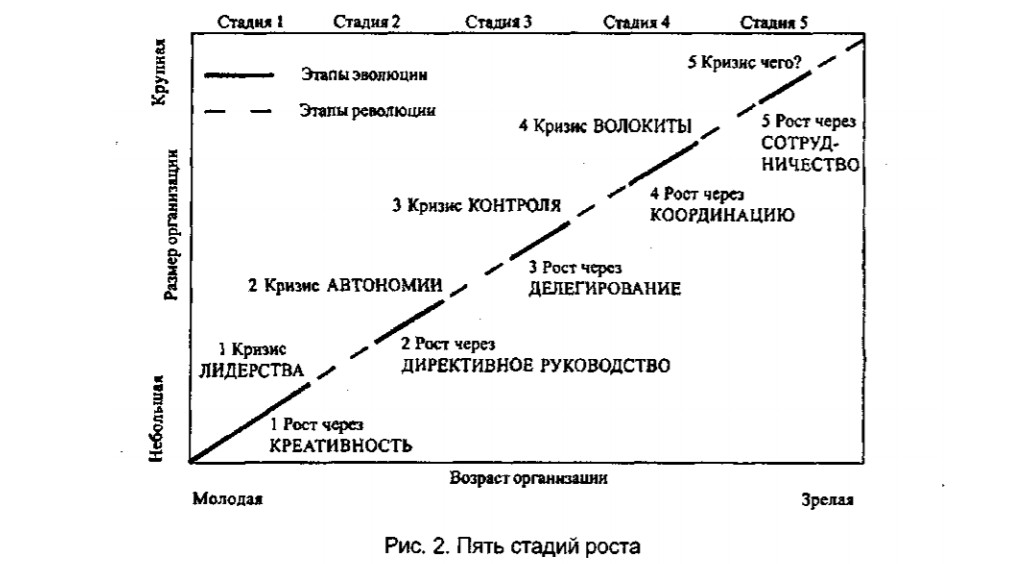
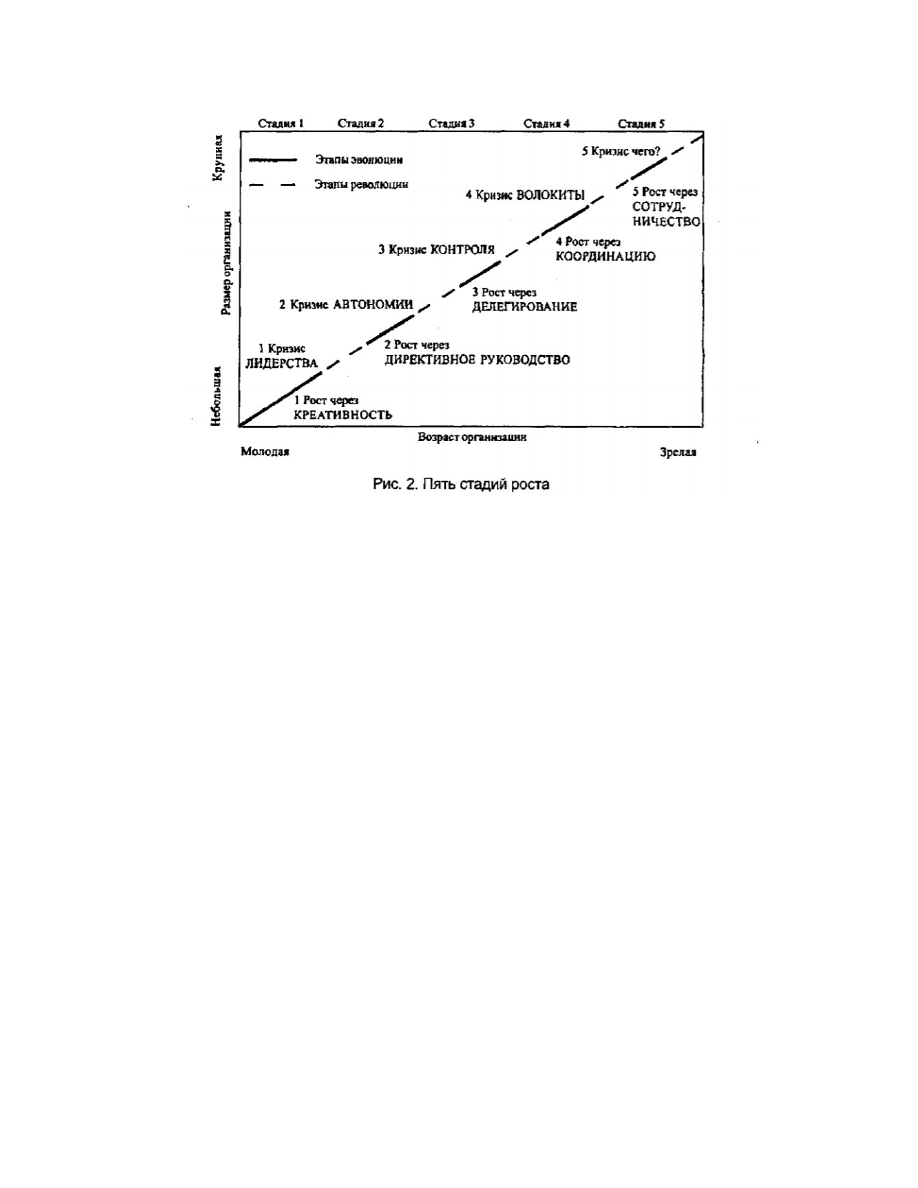
. Как показано на рис. 2, каждый эволюционный
период характеризуется доминирующим стилем управления,
используемым для обеспечения роста,
в то время как каждый революционный период характеризуется
доминирующей проблемой
управления, которая должна быть решена до того, как рост может быть
продолжен.
«психологической пресыщенности» работников
Я подозреваю, что революция пятой стадии будет преодолена с
помощью новых структур и
программ, которые позволяют работникам периодически отдыхать,
расслабляться и возвращать
себя к жизни.
Знайте, на какой стадии организационного развития вы
находитесь. Любая
организация и ее составные части находятся на различных этапах
развития. Задача высшего
руководства состоит в том, чтобы знать об этих этапах; иначе оно
может не осознать, когда придет
время для изменений, или может навязывать неверное решение.
Признайте ограниченность вариантов решений. На каждом
революционном этапе
становится очевидным, что он может завершиться только принятием
определенных специфических
решений; более того, эти решения отличаются от тех, которые
использовались для решения
проблем предшествующей революции. Слишком часто заманчивым
оказывается выбор тех
решений, которые были опробованы ранее, что делает невозможным
начало новой стадии роста.
Осознайте, что решения порождают новые проблемы. Менеджеры
часто не осознают,
что организационные решения создают проблемы для будущего
(например, решение делегировать
полномочия неизбежно вызывает проблему контроля).
Dealing with revered past: Historical identity
statements and strategic change in Japanese family
firms
Our study combined archival research with contemporary documents and interview
data to investigate how 25 Japanese companies engaged with the revered and
significant part of their history embodied in their ka-kun, in the face of strategic
change. In addition to cases of clear-cut remembering or replacing, we identified
three discursive strategies that can be used to establish a sense of continuity in
times of change: elaborating (transferring part of the content of the historical
statement into a new one, and articulating its implications for the current context),
recovering (forging a new statement, different from the historical one, but based on
the retrieval and re-use of historical references), and decoupling (allowing the co-
existence of the historical statement and a contemporary one, serving
complementary purposes). A comparative analysis revealed specific contextual
conditions that tended to be associated with the use of each strategy.
: This paper examines how strategymakers attempt to reconcile change
initiatives with organizational values and principles laid out long before, still
encased in strategic identity statements such as corporate
mottos and philosophies. It reveals three discursive strategies that strategy-
makers use to establish a sense of continuity in time of change: elaborating
(transferring part of
the content of the historical statement into a new one),
recovering (forging a new statement based on the retrieval
and re-use of historical references), and decoupling (allowing the co-
existence of the historical statement and a contemporary one). By so doing,
our study advances research on uses of the past, establishes important
linkages
between identity and strategy research, and enhances our
understanding of the intergenerational transfer of values in
family firms.
Managerial Summary: Crafting a new corporate philosophy or mission statement
can help implement strategic change, but can also be experienced as a disruption in
people's sense of “who we are” as an organization. This paper reveals a variety of
strategies that managers can use to deal with the tension between promoting
change and maintaining a sense of continuity with a distant, revered past. By doing
so, it helps managers confronting these issues deal with the enabling and
constraining effects of the past. While this is a more general challenge for
organizations with historical legacies, it is a particularly delicate issue for family
firms grappling with the need to transfer values from one generation to the next,
while retaining flexibility to change and adapt over time
Digital entrepreneurship ecosystem: How digital
technologies and collective intelligence are reshaping the
entrepreneurial process
Digital technologies have nowadays a significant impact on how new business
ventures are imagined and created. The arising technology paradigm is leveraging
the potential of collaboration and collective intelligence to design and launch more
robust and sustainable entrepreneurial initiatives. However, although the topic of
digital entrepreneurship is relevant and timely, there is a limited literature
discussion on the real impact of digital technologies and collaboration on the
entrepreneurial process. Further research is needed to describe the nature and
characteristics of the entrepreneurial ecosystem enabled by the new socio-technical
paradigm. Based on extant literature, this article proposes a definition of digital
entrepreneurship ecosystem by highlighting the integrated digital-output and
digital-environment perspectives. A collective intelligence approach is then adopted
to define a descriptive framework and identify the distinguishing genes of a digital
entrepreneurship ecosystem. Four dimensions associated to digital actors (who),
digital activities (what), digital motivations (why), and digital organization (how) are
defined and discussed. The framework was also applied to describe 9 real cases of
companies and initiatives, which are analyzed as digital entrepreneurship
ecosystems along the four key dimensions presented. The article ends with a
discussion about the results and a research agenda for future studies.
University ecosystem for student-startups: A
‘platform of trust’ perspective
o exhibit “radical creativity”
This paper has outlined research to specify within and beyond the case of
student startups in
the Aalto platform-of-trust ecosystem three kinds of leverage methods: (1)
production leverage, (2) innovation leverage, and (3) transaction leverage.
Production leverage is represented
by the university campus and the university’s students; innovation
leverage represented by entrepreneurs at the boundary of the university
and its outside, and transaction leverage represented by outside
investors. These intertwine in the ecosystem. Such an ecosystem requires
both radical creativity and a platform of trust. In between, it is expected that
“design thinking”
is in a key role, including personal and social linkages between human
beings and not only
e.g. human-computer interaction.
In an ecosystem with a platform of trust, it is possible to transparently share and
manage information across process stages and organizational boundaries. There is
sense of security and safe reliance so as to assure character, ability and strength,
and to assume truthfulness and sincerity of actors in the industries or other fields
involved.
Implications for practice from this paper for civil engineering, for
entrepreneurship
and for university-based ecosystems practice include: understand before
digitalize; as well as
learn to analyze, codify and even to digitalize before you transfer to another
industry, location
and/or culture for superior returns. Implications for innovation policy and
policy research include understanding what may be equivalent roles to e.g.
Business Finland in Finland as providers of funding for entrepreneurial
ecosystems in other.
A proposition for further research coming out this paper is to study to what
extent
and why, in the field of higher education, modeling, codification and export
of programs for
student startups will benefit from being unpacked and from being
understood in terms of their
social relations before exported, and from whose perspective. How and why
context matters?
To what extent can Aalto model be exported to one or the other of the Baltic
states, for example? A more theoretical call for further research is to take
relatively good times in and around
Helsinki industrial ecology (such as the one in which Aalto University is
embedded) and compare this kind of university-environment dyad with
relatively bad times (such as those recently
in and around the Detroit industrial ecology in which University of Michigan is
embedded)
(Huang-Saad et al., 2017, wihurinrahasto.fi). When times are bad rather than
good, to what
extent may a platform of trust be more or less important in producing
radically creative ideas
and student startups (see Stutz et al., in print)?
Ownership structure, strategic controls and export
intensity of foreign-invested firms in transition economies
This paper examines the relationships between foreign ownership,
managers’
independence in decision-making and exporting of foreign-invested firms in
five European Union accession countries. Using a unique, hand-collected
data
set of 434 foreign-invested firms in Poland, Hungary, Slovenia, Slovakia and
Estonia, we show that foreign investors’ ownership and control over strategic
decisions are positively associated with export intensity, measured as the
proportion of exports to total sales. The study also analyzes specific
governance
and control configurations in foreign-invested firms, showing that foreign
equity and foreign control over business functions are complementary in
terms
of their effects on export intensity
Business model evolution, contextual
ambidexterity and the growth
performance of high-tech start-ups
Focusing on the role of efficiency and novelty design themes, this paper examines
how (a) the initial business model of a start-up, (b) the subsequent changes in the
design themes and (c) the combinative effect of efficiency and novelty (contextual
ambidexterity) impact a start-up's growth performance. The study is based on a
survey involving 267 new ventures from high-tech industries. The results highlight
the importance of pursuing higher efficiency over the life cycle of a start-up,
although not at the moment of its establishment. In relation to business model
ambidexterity, the findings highlight the different effect that contextual
ambidexterity can have on the growth performance of a start-up firm in different
stages of its life cycle. While initial ambidexterity is found to have a negative effect
on growth performance, successive increases in the level of ambidexterity have a
positive influence on growth.
Kasutatud allikad
Sarnased õppematerjalid
![ASPECTS OF BRITISH HISTORY]()
188
rtf
ASPECTS OF BRITISH HISTORY
N. A. Vavilov
ASPECTS OF BRITISH HISTORY
Н. А. Вавилов
КРАТКАЯ ИСТОРИЯ
ВЕЛИКОБРИТАНИИ
Учебное пособие на английском языке
� Москва
Институт международного права и экономики имени А. С.
Грибоедова
2008
2
�УТВЕРЖДЕНО
кафедрой
лингвистики
и переводоведения
Вавилов Н.А.
Краткая история Великобритании: Учебное пособие на английском языке.
– 2-е изд., пересмотр. и испр. – М.: ИМПЭ им. А.С. Грибоедова, 2008. ?
![Windows vene keeles]()
724
odt
Windows vene keeles
WINDOWS OUTSIDE
Версия 1.00
С пожеланиями обращайтесь по адресу [email protected].
© skruks, 2013
Каждый имеет право воспроизводить,
распространять и/или вносить изменения в
настоящий Документ в соответствии с условиями
GNU Free Documentation License, Версией 1.3 или
любой более поздней версией, опубликованной
Free Software Foundation;
данный Документ не содержит Неизменяемых
разделов, не содержит Текста, помещаемого на первой странице
обложки и не содежит Текста, помещаемого на последней страницы
обложки.
Копия лицензионного соглашения раз
![Tarkvaratehnika 3 variant]()
12
pdf
Tarkvaratehnika 3 variant
Сравнить Канбан и Скрам
Scrumikokkuvõte
The Product Owner sets the Product Backlog
During the Sprint Planning, the Product Owner
determines a piece of the top of that list –the Sprint Backlog –and decide how to mplement
itThe Team has a time-box to reach this goal: the sprint
Each day, the Team measures its progress during a 15 minutes meeting:
the Daily Scrum Meeting
During the whole project, the Scrum Master ensures that the Team is still focused on its
objective
At the end of the Sprint, the completed work has to be potentially shippable
The Sprint ends with the Sprint Review and the Retrospective.
The Scrum process is completed when all Stories making up the Product Backlog are
implemented, or the budget is consumed, or when the time is over.
Kanbani võimalikud eelised Scrumi ees
Lihtsus
Puudub suurte Backlogide haldamine Puudub“time boxing” Sprint Backlogide jaoks
Puuudub arendamise edukuse hindamine ja mõõtmine
Scrum Board is r
![Jeffrey Moore Crossing Kuristik-Kuidas tuua tehnoloogia massitootesse]()
36
rtf
Jeffrey Moore Crossing Kuristik. Kuidas tuua tehnoloogia massitootesse
Джеффри Мур
Преодоление пропасти. Как вывести технологический
продукт на массовый рынок
� 2
Текст предоставлен издательством http://www.litres.ru/pages/biblio_book/?art=4519219
«Преодоление пропасти. Как вывести технологический продукт на массо-вый рынок /
Джеффри Мур»: Эксмо; Москва; 2013
ISBN 978-5-91657-537-8
Аннотация
«Преодоление пропасти» считается главной книгой одного из самых ярких
исследователей бизнеса – Джеффри Мура.
Она посвящена маркетингу технологичных товаров. Ее главная тема – ка?
![Sissejuhatus infotehnoloogiasse]()
29
docx
Sissejuhatus infotehnoloogiasse
1 nädal. Sissejuhatus: arvuti ja info,
ajaloo algus ... 1940
Meanings:
Bit - the smallest unit of storage ( 1 binary digit)
Byte - collection of 8 bits / is a unit of storage, 8 binary digits long
Kilobyte - A unit of storage capacity (1024 bytes )
Megabyte - 1,048,576 bytes
Gigabyte - 1,073,741,824 bytes
Terabyte - 1 trillion bytes
Algorithm - is a step by step method of solving a problem
Program - is the expression of an algorithm in a programming language.
ALGORITM - kindel eeskirjade jada, mis määrab üheselt ülesande
lahenduskäigu.
PROGRAMM - programmeerimiskeeles kirja pandud algoritm
Greek logicians ( Kreeka loogikud ):
Parmenides (5 sajand e.m.a.) : kasutas pikki loogilisi põhjendusi.
Zenon Eleast (5 sajand e.m.a.) - apooriad/paradoksid
Sofistid - Sokrates (470-399 e.m.a) - Platon (428/427 - 348/347 e.m.a):
Aristoteles : väidete struktuur kui iseseisev uurimisobjekt
Aristoteles Süllogismide näited:
1. eeldus: iga koer on imetaja.
2. eeldus: mõned nel
Sissejuhatus infotehnoloogiasse
![MAJANDUS TEGEVUSE FINANTS ANALÜÜS ETTEVÕTTE « ANVOL » OÜ PÕHJAL]()
130
pdf
MAJANDUS TEGEVUSE FINANTS ANALÜÜS ETTEVÕTTE « ANVOL » OÜ PÕHJAL
TALLINNA MAJANDUSKOOL
Täiskasvanute koolituskeskus
Albina Voronkova
MAJANDUS TEGEVUSE FINANTS ANALÜÜS
ETTEVÕTTE « ANVOL » OÜ PÕHJAL
Финансовый анализ предприятия на примере фирмы «Anvol» OÜ
Lõputöö
Juhendaja:
Ljubov Gromova
Tallinn 2015
�Выпускная работа составлена мной самостоятельно. Подтверждаю, что при
составлении данной работы даны ссылки на точки зрения, постановки проблем,
собранные данные других авторов.
Автор Альбина Воронкова / подпись и число/
Учебная программа: Бухгалтерский
![Public Administration and Innovation]()
26
docx
Public Administration and Innovation
Preparing for exam.
Focus areas
Defining innovation
● “An innovation is an idea, practice, or object that is perceived as new by an
individual or other unit of adoption.” (Rogers 1952)
● CIS survey: “Product innovations must be new to your enterprise, but they do not
need to be new to your market”.
● “Companies achieve competitive advantage through acts of innovation. They
approach innovation in its broadest sense, including both new technologies and
new ways of doing things” – (Porter 1990)
● “An innovative business is one which lives and breathes “outside the box”. It is
not just good ideas, it is a combination of good ideas, motivated staff and an
instinctive understanding of what your customer wants” – (Branson 1998)
● “...novel implementation of an invention, discovery, new or existing knowledge
in economic process” (Joseph A. Schumpeter)
● An innovation is the implementation of a new or significantl
![English as a Global Language]()
60
pdf
English as a Global Language
Tallinna Mustamäe Humanitargümnaasium
Valeria Jefremenkova
ENGLISH AS A GLOBAL LANGUAGE
INGLISE KEEL KUI ÜLEMAAILMNE KEEL
Research work
Supervisor: Jevgenija Kozlova
Tallinn 2016
1
�Table of Contents
СONTENT…………………………………………………………………………………...2
INTRODUCTION…………………………………………………………………………...3
CHAPTER I……………………………………………………………………………….....5
1.1. A Brief History of the English Language…………………………………………...…..5
1.2. Origins of English as the Global Language……………………………………..……....6
1.3. Necessity of a Global Language...……………………………………………………....8
1.4. Critici
Meedia
Kommentaarid (0)
 100 punkti
Autor soovib selle materjali allalaadimise eest saada 100 punkti.
100 punkti
Autor soovib selle materjali allalaadimise eest saada 100 punkti.
 ~ 10 lehte
Lehekülgede arv dokumendis
~ 10 lehte
Lehekülgede arv dokumendis
 2021-12-13
Kuupäev, millal dokument üles laeti
2021-12-13
Kuupäev, millal dokument üles laeti
 0 laadimist
Kokku alla laetud
0 laadimist
Kokku alla laetud
 0 arvamust
Teiste kasutajate poolt lisatud kommentaarid
0 arvamust
Teiste kasutajate poolt lisatud kommentaarid
 Andtsu
Õppematerjali autor
Andtsu
Õppematerjali autor
 annaabi.ee






















Kõik kommentaarid