Firstly, big forest machines disturb animals. For example, in winter the machines disturb animals who hibernate in winter. As a result, animals can leave their habitations and go somewhere else where is quiter. In addition to disturbing animals, the forest industry endanger wild animals' lives. Some machines can simply kill some animals accidentally. Besides, there are some species which are rear in Estonian forests. These species should be protected. A further problem is poaching- although it is not a very big problem in Estonia, it affects the number of animals. There are, however, a lot of wild animals in our woods and their life is pretty good, compares with some other country, where are more poaching for example. In conclusion, it can be said that although human activities damage and pollute the environment of wild animals, their life in Estonia is not neccessarily inevitable. In fact, there are several places in Estonia which have been turned into wild life
mainland Southeast Asia. • The two major threats to the species are habitat loss and commercial hunting. 3. ASIATIC BLACK BEAR • Found in forests in every country in mainland Southeast Asia, except Malaysia • The species suffer from habitat loss due to logging (metsaraie) and expanding human settlements. • Japan is the only country that has 4. SLOTH BEAR • Found predominantly in India, Nepal, Sri Lanka and Bhutan. • Habitat loss and poaching (salaküttimine) —mainly for the commercial trade in body parts—are the bear's main threats. • And in India sloth bears are captured live and made to perform on the roadside. • The species may have disappeared entirely from 5. ANDEAN BEAR • Also called spectacled (prill) bears. • Andean bears roam (rändama) a variety of types of habitats from Argentina to Panama. • Poaching, agricultural development, and increasing mining (kaevanamine) and oil
Mostly it is caused by our selfish attitude: we do not take care of nature. Zoo is one of the solutions to help to preserve nature and to protect it from poachers. For example Loxodonta africana is an African elephant who has been hunt down and whose population was significantly reduced in 20th century.The population in the Tanzanian Selous Game Reserve, once the largest of any reserve in the world, dropped from 109 000 in 1976 to 13 000 in 2013. 85 000 elephants were lost to poaching in Tanzania between 2009 and 2014. Even though zoos compared to reserves are really small, they are still important in preserving animal species. Also, some of the animals lose their natural habitat completely due to the natural disasters or something even worse like pollution caused by who?-human being. It is really hard to accept the fact that we are trying to protect something from ourselves. Giant panda in south central China does not have a "home" anymore. Chinese
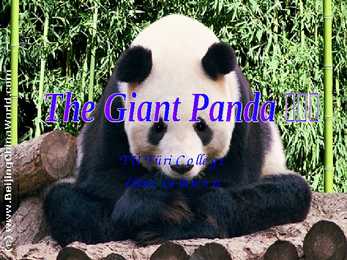
doing a handstand in order to place their scent higher on the tree. History · The Giant Panda was first made known to the West in 1869 by the French missionary Armand David, who received a skin from a hunter. · The first westerner known to have seen a living Giant Panda is the German zoologist Hugo Weigold, who purchased a cub in 1916. · The Giant Panda has been a · The population boom in target for poaching by locals China after 1949 created since ancient times, and by stress on the pandas' foreigners since it was habitat. introduced to the West. · During the Cultural · Starting in the 1930s, Revolution, all studies and foreigners were unable to conservation activities on poach Giant Pandas in the pandas were stopped. China because of the · After the Chinese economic
Causes: *The main cause of animal extinction, without doubt,is human demand, either for animal resources directly, or for the natural resources of the animals' habitats. *In addition to that, there are other indirect causes caused by human activities. *Habitat loss: Is considered to be the main cause for animal extinction. Humans are clearing our forests for wood and timber. The foodchain is disturbed and animals will die. *Wildlife trade: Poaching and wildlife trade are another common threat to animals. International wildlife trade has also been linked to drugs trade. The most common anilmal trade is pet trade, such as orangutangs. Animals are also killed for fur(tigers, leopards, cheetahs) *Climate change: It has been recently suggested that warmer global temperatures may be affecting animals. In fact, it has been suggested that the golden toad became extinct because of the warmer climate. The Animals
• The 2012 update of the IUCN Red List of Threatened Species shows that of the 63,837 species examined worldwide, 19,817 are threatened with extinction - nearly a third of the total. • If present trends continue, scientists warn that within a few decades, at least half of all plant and animal species on Earth will be extinct, as a result of climate change, habitat loss, pollution, acidifying oceans, invasive species, over- exploitation of natural resources, overfishing, poaching and human overpopulation. Lower Life Expectancy in the Fastest Growing Countries • According to a Harvard study, "Over the next forty years, nearly all (97%) of the 2.3 billion projected increase will be in the less developed regions, with nearly half (49%) in Africa." Already strained with relentless population explosion, many developing countries, such as in Sub Saharan Africa and Southern Asia, will experience a degradation of their quality and
times is related to its unusual dietary requirements the species exists almost entirely on bamboo habitat isolation and relatively slow reproductive rate. But this new study, published in Molecular Biology and Evolution, has uncovered an important relationship between the species' decline and human activities. "It is clear that the species has suffered at the hands of human activities such as deforestation and poaching," said Professor Michael Bruford. The research also shows that where habit conservation projects have been properly implemented, the giant panda is flourishing and its numbers are increasing. "Our research suggests we have to revise our thinking about the evolutionary prospects for the giant panda and that the species has a viable future and possesses the genetic capacity to adapt to new circumstances," said Professor Bruford. Scientists count rare river dolphins
kitchen and table utensils. This book differs from most books written for the royal courts in its preference for domestic animals and Bartolomeo Scappi courtyard birds rather than game. Recipes include lesser cuts of meats personal chef to Pope Pius V such as tongue, head and shoulder. The third volume has recipes for fish in Lent. These fish recipes are simple, including poaching, broiling, grilling and frying after marination. Particular attention is given to seasons and places where fish should be caught. The final volume includes pies, tarts, fritters and a recipe for a sweet Neapolitan pizza (not the current savory version, as tomatoes had not been introduced to Italy. However, such items from the New World as corn (maize) and turkey are included. 5
product, which is visually unattractive (Carr above 80°C before being mixed with the pro- et al. 2005). teins (liver or lean meat). The objective is to The taste and flavor of fat varies between reach a final internal temperature between animal species. Chicken fat is neutral in 50°C and 60°C for ham fat and between 70°C taste and well suited as a fat component for and 75°C for jowl fat. Fat poaching also pure chicken products (Heinz 2007). It con- causes contraction of the connective tissues, tains a lot of linoleic acid; it melts at a which will facilitate the grinding; it elimi- low temperature; and it becomes oxidized nates low-melting fats, which can cause easily (Solignat 2003). Beef fat is considered weight losses during cooking, and it lowers less suitable for further processing than pork the microbial content. Thus, for hot emul-
 annaabi.ee