•Irish setters are not the highly intelligent animals they used to be. The difference between the generic indefinite pronoun and the normal indefinite pronoun is that the latter refers to any of that class ("I want to buy a beagle, and any old beagle will do.") whereas the former (see beagle sentence) refers to all members of that class. gerund Every gerund, without exception, ends in ing. Gerunds are not, however, all that easy to identify. The problem is that all present participles also end in ing. What is the difference? Gerunds function as nouns. Thus, gerunds will be subjects, subject complements, direct objects, indirect objects, and objects of prepositions. Present participles, on the other hand, complete progressive verbs or act as modifiers. Read these examples of gerunds: Since Francisco was five years old, swimming has been his passion. Swimming = subject of the verb has been. Francisco's first love is swimming.
Tener que + infinitive To have to + infinitive Ir a + infinitive To go to + infinitive Acabar de + infinitive To have just + past participle Hace + time time + ago 42. Progressive Tenses The progressive tense indicates an action that is ongoing. It is formed by using estar (in any tense) with a present participle. Present participles are formed by dropping the ending of the verb, and adding the following endings to the stem: Present Participles -ar -ando -er -iendo -ir -iendo Juan está hablando. Josh is talking. Estaban cantando. They were singing. Estuve escribiendo una carta. I was writing a letter.
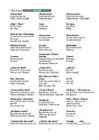
plural in nouns (story-stories), pronouns (I-we), determiners (this-these) and verbs (he works hard-they work hard). participle kesksõna, partitsiip The non-tensed forms of verbs ending in –ing and -ed. working, worked, burning, burnt In irregular verbs, the -ed participles display variant forms. partitive osatarind A quantifying expression used before a non-count noun a pair of glasses, a piece of paper, to specify the units, parts and collections of things. a bunch of roses, parts of speech sõnaliigid Another term for word class, referring to the linguistic
between · The vowels do not occur in many varieties in WEng · Educated WEng is not rhotic · Tendency to lengthen intervocalic consonants before unstressed syllables (butter, money) Non-systemic pronounciation differences · For some speakers, /g/ is absent in the words language and longer. · For some speakers // occurs in the words comb and tooth. Grammar: · Generalisation of word forms (I likes, they sees) · Non-standard use of ,,never" (I never did it) · Participles are often proceeded by ,,a" (I sat there a-watching) · Universal tag ,,isn't it" is used disregarding the main person, tense or auxiliary (You are going now, isn't it?) · In North-Wales Welsh use ,,yes" (You are studying Welsh, yes?) · Fronting of a constituent (Singing they were; Coming tomorrow he is) · Negative use of the word ,,too" (They can't do that too) · Repetition of an adjective or an adverb for emphasis (It was a high high building)
ability and intention to do something, willingness. For example: He can play the guitar. I will help you. 5.3 What are the differences and similarities between modal verbs and auxiliary verbs? Differences: Modal verbs lack present and past participles which means that they do not show tense. In order to show tense they need paraphrasing. For example: Canning playing the piano pleases him.* → Being able to play the piano…. Canning, musting, maying* Modal verbs are always finate! Modals do not have an ‘s form. Can’t say coulds, mights*
D. the passive auxiliary BE + the ed participle of a MV: was written These four basic constructions also enter into combination with each other. CD: is being written ABD: may have been written ABCD: may have been being written The more complex the VP pattern is, the less commonly it occurs. Nonfinite verb phrases As modals have no nonfinite forms, they cannot occur in nonfinite verb phrases. infinitives participles simple to examine examining B to have examined having examined C to be examining [being] examining D to be examined [being] examined complex BC to have been examining having been examining BD to have been examined having been examined
m ar H am Gr elp To form the present perfect tense join have or has to the past participle of the verb: have + past participle has + past participle The past participle of a regular verb usually ends in -ed, just like the simple past tense. But the past participles of irregular verbs don't follow this rule. 96 Exercise 1 Write the past participle of these verbs on the blanks. 1 break_______________ 6 buy _______________ 2 drink _______________ 7 find _______________ 3 cut _______________ 8 draw _______________ 4 do _______________ 9 hear _______________ 5 sing _______________ 10 know_______________ Exercise 2 Fill in the blanks with the present perfect tense of the
?Tl waiting in a queue fora longtime I feltsatisfied when t passed thetest, ETI beinglatefor school/work We use-ing participles to saywhat an experience islwas lETl missing thebus/trainto school/work like;Possing thetestwos sotisfying, [TTl walking homealone at nrght IgT-l goingto thedentist
?Tl waiting in a queue fora longtime I feltsatisfied when t passed thetest, ETI beinglatefor school/work We use-ing participles to saywhat an experience islwas lETl missing thebus/trainto school/work like;Possing thetestwos sotisfying, [TTl walking homealone at nrght IgT-l goingto thedentist
?Tl waiting in a queue fora longtime I feltsatisfied when t passed thetest, ETI beinglatefor school/work We use-ing participles to saywhat an experience islwas lETl missing thebus/trainto school/work like;Possing thetestwos sotisfying, [TTl walking homealone at nrght IgT-l goingto thedentist
?Tl waiting in a queue fora longtime I feltsatisfied when t passed thetest, ETI beinglatefor school/work We use-ing participles to saywhat an experience islwas lETl missing thebus/trainto school/work like;Possing thetestwos sotisfying, [TTl walking homealone at nrght IgT-l goingto thedentist
 annaabi.ee