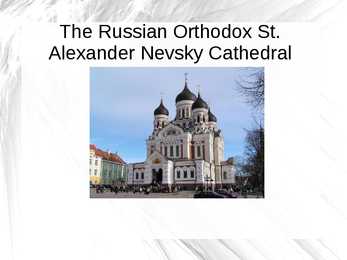
The Russian Orthodox St. Alexander Nevsky Cathedral The Russian Orthodox St. Alexander Nevsky Cathedral is designed by Mikhail Preobrazhensky ( a professor at St. Petersburg Academy of Arts) And built on the order of Alexander III between 1894 and 1900,during the period when the country was part of the Russian Empire The Alexander Nevsky Cathedral is Tallinn's largest and oldest orthodox cathedral It is dedicated to Saint Alexander Nevsky who in 1242 won the Battel of the Ice on Lake Peipus The church's towers' hold Tallinn's most powerful church bell ensemble,consisting of 11 bells (one of them weighing 15 tonnes) Orthodoxy in Estonia is practiced by 12.8 % of the population,making it the second most identifield religion after Lutheran Christianity with 13.6 % Orthodoxy is mostly practiced within Estonia's Russian ethnic minority The first mention of an Orthodox congregation in Estonia dates from 1030
Tallinn sightseeing Cristofer Krik 8.klass Lagedi Kool Tallinn's Old Town Included in the UNESCO World Heritage List Best protected and intact medieval town Cobblestone lanes, gothic spires and iron street lamps Cappuccino and Wifi The Town Hall On Raekoja square Intact gothic town hall Operates as a museum and concert hall ,,Old Thomas" Town Hall Aphothecary The Aleksander Nevsky Cathedral Orthodox cathedral Design by Mikhail Preobrazhensky Spectacular and onion- domed structure Dedicated to Alexander Yaroslavich Nevsky Kasutatud materjal http://www.visitestonia.com/en/ http://www.tourism.tallinn.ee/eng/explore/attractions/old_town http://images.google.ee/ http://en.wikipedia.org/wiki/Tallinn
Kunda Ühisgümnaasium Tallin Old Town Report Student: Kristin Karu Teacher: Kristi Aron Kunda 2012 The Alexander Nevsky Cathedral The Alexander Nevsky Cathedral is an orthodox cathedral in the Tallinn Old Town,Estonia. It was built to a design by Mikhail Preobrazhensky in a typical Russian Revivalstyle between 1894 and 1900, during the period when the country was part of theRussian Empire. The Alexander Nevsky Cathedral is Tallinn's largest and grandest orthodox cupola cathedral. It is dedicated to Saint Alexander Nevsky who in 1242 won the Battle of the Ice on Lake Peipus, in the territorial waters of present-day Estonia
It remains an incredible building inside and out. From within, admire vaulted roofs and brightly decorated colonnades, from outside marvel at the slender tower, topped with Renaissance spire (added in 1627), reaching 64m towards the ether. Incidentally, the moustachioed weather vane on top is the symbolic guardian of the city - Vana Toomas! http://www.tallinn-life.com/culture/culture_details/1-Tallinn_Town_Hall Alexander Nevsky Cathedral One of Tallinn's most resplendent monuments, but not one of it's most popular, the spectacular Alexander Nevsky Cathedral was built on orders from St. Petersburg during the times of Russian Imperial rule. Supposedly built on the grave of a legendary Estonian hero, Kalevipoeg, on the city's mighty Toompea Hill, the Orthodox cathedral was something of a Russian propaganda exercise at the time and still remains a subject of controversy amongst hardline patriots. Most locals though are
S » Tallinn» . , Tallinn refreshingly uncontrived. , , varied moving . Tallinn, - , , yourselves shorefront promenade. , . Tallinn delightful ofcourse - europe. sightsseeings, , intresting. Toompea Nevsky, 1900. Tallinn Mikhail Preobrazhenski St. Petersburg. . Toompea . 16th , Tallinn Europe. , Riga Vilnius , 80 2.35km . St Mary 1223 Toompea. More commonly , noblemen. (Toomkirik) Kiriku . GLAVN Lutheran . . 1878 Classicism Romanticism. 2 , . 1510-1529 seaward storehouse gunpowder, .
Lutheran church 1219 1233 The stone church Organ-1913 Danish King's Garden Location Old legends Danneborg Day The House of the Estonian Knighthood Location Town residence 19201940 1948 to 1992 April 1, 1993 Alexander Nevsky Cathedral Location Church 1900 Mikhail Preobrazhensk Before the building Decoration Maiden Tower Location Prison 14th century Presently References http://tourism.test.neti.ee/fpage/explore/attractions/oldtown/?_page=2&_count_all=22 http://www.flat3.co.uk/europe/full_size/981052.jpg http://www.nomadig
Town Hall Square Toompea Castle & Tall Tallinn Town Hall Hermann's Tower Town Hall Pharmacy Cathedral of Saint Mary the Virgin Great Guild Hall Danish King's Garden House of the Brotherhood of Black Heads Other Attractions Kadriorg Palace The Kadriorg Art Museum Alexander Nevsky Cathedral Russalka Soviet Legacy KGB Headquarters Soviet Legacy Tallinn TV Tower - Closed from November 26th 2007 Open Air Attractions Estonian Open Air Museum Open Air Attractions Tallinn Zoo -Established in 1939 Open Air Attractions Tallinn Botanic Garden -Established in 1961 Shop In Tallinn/Eat in Tallinn Top 3 biggest
Toompea - obere Stadt Dieser Bereich war einmal eine unterschiedliche Stadt (Dom zu Reval), der Wohnsitz des Chivalry von Estland, römisch-katholische Bishops von Tallinn (bis 1561) und die lutherischen Betriebsleiter von Estland und besetzte einen leicht verteidigungsfähigen Aufstellungsort, der die umgebenden Bezirke übersieht. Die Hauptanziehungskräfte sind die Wände und verschiedene Bastionen von Castrum Danorum, die russische orthodoxe Kathedrale Alexander-Nevsky (errichtet während des Zeitraums des russischen Reiches, wurde die Kirche auf einem Aufstellungsort errichtet, der früher eine Statue von Martin Luther unterbrachte) und die lutherische Kathedrale (Domkirche) und von alten estnischen Royal Palace jetzt das Parlamentsgebäude. Altstadt - Bereich ist eine der besten konservierten alten Städte in Europa und die Behörden setzen seine Rehabilitation fort. Die Sehenswürdigkeiten da sind: " Fettes Margaret" , " Kiek in de Kök" , Kirchturm Str
Tapa Gümnaaasium Aleksandr Borodin Referaat Sisukord 1. Üldandmed 3 2. Üldiseloomustus 4 3. Lisad 5 Üldandmed Tuntud kui Aleksandr Porfiryevich Borodin Sündinud: 31-Oct-1833 Sünnikoht: St. Petersburg, Venemaa Suri: 15-Feb-1887 Surmakoht: St. Petersburg, Venemaa Surma põhjus: südameatakk Jäänused: Maetud, Alexander Nevsky Kirik, St. Petersburg, Venemaa Sugu: Mees Rass: Valge Seksuaalne orientatsioon: hetero Okupatsioon: Helilooja Rahvus: Venelane Isa:Luka Gedevanishvili Naine: Ekaterina Sergeyevna Protopopova (abiellus 29-Apr-1863, kuni surmani, üks laps) Tütar: Liza Balaneva (lapsendatud) Üldiseloomustus Andekas keemik ja väga suur muusik. Lapsepõlvest peale armastas loodusteadusi, kuid tegeles ka kirjandusega, armastas joonistada, õppis lapsepõlves mitut keelt (pr, it keel ja kultuur)
There is also The Holy Spirit Church with its colorful Renaissance clock, elaborate altar, and painted pews. The 13th century St. Nicholas got bombed in World War II but was meticulously reconstructed and now houses a display of religious art, including the freaky “Dance Macabre” of cavorting skeletons. Cathedral of St. Mary the Virgin and the Town Hall offer fine views of the city. The most visible church that seems to get on all the postcards is the Russian Orthodox St. Alexander Nevsky Cathedral with its onion domes. Several of the medieval buildings house museums: Epping Tower has a collection of medieval arms and armor, the 15th-century Great Guild Hall houses the Estonian History Museum, a 14th century merchant’s mansion is home to the Tallinn City Museum, and Fat Margaret’s cannon tower from 1530 is now the Maritime Museum. One of the most popular attractions is Kiek en de Kök, an imposing tower on the slopes of Toompea Hill
Renovation was carried out in 1996-2000. Tall Hermann - tower in the south-west corner of the castle; 49 m built in 1371; ten floors and a viewing platform. Estonian flag is raised there every morning at sunrise but not before 7am and lowered at sunset but not later than 10pm; except at midsummer June 23, when it’s not lowered at all. It’s commonly recognised that whoever’s flag flies on top of this tower is the ruler of Estonia. Toompea as a tourist attraction Alexander Nevsky Cathedral - largest and grandest orthodox cathedral crowning the hill of Toompea. It was finished in 1900, when the country was a part of the Russian empire. Time of russification, many estonians against it. Dedicated to the prince of novgorod, alexander nevsky who won the battle of ice. Due to the lack of funds and the building’s massive construction, it was never demolished. Kohtuotsa viewing platform - gives great view to the both parts of the city. blabla
Short foot is a street between Rataskaevu street and Long foot in the old town of Tallinn. The name that is used nowadays was translated from german by anton thor helle and it is Lühike jalg. Pikk jalg (lit. long leg/foot), One of the oldest streets in Tallinn, previously known as Strantstrasse (beach road) (1362); Pikk jalg (long-leg) is a steep narrow road which was once the only way into the fortress. It runs from Pikk in the lower town right up to Lossi plats and the Nevsky cathedral. A couple of cafes in the old houses along Pikk jalg offer excellent views and genuine ambience, as well as plenty of caffeine to help you up the hill. The gate tower at the end dates from around 1380. Because of the names short and long Tallinn is sometimes called a limping city. Short Leg is also sometimes called street-stairs, because it is made completely out of stairs. The Upper and Lower Towns were connected by the Long Leg street (Pikk jalg) during the Middle Ages
culture and architecture Toompea. This area was once a separate town (Dom zu Reval), the residence of the Chivalry of Estonia, Roman Catholic bishops of Tallinn (until 1561) and Lutheran superintendents of Estonia, occupying an easily defensible site overlooking the surrounding districts. The major attractions are the walls and various bastions of Castrum Danorum, the Russian Orthodox Alexandr Nevsky Cathedral (built during the period of Russian Empire, the church was built on a site that formerly housed a statue of Martin Luther) and the Lutheran Cathedral. Kadriorg is 2 kilometres east of the centre and is served by buses and trams. The former palace of Peter the Great, built just after the Great Northern War, now houses (part of) the Art Museum of Estonia, presidential residence and the surrounding grounds include formal gardens and woodland.
● Tall Hermann is one of the towers around the Toompea Castle. It’s 49-metres high watch-tower from the year 1371. Viewing platform, to get on top you must take 215 steps. Whoever’s flag is on top of this tower is the ruler of Estonia. (There have been German and Soviet flags). Today the estonian flag is hoisted every day at sunrise and lowered at the sunset, except at midsummer when it’s not lowered at all on the night of June 23. Nevsky Cathedral ● It’s the largest and grandest orthodox catherdral in Talinn. It was finished 1900, when Estonia was part of the Russian Empire. It was a time of russification. It’s architecturally absolutely different from everything else at Toompea, it’s also disliked by many Estonians as a symbol of oppression and the russian power, but it has never been actually taken down. The legend says it’s the very grave of Kalev, estonian’s national hero. Stenbock House
Toompea - obere Stadt Dieser Bereich war einmal eine unterschiedliche Stadt (Dom zu Reval), der Wohnsitz des Chivalry von Estland, römisch-katholische Bishops von Tallinn (bis 1561) und die lutherischen Betriebsleiter von Estland und besetzte einen leicht verteidigungsfähigen Aufstellungsort, der die umgebenden Bezirke übersieht. Die Hauptanziehungskräfte sind die Wände und verschiedene Bastionen von Castrum Danorum, die russische orthodoxe Kathedrale Alexander-Nevsky (errichtet während des Zeitraums des russischen Reiches, wurde die Kirche auf einem Aufstellungsort errichtet, der früher eine Statue von Martin Luther unterbrachte) und die lutherische Kathedrale (Domkirche) und von alten estnischen Royal Palace jetzt das Parlamentsgebäude. Altstadt - Bereich ist eine der besten konservierten alten Städte in Europa und die Behörden setzen seine Rehabilitation fort. Die Sehenswürdigkeiten da sind: " Fettes Margaret" , " Kiek in de Kök" , Kirchturm Str
Understood how griffith was using the film language. How can i achieve the effect. Usge of editing to create metaphors. Revolutionary idea: discovery of a cinematic language. The kuleshov experiments: · 1: the expressionless face. · 2: three shots, happy man, revolver, sad man · 3: creation of artificial landscapes by editing together shots of toally different locations Eisenstein: Seleced filmiography: strike! Battleship potemkin, october, alexander nevsky, ivan the terrible part 1, ivan the terrible part 2 During his filmmaking career esenstein was under permanent critiscism from the soviet authorities because his approach was considered to be formalistic and arty. His american adventure was a largely faailure. The battleship potemkin: Divided in 5 acts, film based on editing rather than narration. Gropus shots juxtaposed with etreme close-ups, multiple directions of movements, manipulation of time for dramatic purpose. High amount of shots
(i.e. the language of Rus', not to be confused with the contemporaneous Church Slavonic nor with modern Russian). The main type of Old Russian historical literature were chronicles, most of them anonymous. Anonymous works also include The Tale of Igor's Campaign and Praying of Daniel the Immured. Hagiographies (Russian: , zhitiya svyatykh, "lives of the saints") formed a popular genre of the Old Russian literature. Life of Alexander Nevsky offers a well-known example. Other Russian literary monuments include Zadonschina, Physiologist, Synopsis and A Journey Beyond the Three Seas. Bylinas oral folk epics fused Christian and pagan traditions. Medieval Russian literature had an overwhelmingly religious character and used an adapted form of the Church Slavonic language with many South Slavic elements. The first work in colloquial Russian, the autobiography of the archpriest Avvakum, emerged only in the mid-17th century.
 annaabi.ee