Vajad kellegagi rääkida?
Küsi julgelt abi LasteAbi
Logi sisse

Liikumisverbid (3)

5 VÄGA HEA
Punktid
Vene keel - vene keelsed luuletused
Verbs of motion
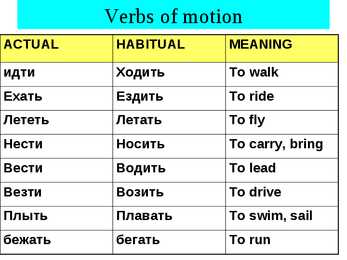
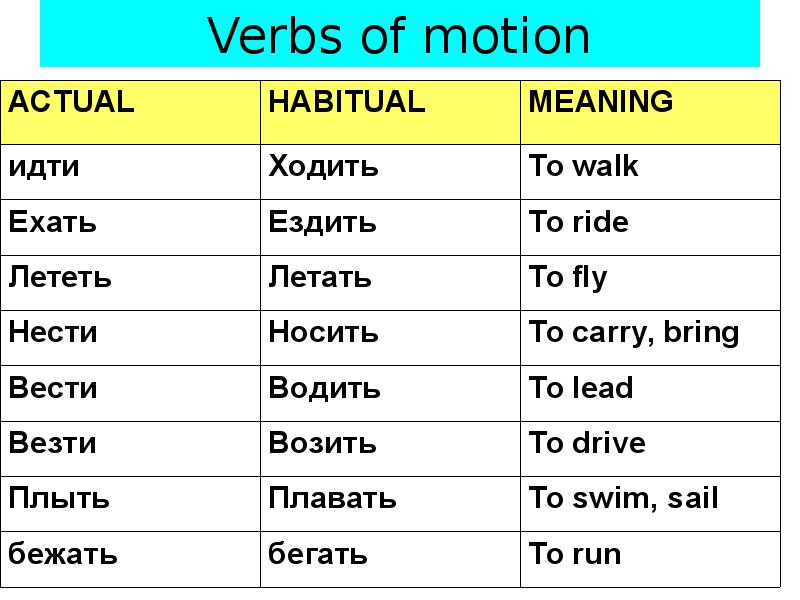
Verbs of motion
ACTUAL HABITUAL MEANING
To walk
To ride
To fly
To carry, bring
To lead
To drive
To swim, sail
To run
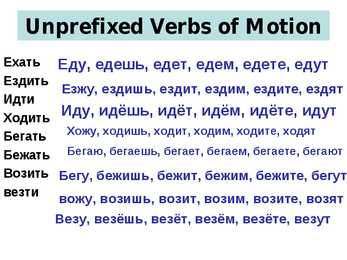
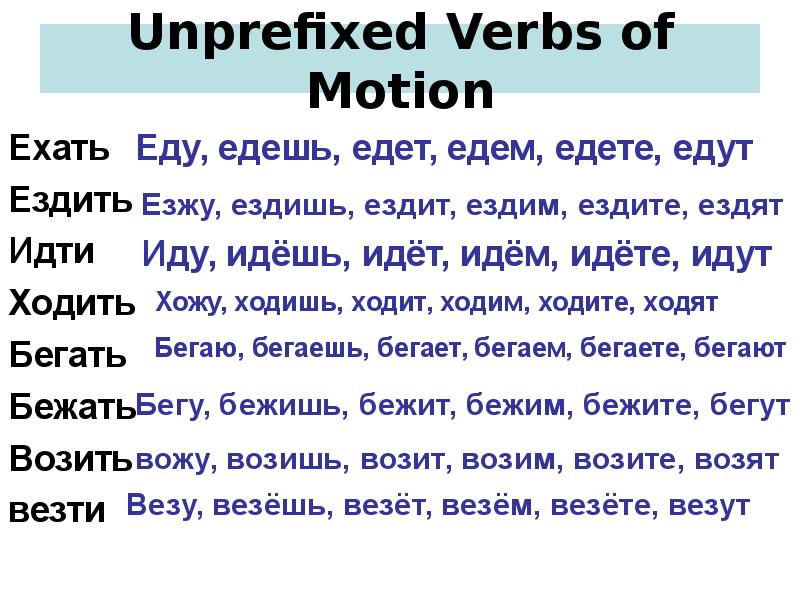
Unprefixed Verbs of M otion
, , , , ,
, , , , ,
, , , , ,
, , , , ,
, , , , ,
, , , , ,
, , , , ,
, , , , ,
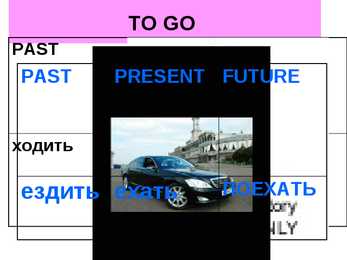
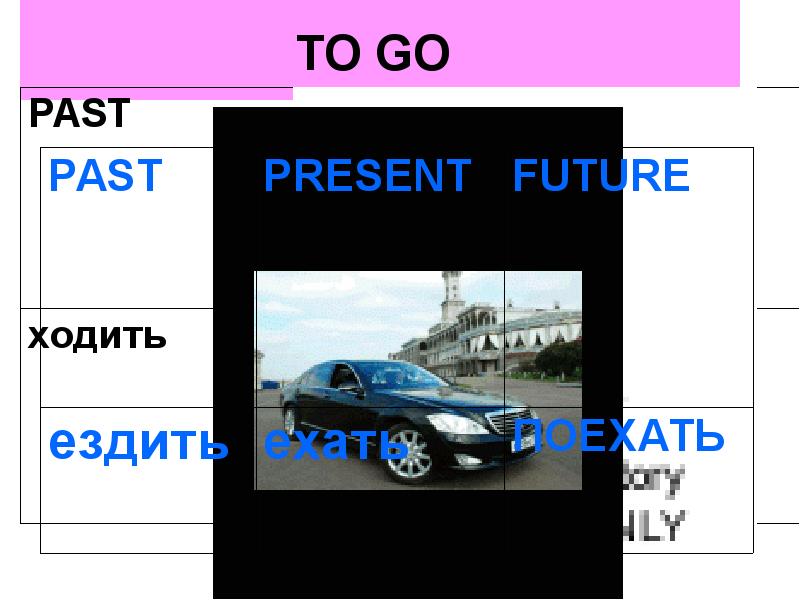
TO GO
PAST PRESENT FUTURE
PAST PRESENT FUTURE
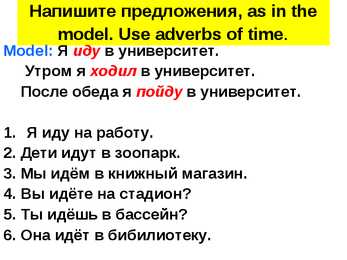
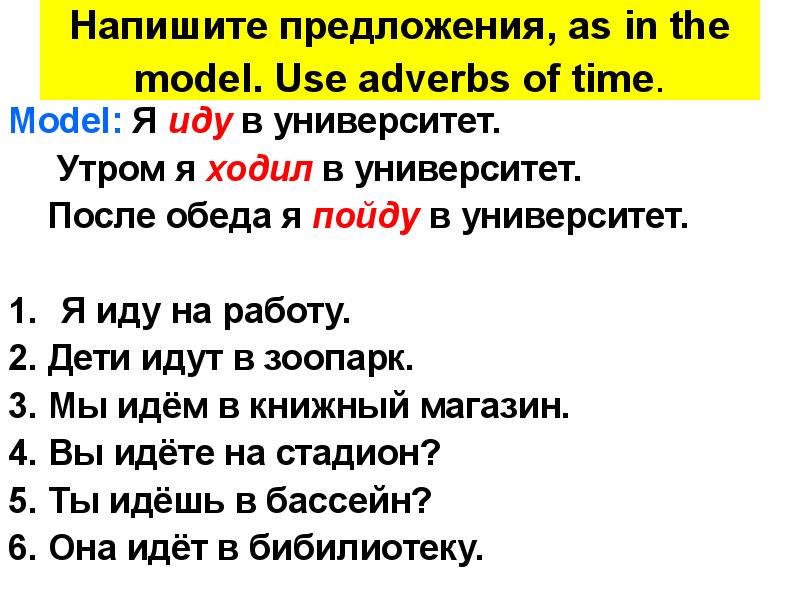
, as in the
model. Use adverbs of time.
Model: .
.
.
1. .
2. .
3. .
4. ?
5. ?
6. .
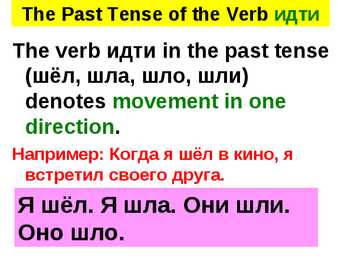
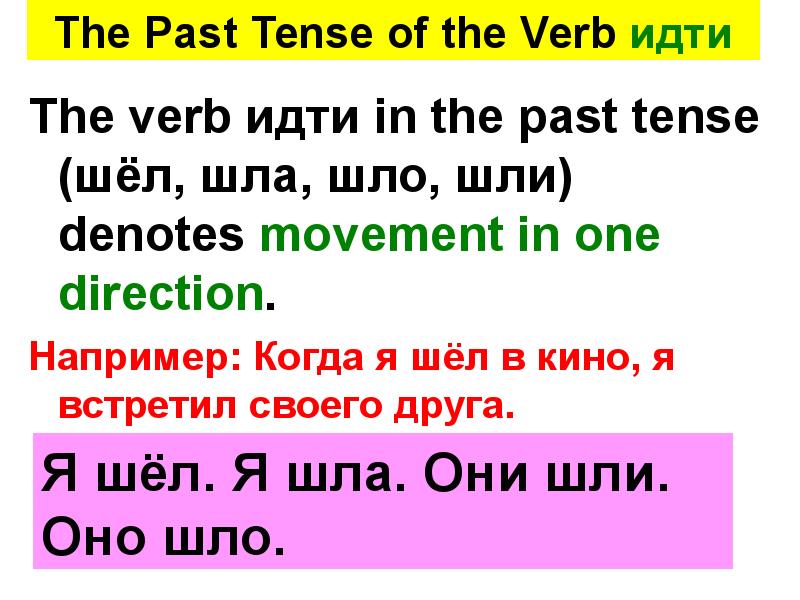
The Past Tense of the Verb
The verb in the past tense
(, , , )
denotes movement in one
direction.
: ,
.
. . .
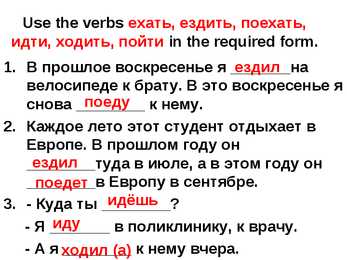
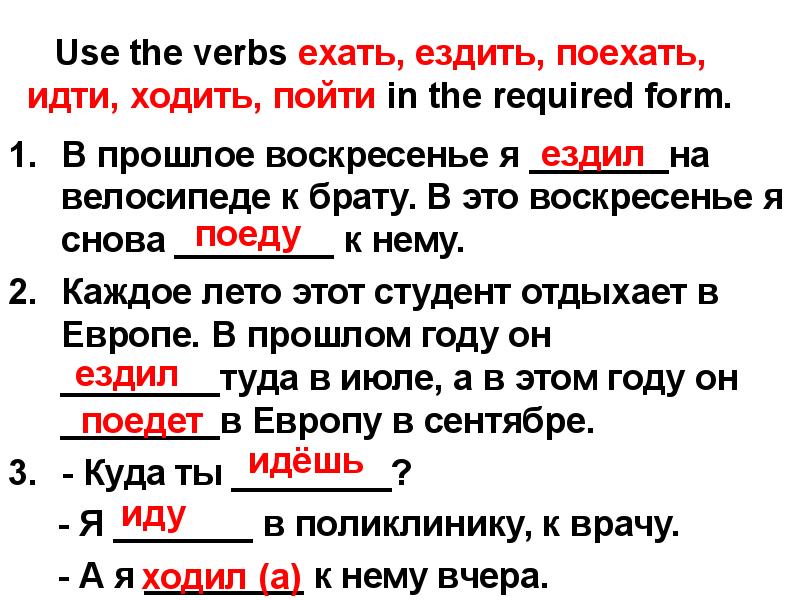
Use the verbs , , ,
, , in the required form.
1. _______
.
.
________
2.
.
________ ,
________
.
3. - ________?
- _______ , .
- ________
() .
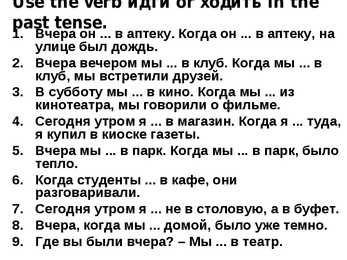
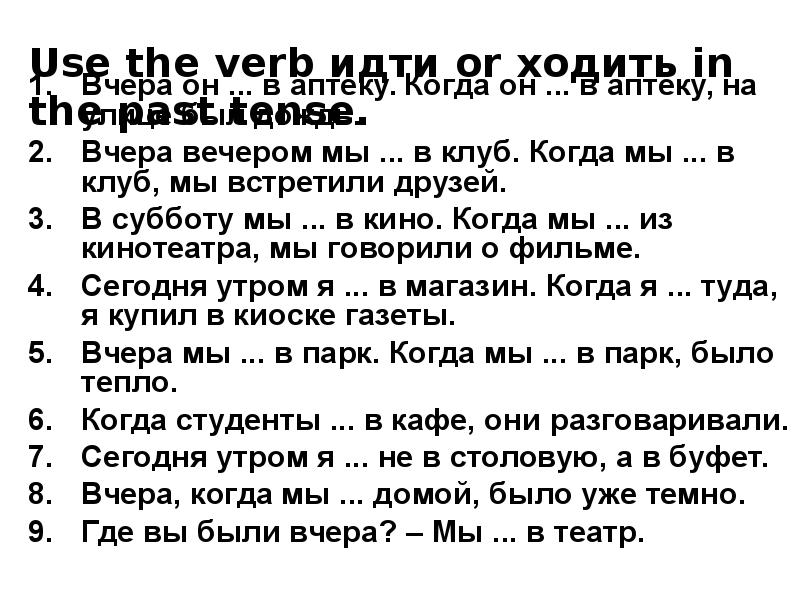
Use the verb or in the
past tense.
1. ... . ... ,
.
2. ... . ...
, .
3. ... . ...
, .
4. ... . ... ,
.
5. ... . ... ,
.
6. ... ,
.
7. ... , .
8. , ... , .
9. ? ­ ... .
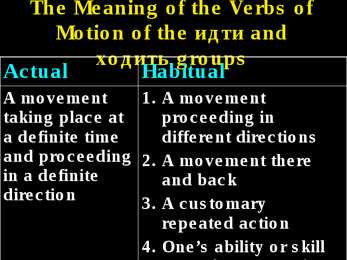
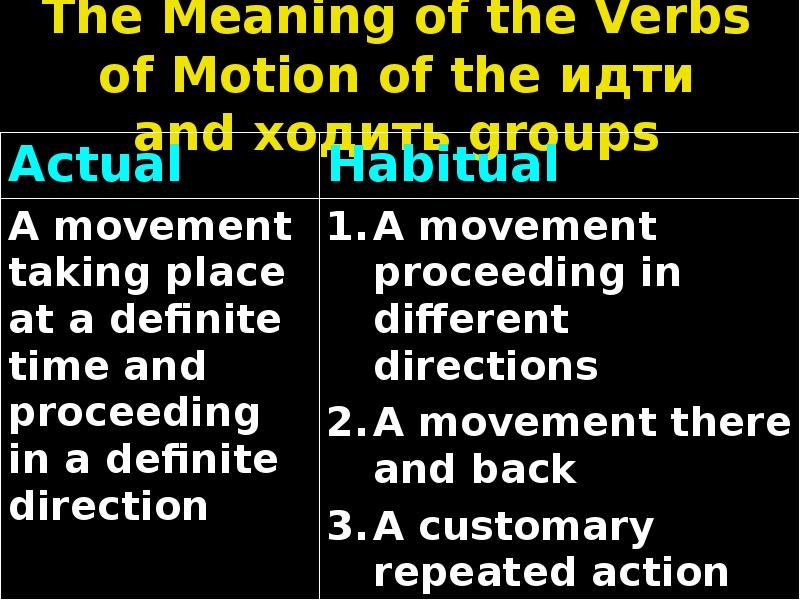
The Me aning o f the Ve rbs o f
Mo tio n o f the and
g ro ups
Ac tual Habitual
A mo ve me nt 1. A mo ve me nt
taking plac e at pro c e e ding in
a de finite time diffe re nt dire c tio ns
and pro c e e ding 2. A mo ve me nt the re
in a de finite and bac k
dire c tio n 3. A c us to mary
re pe ate d ac tio n
4. One 's ability o r s kill
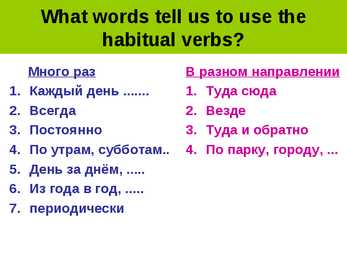
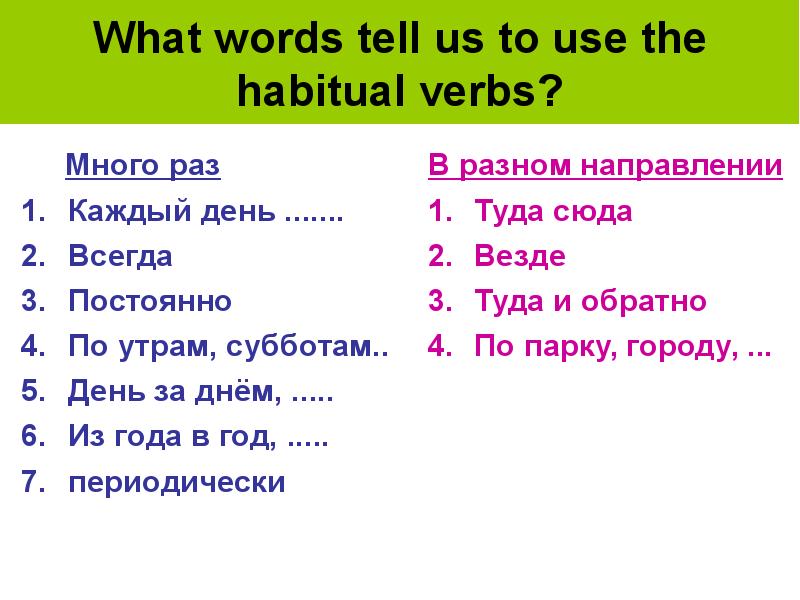
What words tell us to use the
habitual verbs?
1. ....... 1.
2. 2.
3. 3.
4. , .. 4. , , ...
5. , .....
6. , .....
7.
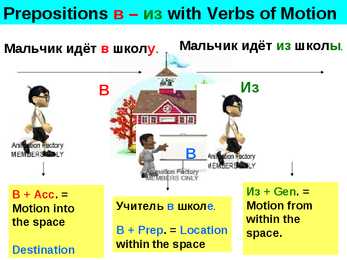
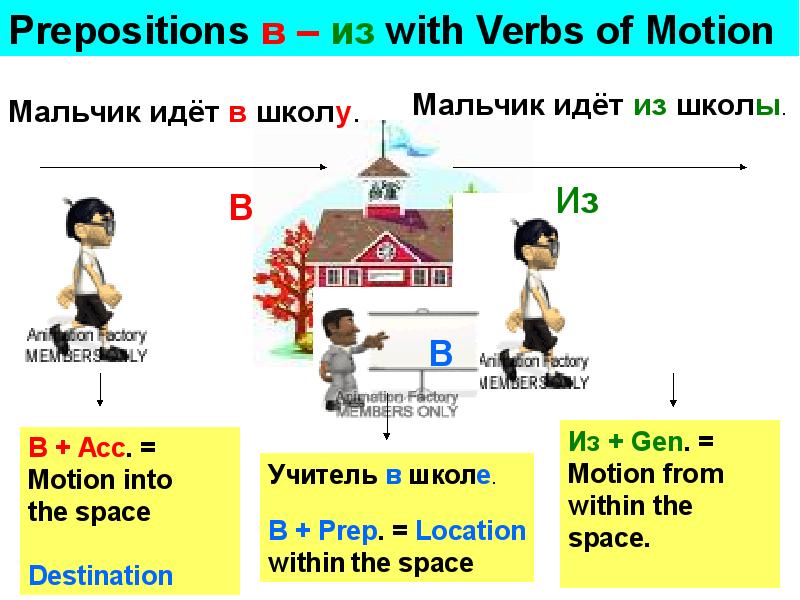
Prepositions ­ with Verbs of Motion
. .
+ Acc. = + Gen. =
Motion into . Motion from
the space within the
+ Prep. = Location space.
within the space
Destination
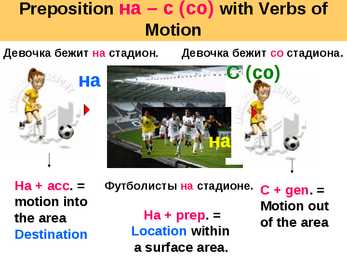
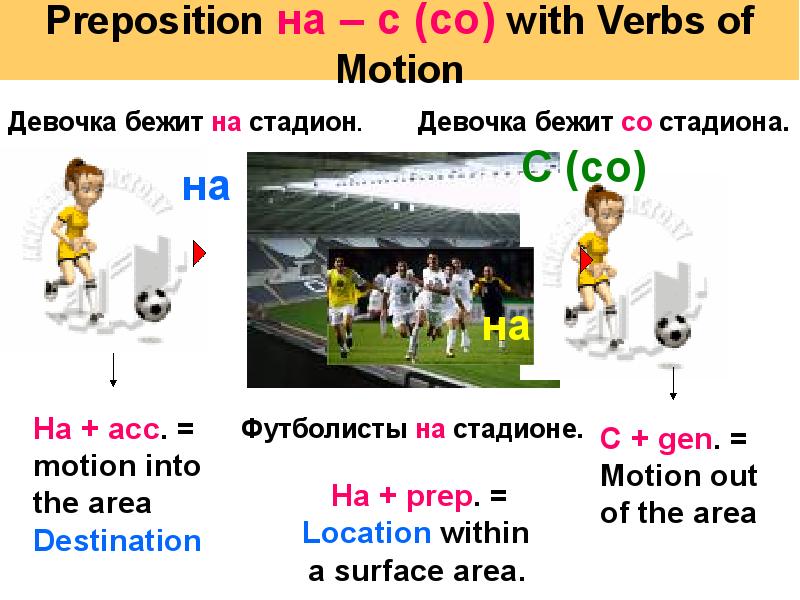
Preposition ­ () with Verbs of
Motion
. .
()
+ acc. = . + gen. =
motion into Motion out
the area + prep. =
of the area
Destination Location within
a surface area.
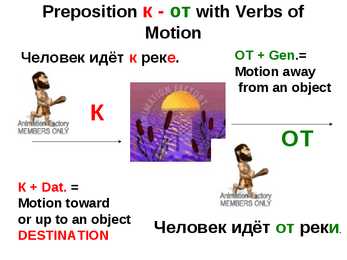
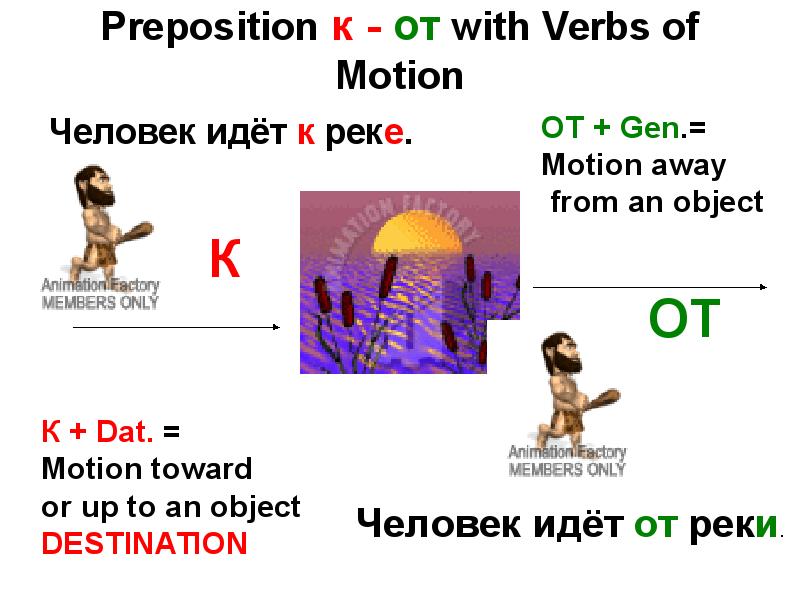
Preposition - with Verbs of
Motion
. + Gen.=
Motion away
from an object
+ Dat. =
Motion toward
or up to an object
DESTINATION
.
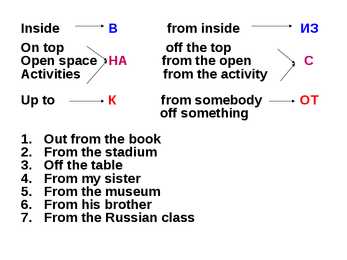
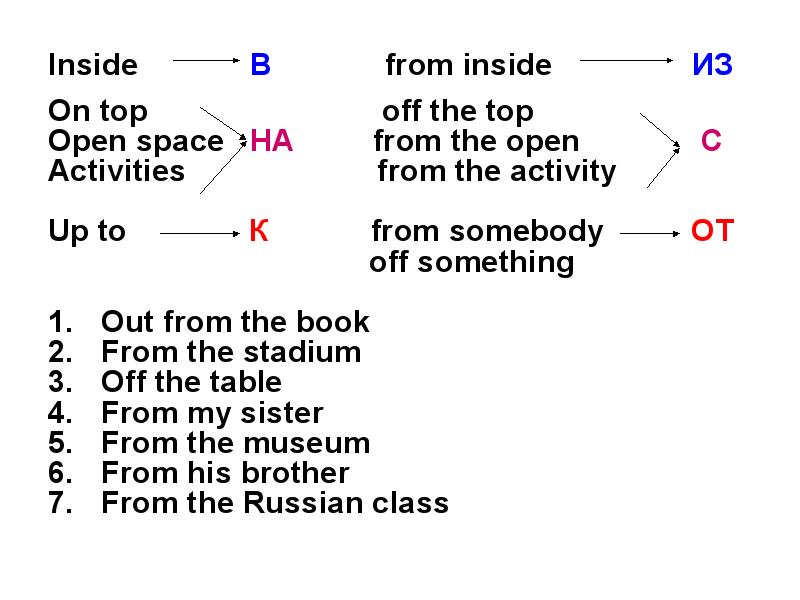
Inside from inside
On top off the top
Open space from the open C
Activities from the activity
Up to from somebody
off something
1. Out from the book
2. From the stadium
3. Off the table
4. From my sister
5. From the museum
6. From his brother
7. From the Russian class
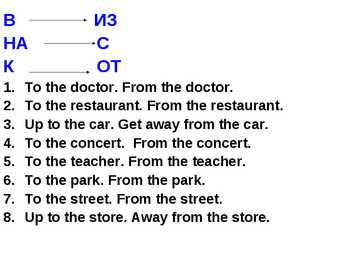
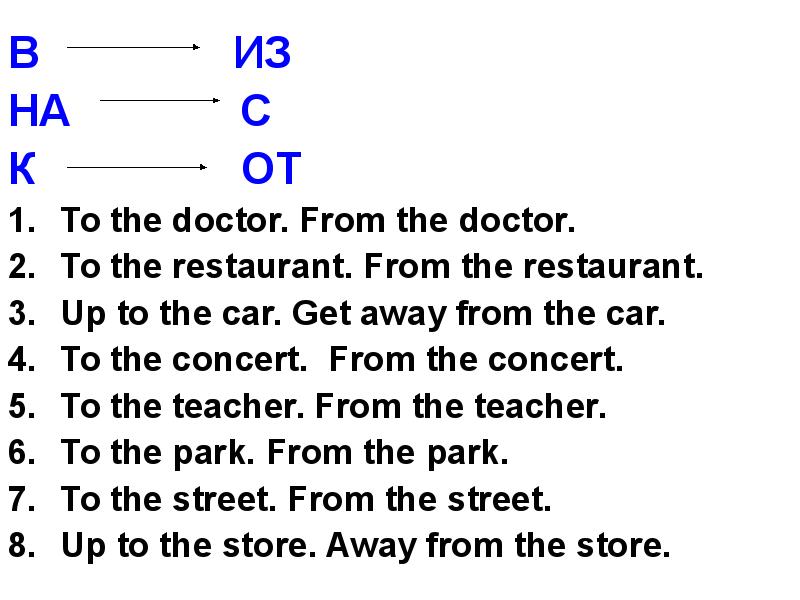
1. To the doctor. From the doctor.
2. To the restaurant. From the restaurant.
3. Up to the car. Get away from the car.
4. To the concert. From the concert.
5. To the teacher. From the teacher.
6. To the park. From the park.
7. To the street. From the street.
8. Up to the store. Away from the store.
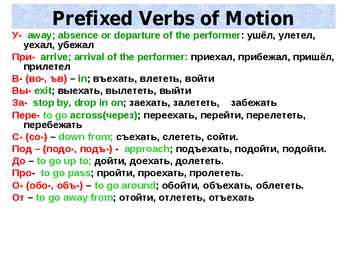
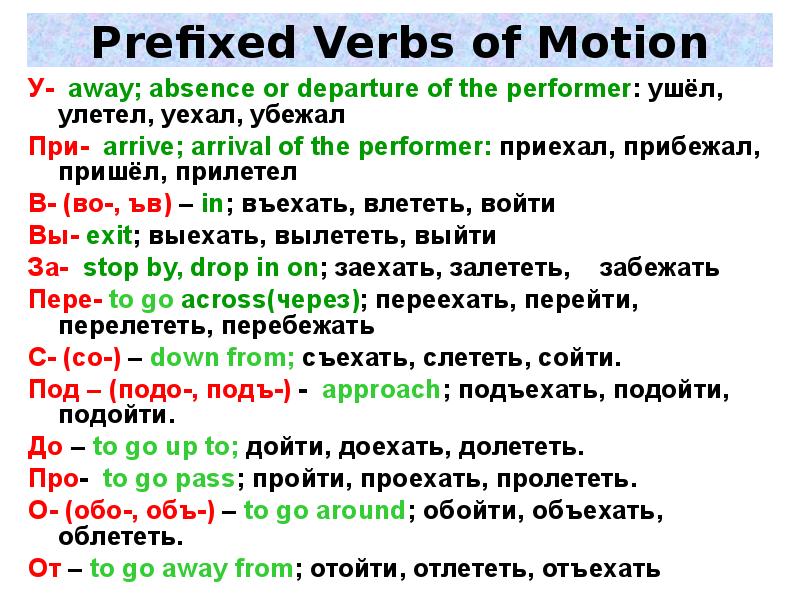
Prefixed Verbs of Motion
- away; absence or departure of the performer: , ,
,
- arrive; arrival of the performer: , , ,
- (-, ) ­ in; , ,
- exit; , ,
- stop by, drop in on; , ,
- to go across(); , , ,
- (-) ­ down from; , , .
­ (-, -) - approach; , , .
­ to go up to; , , .
- to go pass; , , .
- (-, -) ­ to go around; , , .
­ to go away from; , ,
, ,
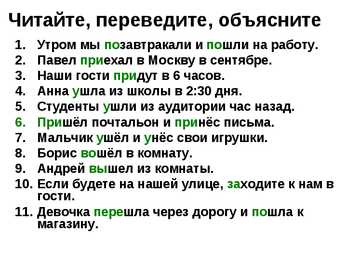
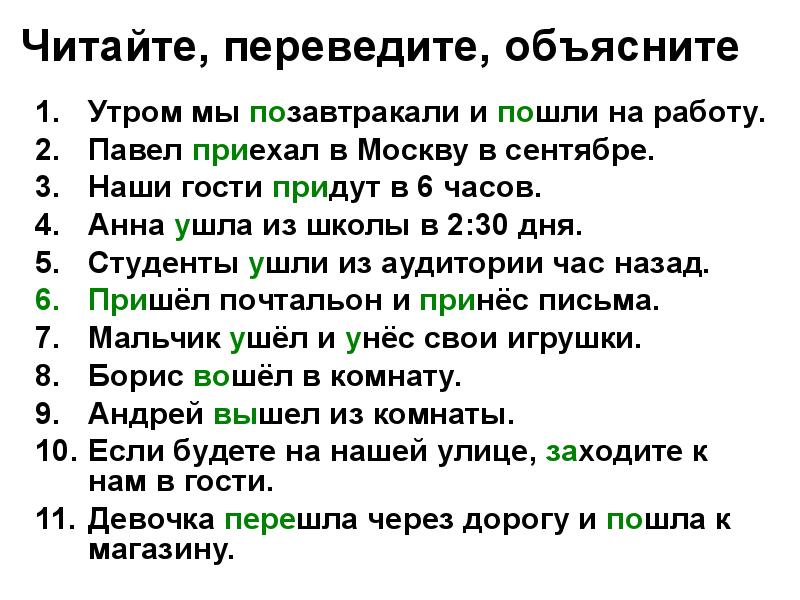
1. .
2. .
3. 6 .
4. 2:30 .
5. .
6. .
7. .
8. .
9. .
10. ,
.
11.
.
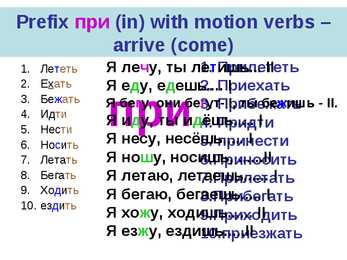
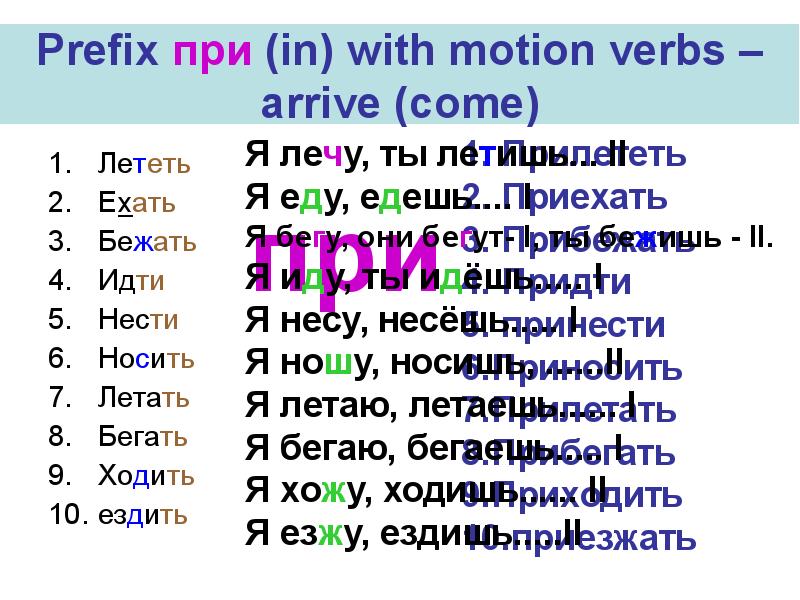
Prefix (in) with motion verbs ­
arrive (come)
1. , ...
1. II
2. , ....
2. I
3.
4.
5.
6.
, -
3.
4.
, .....
5.
I, - II.
, .....
I
I
7. , ,6. ......II
8. , ......
7. I
9. , ..... I
8.
10.
, ......
9. II
, .....II
10.
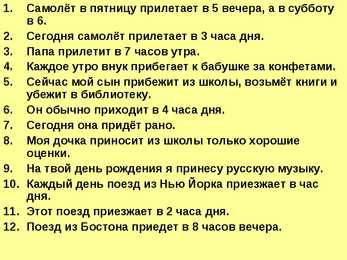
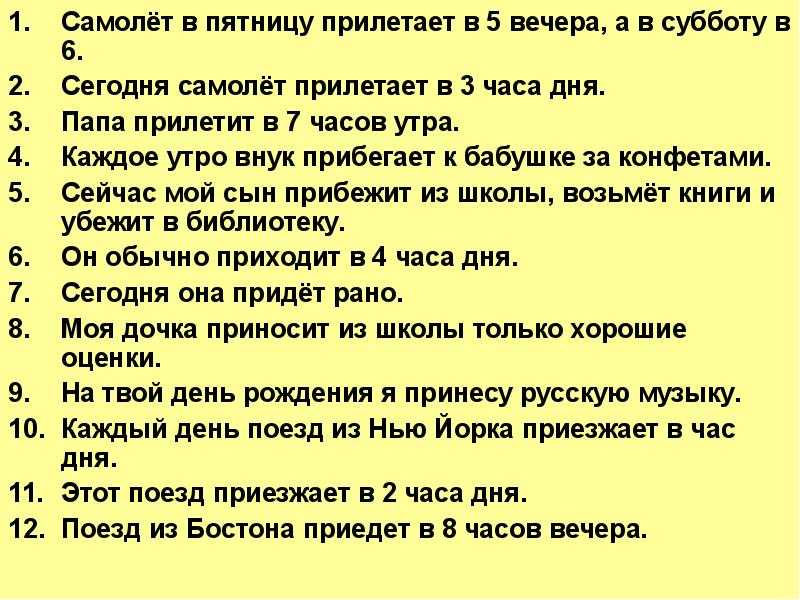
1. C 5 ,
6.
2. 3 .
3. 7 .
4. .
5. ,
.
6. 4 .
7. .
8.
.
9. .
10.
.
11. 2 .
12. 8 .
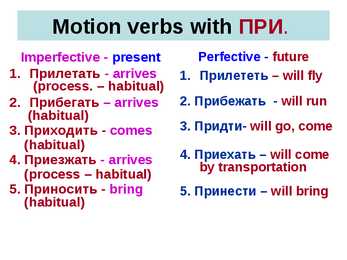
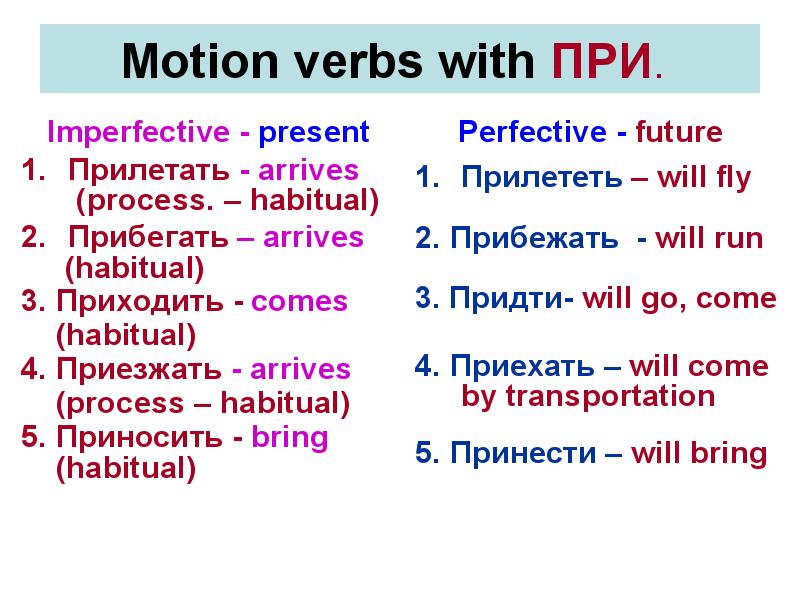
Motion verbs with .
Imperfective - present Perfective - future
1. - arrives 1. ­ will fly
(process. ­ habitual)
2. ­ arrives 2. - will run
(habitual)
3. - comes 3. - will go, come
(habitual)
4. - arrives 4. ­ will come
by transportation
(process ­ habitual)
5. - bring 5. ­ will bring
(habitual)
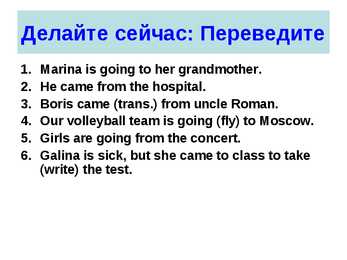
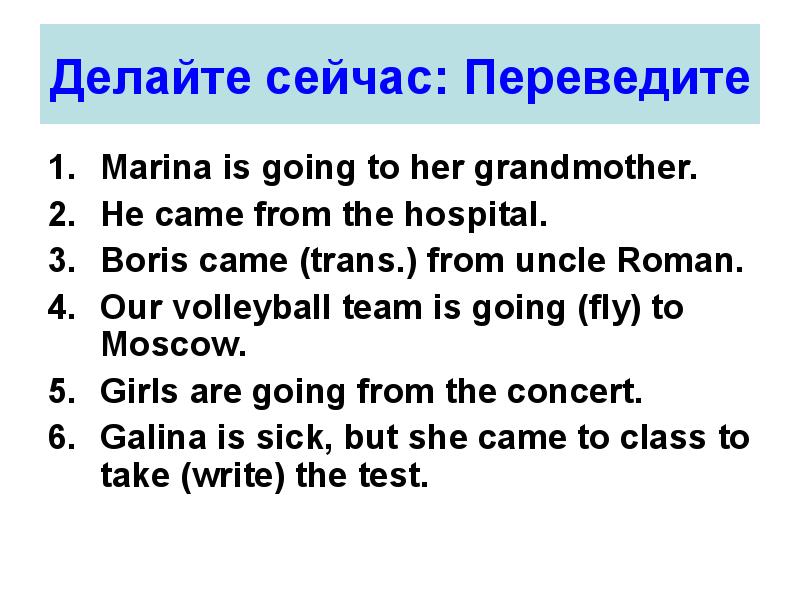
:
1. Marina is going to her grandmother.
2. He came from the hospital.
3. Boris came (trans.) from uncle Roman.
4. Our volleyball team is going (fly) to Moscow.
5. Girls are going from the concert.
6. Galina is sick, but she came to class to take
(write) the test.
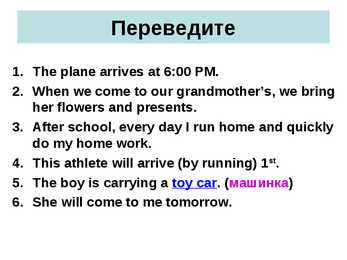
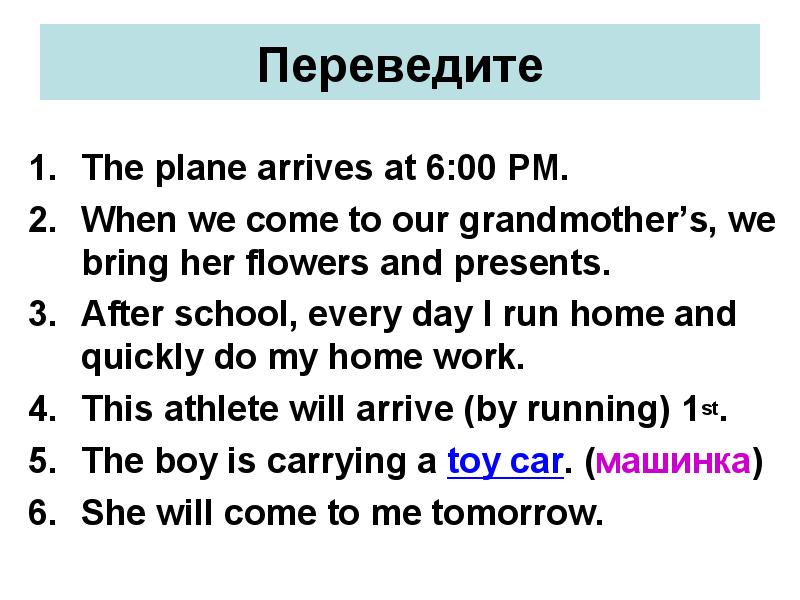
1. The plane arrives at 6:00 PM.
2. When we come to our grandmother's, we bring
her flowers and presents.
3. After school, every day I run home and quickly
do my home work.
4. This athlete will arrive (by running) 1 st.
5. The boy is carrying a toy car. ()
6. She will come to me tomorrow.
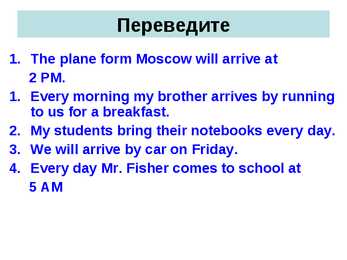
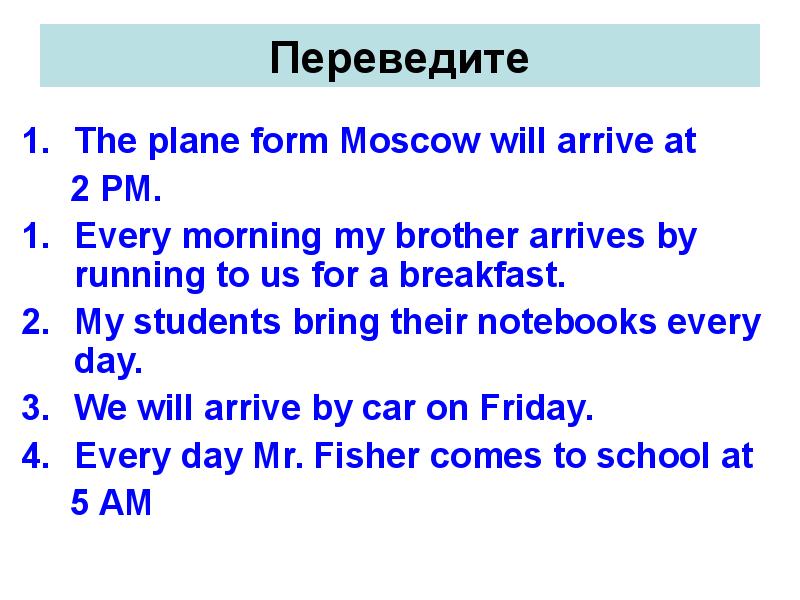
1. The plane form Moscow will arrive at
2 PM.
1. Every morning my brother arrives by running
to us for a breakfast.
2. My students bring their notebooks every day.
3. We will arrive by car on Friday.
4. Every day Mr. Fisher comes to school at
5 AM
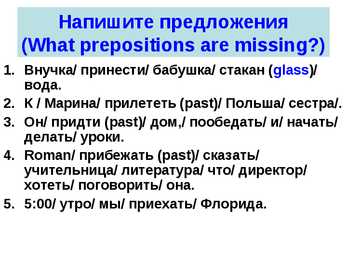
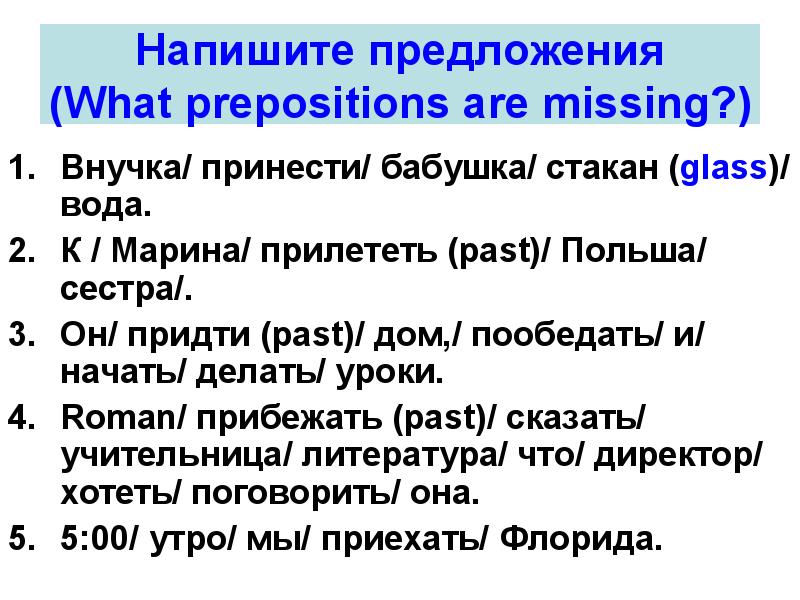
(What prepositions are missing?)
1. / / / (glass)/
.
2. / / (past)/ / /.
3. / (past)/ ,/ / / /
/ .
4. Roman/ (past)/ /
/ / / /
/ / .
5. 5:00/ / / / .
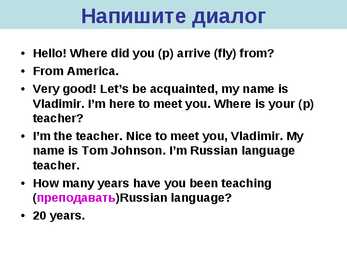
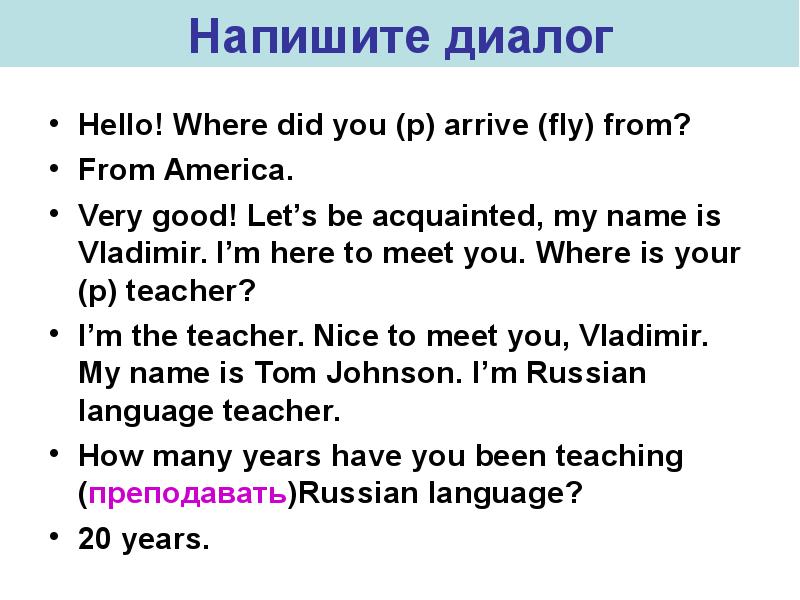
· Hello! Where did you (p) arrive (fly) from?
· From America.
· Very good! Let's be acquainted, my name is
Vladimir. I'm here to meet you. Where is your (p)
teacher?
· I'm the teacher. Nice to meet you, Vladimir. My
name is Tom Johnson. I'm Russian language
teacher.
· How many years have you been teaching
()Russian language?
· 20 years.
· Where did you study Russian?
· I graduated Moscow University. I studied in
Moscow for 4 years.
· You speak Russian very well.
· Thank you.
· You (p) will go to the hotel now. I will come
at 6:00, and we will go to the concert. It
was nice to meet you, Tom.
· The same here. Have a good day, Vladimir.
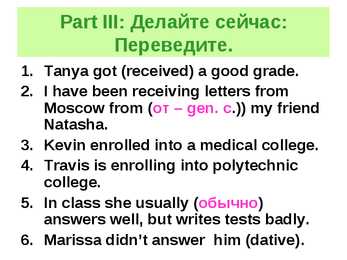
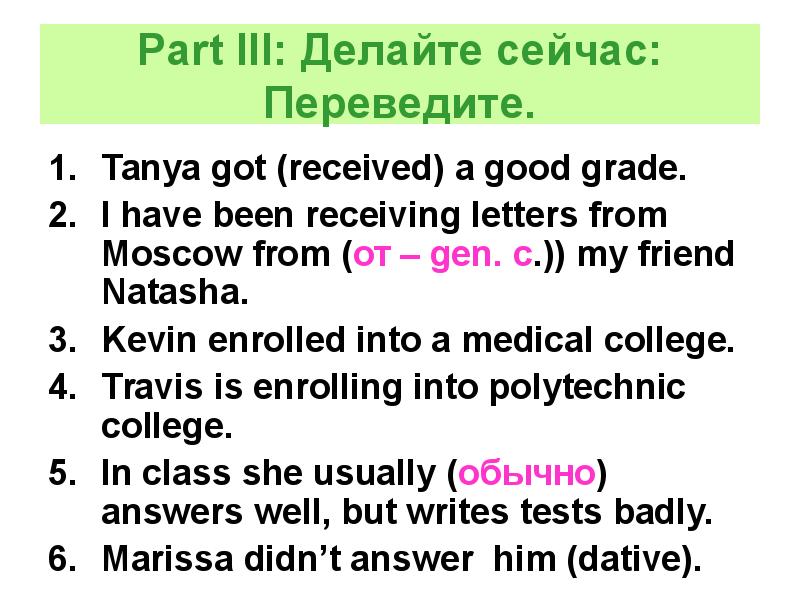
Part III: :
.
1. Tanya got (received) a good grade.
2. I have been receiving letters from
Moscow from ( ­ gen. c.)) my friend
Natasha.
3. Kevin enrolled into a medical college.
4. Travis is enrolling into polytechnic
college.
5. In class she usually ()
answers well, but writes tests badly.
6. Marissa didn't answer him (dative).
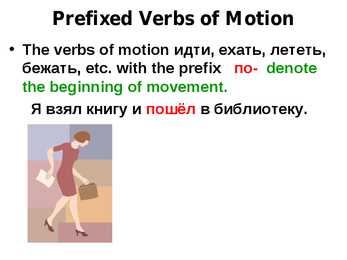
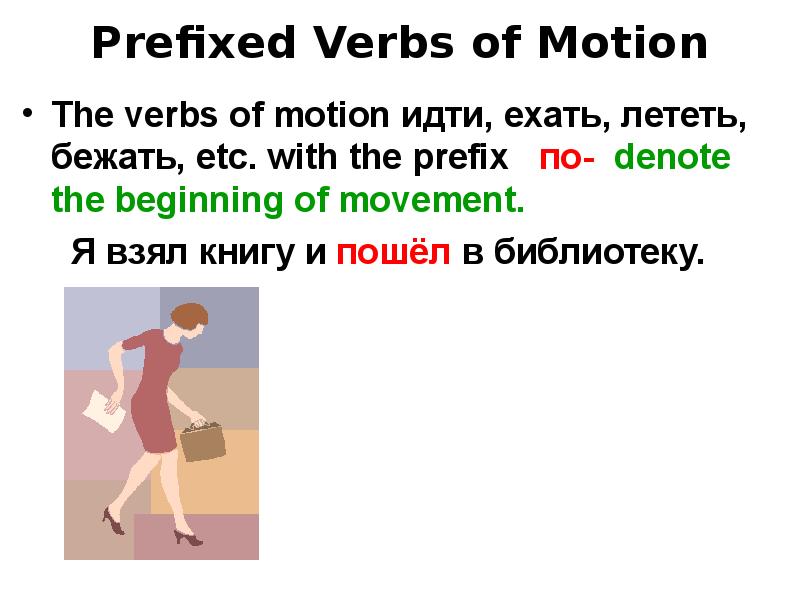
Prefixed Verbs of Motion
· The verbs of motion , , ,
, etc. with the prefix - denote
the beginning of movement.
.
Vasakule Paremale
Liikumisverbid #1 Liikumisverbid #2 Liikumisverbid #3 Liikumisverbid #4 Liikumisverbid #5 Liikumisverbid #6 Liikumisverbid #7 Liikumisverbid #8 Liikumisverbid #9 Liikumisverbid #10 Liikumisverbid #11 Liikumisverbid #12 Liikumisverbid #13 Liikumisverbid #14 Liikumisverbid #15 Liikumisverbid #16 Liikumisverbid #17 Liikumisverbid #18 Liikumisverbid #19 Liikumisverbid #20 Liikumisverbid #21 Liikumisverbid #22 Liikumisverbid #23 Liikumisverbid #24 Liikumisverbid #25 Liikumisverbid #26 Liikumisverbid #27 Liikumisverbid #28
Punktid 10 punkti Autor soovib selle materjali allalaadimise eest saada 10 punkti.
Leheküljed ~ 28 lehte Lehekülgede arv dokumendis
Aeg2010-05-31 Kuupäev, millal dokument üles laeti
Allalaadimisi 63 laadimist Kokku alla laetud
Kommentaarid 3 arvamust Teiste kasutajate poolt lisatud kommentaarid
Autor AbiAndja Õppematerjali autor
Ingliskeelne PowerPointi esitlus, mis õpetab kenasti vene keele sihilisi ja sihituid verbe, minevikku, olevikku, tulevikku, eesliiteid ja eessõnu.

Sarnased õppematerjalid

Ajavormide teooria
18
doc

Ajavormide teooria

Windows are not made of wood. Simple Present · · New York is a small city. It is not important that this fact is untrue. [VERB] + s/es in third person USE 3 Scheduled Events in the Near Examples: Future · You speak English. · Do you speak English? · You do not speak English. USE 1 Repeated Actions Examples: · The train leaves tonight at 6 PM. · The bus does not arrive at 11 AM, it arrives at 11 PM. ·

Inglise keel
English Grammar Book 1
159
pdf

English Grammar Book 1

All rights reserved. No part of this book may be reproduced in any form or by any means, electronic or mechanical, including photocopying, recording, or by any information storage and retrieval system, without the written permission of the publisher. ISBN 1-59905-201-6 Printed in the United States of America 13 12 11 10 09 08 07 9 8 7 6 5 4 3 2 1 Introduction Grammar is a very old field of study. Did you know that the sentence was first divided into subject and verb by Plato, the famed philosopher from ancient Greece? That was about 2,400 years ago! Ever since then, students all over the world have found it worthwhile to study the structure of words and sentences. Why? Because skill in speaking and writing is the hallmark of all educated people. Lesson by lesson, this book provides basic instruction in the eight parts of speech--nouns, pronouns, verbs, adjectives, adverbs, prepositions, conjunctions, and

Inglise keel
Inglise keele struktuur
29
docx

Inglise keele struktuur

Anglo ­ Frisian » English 2. How to classify words into different word classes? (definition ­ is that enough?, morphology, distribution and function tests); Grammatical categories for nominals, verbs, adjectives. "A set of words like dog, child, cat, man, bird where the individual words are mutually substitutable is known as a word class..." Definitions a) A noun is the name of a person, place or thing. b) A verb expresses an action, process or state. c) An adjective is a describing word which modifies a noun. "Although such definitions will identify many members of a word class, linguists generally agree that they need to be supplemented by formal tests. e.g. sincerity Sincerity can be frightening misery Lee is misery itself. Such miseries are uncommon Distribution: - a distribution test Kim is an engine driver

Inglise keel
Superstar 1 tests
41
doc

Superstar 1 tests

Tests Superstar 1 Luke Prodromou Test 1 Name____________________ Class_______ Use your English 1 Complete these sentences using the correct form (present simple or present continuous) of the verb in brackets. _ 1 She is in a band and she _________________________________ (record) a CD at the moment. _ 2 She is an actress and often _________________________________ (appear) on television. _ 3 At the moment she _________________________________ (have) a rest because she is tired. _ 4 Mike is a doctor and he _________________________________ (live) in Manchester. _ 5 I _________________________________ (start) work at 8.30 every morning.

Inglise keel
Inglise keele jaotusmaterjal
37
doc

Inglise keele jaotusmaterjal

number, ning eessõna in, kui öeldakse ainult tänava nimi. They live at 5 Oxford Street. She got a job in Weston Road. Ameerika inglise keeles kasutatakse tänavatest rääkides eessõna on. He lives on Penn Street. What's the address? Do you know the address? Practise asking and saying addresses: Süda 1, 10118 Tallinn Akadeemia tee 311 Kentmanni 25-91 Saue, Harjumaa, 76402 Jõgisoo MODULE 5 Word order A Verb + object I like children very much. Did you see your friends yesterday? Ann often plays tennis. B Place and time Tom walks to work every morning. She has been in Canada since April. We arrived at the airport early. It is often possible to put time at the beginning of the sentence: On Monday I'm going to Paris.

Inglise keel
Inglise keele grammatika reeglid
4
docx

Inglise keele grammatika reeglid

going to go to the party. I told you he was going to come to the party. I already told Mark that when he arrived, we would go out for dinner. Active= I knew John would finish the work by 5:00 PM. Passive= I knew the work would be finished by 5:00 PM. 17. Gerunds See on nimisõna, mis on tuletatud teguseõnast ning lõppu käib -ing. Reading helps you learn English. He enjoys not working. 18. Infinitives See on tegusõna to vorm. Näiteks: sõnast learn tekib to learn 19. Phrasal Verb See on tegusõna + eessõna või määrsõna, mis loob esimesest lausest teise tähenduse, kasutades sama tegusõna. I ran into my teacher at the movies last night. He ran away when he was 15. 20. Negative question Negatiivsed küsimused sisaldavad enamasti emotsioone ning kõlavad teatud situatsioonides ebaviisakalt. Didn't she like the film? ­ Yes, she did. Aren't they reading now? ­ Yes, they are. Isn't he a student? Can't you read? Isn't she a beauty? 21. General question

Inglise keel
Prepositions
6
rtf

Prepositions

at once on this occasion in his youth at last on time in these days at his moment in the end at the same time in the middle of the month at that time in two day`s time at first sight at present Phrasal verbs: A phrasal verb is a phrase made up of two or three words: a verb combined with an adverb or a preposition, or a verb combined with an adverb and a preposition. Phrasal verbs are very common in English, and their meaning may be quite different from the meaning of the ordinary verb, eg you may know the individual meanings of the words make and off, but you may not be able to guess that to make off means "to leave or escape" . Some phrasal verbs have the adverb or preposition following

Inglise keel
I Love English 6 Workbook e-õpik lk-1-27
18
doc

I Love English 6 Workbook e-õpik lk. 1-27

ühtki selle töövihiku osa paljundada ei elektroonilisel, mehaanilisel ega muul viisil. Töövihik on kooskõlas 2009. a uuendatud õppekomplektiga I Love English 6. Tartu, 2014 ISBN 978-9949-436-59-0 Kirjastus Studium Riia 15b, Tartu 51010 www.studium.ee Trükitud OÜ Greif trükikojas Lohkva, Luunja vald Tartumaa 62207 --- 3 xxx 1. The Big Apple 1. Write the verbs in the present continuous or the past continuous tense. Do you remember? am is are was were verb -ing 1 Sorry. I ... (write) a report at the moment. I can't come with you. 2 When Peter arrived, his friends ... (play) football. 3 I ... (sleep) when the alarm went off in my sister's room. 4 Dad's mobile phone is switched off because he ... (fly) to Paris. He's on the plane at the moment. 5 I ... (read) an interesting book. It's a collection of memories. 6 Leo was late again. He ... (step) out of his father's car when the bell rang. 7 Helen ..

Inglise keel


Meedia

Kommentaarid (3)

kadryy profiilipilt
kadryy: Super, venekeelsed eessõnad jäävad väga hästi piltide kujul meelde!
11:42 07-10-2011
lotu13 profiilipilt
lotu13: head tabelid, annavad põhjaliku ülevaate.
21:03 15-11-2011
riffmank profiilipilt
riffmank: aitäh, aitas!
18:42 26-01-2012


Sellel veebilehel kasutatakse küpsiseid. Kasutamist jätkates nõustute küpsiste ja veebilehe üldtingimustega Nõustun