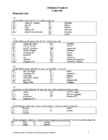
Aim Determination of total and carbonate hardness of tap water using titration technique. Eliminating total hardness with a Na+ ion-exchange softener. Reagents 0.1 M hydrochloric acid, 0,025 M and 0,005M trilon-B solution, buffer solution (NH4Cl + NH3∙H2O), indicators methyl red (mr) or methyl orange (mo) and chromogen black ET-00. Apparatus Conical flasks (250 ml, 500 ml), measuring cylinder (25 cm 3), burette (25 cm3), pipettes (100 cm3). Experimental Procedure A Determination of carbonate hardness 1. Rinse the 100 cm3 pipette 2...3 times with a small amount of the test water. Wash the conical flask with distilled water
Aim To familiarize oneself with some more common instances of corrosion. Reagents Hydrochloric acid 0.1 M; sulphuric acid 0.1 M; zinc and aluminium granules; copper wire; solution of copper(II) sulphate; solution of copper(II) chloride; solution of iron(II) sulphate; solution of potassium hexacyanoferrate(III); zinc-plated iron sheet; tin-plated iron sheet; iron paper clips; solid NaCl; urotropin. Equipment Test tubes, small beaker (50 cm3), centrifuge tube. Experiments 1. Making of a galvanic pair 1.1. Place a zinc granule on the bottom of the centrifuge tube and pour solution of
Aim of the work The determination of the concentrations of acid and base solutions through titration. Used compounds HCl solution with an unknown concentration. NaOH solution with a known accurate concentration, indicators phenolphthalein (ff/pp) and methyl red (mp/mr). Equipment Conical flasks (250 cm3), 2 burettes (25 cm3), pipette (10 cm3). Procedure A. Determining the concentration of a hydrochloric acid solution through titration 1. To determine the concentration of the acid solution take the NaOH solution with a known concentration (the standard solution) and pour it into the burette (α in figure 2.2). See that there are no air bubbles near the tip. Fill the burette until the 0-point of the scale. When measuring the level of the solution keep your eyes at the same level with the liquid level. The lower edge of the liquid level has to be at the 0
Aim Determining the identity of an unknown metal. Measurement of gas volume, calculations with gases based on reaction equations. Substances 10% solution of hydrochloric acid, 5,0...10,0 mg piece of a metal. Equipment Apparatus for measuring the volume of gas, measuring cylinder (25 cm 3), funnel, filter paper, thermometer, barometer and hygrometer. Experimental procedure 1. The experimental apparatus (Figure 1) consists of two burettes connected with a rubber hose (a), which is filled with water. One burette is connected to a test tube (b), in which the metal reacts with the acid. 2. Preparation for the experiment
H2SO4 sulfuric HNO3 nitric H2SO3 sulfurous HNO2 nitrous H2CO3 carbonic HC2H3O2 acetic H3PO4 phosphoric H3BO3 boric H3PO3 phosphorous H2C2O4 oxalic HClO4 perchloric HCl hydrochloric HClO3 chloric HBr hydrobromic HClO2 chlorous HF hydrofluoric HClO hypochlorous HI hydroiodic HCN hydrocyanic H2SO4, HClO4, HClO3, HNO3, HCl, HBr, HI can be considered to be strong acids, ionizing completely in most cases; the rest are weak acids.
4. Behavior in the wild Not found in nature. If appears, starts oxidation. In reactions localized at nitrogen or more commonly results in the formation of new C-N bonds. In alkaline solution, azobenzene results, whereas arsenic acid produces the violet-coloring matter violaniline. Chromic acid converts it into quinone, whereas chlorates, in the presence of certain metallic salts (especially of vanadium), give aniline black. Hydrochloric acid and potassium chlorate give chloranil. Potassium permanganate in neutral solution oxidizes it to nitrobenzene, in alkaline solution to azobenzene, ammonia and oxalic acid, in acid solution to aniline black. Hypochlorous acid gives 4-aminophenol and para-amino diphenylamine. Oxidation with persulfate affords a variety of polyanilines compounds. These polymers exhibit rich redox and acid-base properties. 5. Toxicity data on chemical a) General toxicity
Gradable/non-gradable: Most adjectives are gradable. Gradability is manifested through comparison: tall ~taller ~tallest beautiful ~more beautiful ~most beautiful It is also manifested though modification of intensifiers: very tall so beautiful extremely useful All dynamic and most stative adjectives are gradable; some stative adjectives are not, principally denominal adjectives like atomic scientist and hydrochloric acid, and adjectives denoting provenance, eg: British. Inherent/noninherent: Most adjectives are inherent. For example the inherent adjective in a wooden cross applies to the referent of the object directly: a wooden cross is also a wooden object. On the other hand in a wooden actor the adjective is noninherent: a wooden actor is not (presumably) a wooden man. INHERENT NONINHERENT a firm handshake a firm friend a perfect alibi a perfect stranger
 annaabi.ee