 50 punkti
Autor soovib selle materjali allalaadimise eest saada 50 punkti.
50 punkti
Autor soovib selle materjali allalaadimise eest saada 50 punkti.
 ~ 1 leht
Lehekülgede arv dokumendis
~ 1 leht
Lehekülgede arv dokumendis
 2011-01-19
Kuupäev, millal dokument üles laeti
2011-01-19
Kuupäev, millal dokument üles laeti
 10 laadimist
Kokku alla laetud
10 laadimist
Kokku alla laetud
 0 arvamust
Teiste kasutajate poolt lisatud kommentaarid
0 arvamust
Teiste kasutajate poolt lisatud kommentaarid
 K2tlinp
Õppematerjali autor
K2tlinp
Õppematerjali autor
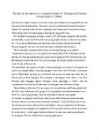
The aim of this report is to compare hobbies of Estonian and Russian young people in Tallinn. The aim of this report is to give an overview of the current situation involving the Russian and Estonian youth attending hobbies. The report is based on the Estonian Human Development Report. This report describes the ratios regarding to the Estonian and Russian youth living in Tallinn doing sports, learning languages, dancing and singing folk music. The first hobby I am going to compare is sport. 21.0% of Estonian youngsters said that their favorite hobby is sport and 31.5% of Russian young people said that it is their favorite hobby too. So we can say that Russians are more active than Estonians. We can also say that Russian youngsters take more care about their bodies and health than Estonians. The second hobby I questioned them about was dancing
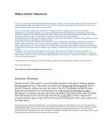
Holidays, Festivals, Cultural events TALLINN - If you're looking for entertainment in Estonia this summer, you are really spoiled for choice. Festivals and events dedicated to the consumption of beer are a lot of fun, but if you want to get the true feel of the country, you need something a little more ethnic. Like a town fair. Just as July becomes August, the seaside town of Haapsalu will host a grand spectacle of rural Estonian entertainment. The White Lady Days is a summer celebration filled with amusement for all the family. Held in and around the remains of the Teutonic-knights-era castles, the fair combines enchanting medieval legends with modern countryside charm to create a comprehensive experience of Estonia beyond the big cities. But the legend of the White Lady of Haapsalu, which is at the heart of the festival, is perhaps the most famous tall tale of the many that are so abundant in Estonia's folklore.
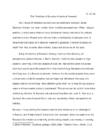
01.12.14 The Priorities of Estonian Historical Research As a result of multiple nations having ruled over Estonian lands, Estonian history has been written from multiple perspectives. Often, religion, politics, and personal motives have fashioned history into what its authors wanted it to be. People have written from a multiplicity of perspectives. It should be one Estonian historical research's greatest priorities to distance itself from this, to seek after holistic, balanced accounts of the past. Early chronicles of Estonian history illustrate this diversity of perspective. Johann Renner, a Baltic German, held his own people in high esteem, deeming them the people of God. He implied this when he wrote that God would save His people from the hand of Gog. He seems to indicate that Gog was the Muscovite people. Perhaps the Muscovite people truly were
There are over 1,400 lakes in Estonia, biggest being Lake Peipsi and Lake Võrtsjärv, while the deepest is Rõuge Suurjärv. The two longest rivers are the Võhandu and the Pärnu and the widest is Emajõgi. About 50% of the country is covered by forests while wetlands cover 30%. The landscape of Estonia, through covering a small area, is varied and unique. Lake Peipsi is Estonia's largest lake and Europe's fourth largest freshwater lake. 5. Symbols The flag The Estonian blue-black and white national flag was originally the flag of the Estonian Students' Society and was consecrated in Otepää Church in 1884. Today there is a memorial plaque on the church wall commemorating the event. The Flag Museum, opened in an annex in 1996, attracts tourists who take an interest in the history of the flag. After about half a century, during which it was prohibited by the Soviet authorities, the flag was seen again in public for the first time in Tartu in May 1988
There are hundreds of different countries and nationalities in the world and each one is peculiar in its own way. For example, Italians are very impulsive. French people don't like the British. Germans are pedantic. Russians are generous, but lazy. What about Estonians? In Estonia when a stranger on a street smiles at you, you can assume that: he is either drunk, insane, from another country or all of the above. Estonians don't smile too often. Estonians are not very talkative either. In Estonian schools teachers have stopped asking their students "Are there any questions?" It is especially hard to keep a conversation flowing with an Estonian when you don't know each other very well. I tried to make a conversation with an Estonian classmate of mine once (whom I didn't know very well) and it sounded like that: Me: So... what did you do during your holidays? Classmate: Went skiing. Me: Cool! Did you go there with your family?
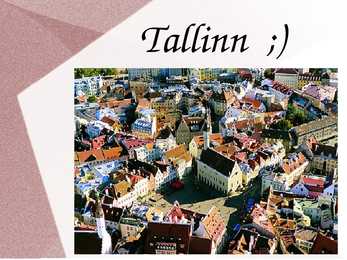
Tallinn ;) The fundaments of Tallinn were laid some 4,500 years ago, but the city really came to life in the Middle Ages, during which it was occupied by Danes, Swedes, Germans, Russians. After being part of the Russian Empire and the Soviet Union, it became the capital of an independent Estonia in 1991. The old town now is a wellpreserved testimony of Tallinn's past, a small island in a sea of the modern city. A large part of what gives Old Town its
........................................................................... 18 References............................................................................................................................ 19 2|Page 17101850 The century and a half following the Great Northern War, which ended with the Peace of Uusikaupunki, was a relatively static period in Estonian history with few momentous events. This was the time of the crystallization and the culmination of serfdom, when various socio- political and cultural undercurrents were also active, preparing the ground for the industrial society and the national-democratic movement in the second half of the 19th century. The 1710 of the corporations of knights and towns, until Alexander II (18551881), established the relationships between Estonia, Livonia and the Russian Empire. The Baltic
There are no bobsleigh tracks in Australia and the nearest one is in Japan, although Australia competes in slide events overseas, and there is a bobsleigh push track in Melbourne. 8. Sports in Estonia There have been many different thoughts about the beginning of sports in Estonia. There is no exact answer to that problem. It all depends on the point of view. You can go into ancient times looking for the beginnings of sports like wrestling. One possible beginning of Estonian sports could be games called "killamängud". The first Estonian mentioned in the Guinness Book of Records was a sportsman. In the Olympic Games of 1912 in Stockholm, the Finn Alfred Asikainen and the Estonian Martin Klein wrestled for a record 11 hours and 40 minutes. Klein won, and "Russia" was given as his country of residence. The first chance to rectify this mistake came in 1918 when the Republic of Estonia came into being for the first time
 annaabi.ee




Kõik kommentaarid