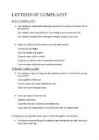
./I am writing to you in connection with.. I am writing to complain about a damaged videotape I bought at your shop. · I hope you will deal with this matter/resolve this matter quickly. I assume you will replace.. I trust the situation will improve I hope the matter will be resolved I hope we can sort this matter out amicably (heatahtlikult) I trust this matter will receive your immediate attention. STRONG COMPLAINT: · I am writing to express my disgust at (the appalling treatment I received while staying at your hotel) I was appalled at (kohkunud) I want to express my strong dissatisfaction with I feel I must protest/complain about · I insist you replace the item at once I demand a full refund I hope that I will not be forced to take further action I insist upon full compensation or I will be forced to take this matter further. Complaints and justification can be linked together as follows:
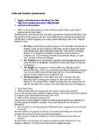
· He generally sang at least one song on each studio album as part of an attempt to establish the vocal personality of all four members. · In some cases, Lennon or McCartney wrote the lyrics and melody especially for him, as they did for "Yellow Submarine" . The Beatles · Starr did eventually begin composing, and is credited with "Don't Pass Me By" and "Octopus's Garden" as sole songwriter. · His disgust with the band's tensions and boredom at waiting around to contribute during the sessions for the White Album caused him to quit the group temporarily. · He did not return for two weeks, even though the other Beatles urged him to come back: Lennon sent telegrams, and Harrison set up flowers all over the studio for Starr's return saying "Welcome home". After The Beatles · After the announcement of the breakup of The
Hamlet WILLIAM SHAKESPEARE Character List Hamlet - The Prince of Denmark, the title character, and the protagonist. About thirty years old at the start of the play, Hamlet is the son of Queen Gertrude and the late King Hamlet, and the nephew of the present king, Claudius. Hamlet is melancholy, bitter, and cynical, full of hatred for his uncle's scheming and disgust for his mother's sexuality. A reflective and thoughtful young man who has studied at the University of Wittenberg, Hamlet is often indecisive and hesitant, but at other times prone to rash and impulsive acts. Hamlet (In-Depth Analysis) Claudius - The King of Denmark, Hamlet's uncle, and the play's antagonist. The villain of the play, Claudius is a calculating, ambitious politician, driven by his sexual appetites and his lust for power, but he occasionally shows
Darcy, who had raised two boys equally as his sons. Two childhood friends parted immediately after old Mr.Darcy's death in arguings over money, power and honour (which one Wicham- had less in tons). · Mr. Darcy seemed to be an utterly arrogant, cold- and careless-natured man to strangers. Once you got to know his true nature, you got to know one honest, loyal and fair man, who expressed his disgust for "false pearls" by keeping distance. Even though he so tended to escape from those worthy of his sympathy, too. Still, everything wonderful fascinated him deeply, as a pure soul he didn't lie about his feelings. · Mr. Wickham hid an irresponsible, ungrateful and advantage-taking persona under the mask of a gentleman. A pretty face with a rotten heart, but nothing extraordinary... · Mr
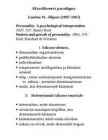
· motivatsiooni kirjeldavad isiksuse jooned (dynamic traits) kaks liiki: ergid (erg) ja metaergid (metaerg) 1) ergid = vajadused, instinktid = pärilikud uudishimu erg (curiosity), seksuaalerg (sex ), sotsiaalsuse erg (gregariousness), kaitsmise ehk hoolitsuse erg (protection) , domineerimise erg (self-assertion), kaitstuse ehk turvalisuse erg (security), nälja erg (hunger), viha ehk agressiivsuse erg (anger), mittemeeldimise ehk vastikuse erg(disgust), meeldivuse erg (appeal), allumise (self- submission) ergid põhjustavad: a) selektiivset taju b) emotsionaalset reaktsiooni objektile või ideele c) eesmärgi saavutamise või teostamise d) sihipärase või eesmärgile suunatud käitumist 2) metaergid = keskkonna (kultuuri) poolt vormitavad ehk omandatavad kaks tüüpi: arvamused ehk hinnangud (sentiments) - tähelepanu, emotsioonide ja reaktsioonide seostamine kindlate objektide või objetide klassiga näit
· motivatsiooni kirjeldavad isiksuse jooned (dynamic traits) kaks liiki: ergid (erg) ja metaergid (metaerg) 1) ergid = vajadused, instinktid = pärilikud uudishimu erg (curiosity), seksuaalerg (sex ), sotsiaalsuse erg (gregariousness), kaitsmise ehk hoolitsuse erg (protection) , domineerimise erg (self-assertion), kaitstuse ehk turvalisuse erg (security), nälja erg (hunger), viha ehk agressiivsuse erg (anger), mittemeeldimise ehk vastikuse erg(disgust), meeldivuse erg (appeal), allumise (self- submission) ergid põhjustavad: a) selektiivset taju b) emotsionaalset reaktsiooni objektile või ideele c) eesmärgi saavutamise või teostamise d) sihipärase või eesmärgile suunatud käitumist 2) metaergid = keskkonna (kultuuri) poolt vormitavad ehk omandatavad kaks tüüpi: arvamused ehk hinnangud (sentiments) - tähelepanu, emotsioonide ja reaktsioonide seostamine kindlate objektide või objetide klassiga näit
make it or break it. Colossal Angeles needs no introduction. casinos, like the Bellagio and But its notoriety both help and hurt its reputation. The traffic on the Caesar's Palace, beckon to "101" will tire you out just as much travelers with neon light, as an evening at a lively West fascinating shows and, of Hollywood club. And your disgust course, sprawling casino at the thick smog over the city will floors. But these mega-resorts negate your enjoyment of a offer guests more than just slot sunset overlookingSanta Monica machines and drink. Spas, Beach. To appreciate Los pools, luxury hotel rooms, elite Angeles, visit the area more than clubs and exotic restaurants once and get advice from locals. are now part of the allure. Austin and Beijing
The environment presents challenges to each individual and those who adapt best will have a greater chance of surviving and passing on their genes. This is the principle of Charles Darwin's theory of evolution. Evolutionary psychology is grounded on the principle that as genes mutate, those that are advantageous are passed down through natural selection. One example of evolutionary research is the study of emotions. Fessler has carried out research on disgust. He argues that the emotion of disgust allowed our ancestors to survive long enough to produce offspring, who in turn passed the same sensitivities to us. He investigated nausea experienced by women in their first trimester of pregnancy. During this period, certain hormones lower the level of the mother's immune system, so the body will not fight the new foreign genetic material in her womb. Fessler hypnotized that the nausea response helps to compensate the suppressed immune system
his work. Kipling lived outside Capetown from 1900-08, and during that period again produced a great deal of work, much of it far more `Imperialist ` than anything he had written before. During this time the public's love affair with Kipling ended, a trend that was hastened by the increasing harshness of his views. He became a much caricatured figure in the press, whilst the public became tired of constant exhortations. Kipling left South Africa in disgust when the Liberals came to power in Britain, and, as he saw it, destroyed all that had been gained in the Boer war. Until the end of his life, Kipling's world view would be distorted by the paranoid belief that conspiracy and betrayal were everywhere in public life. World War One proved a bracing diversion for the embittered Kipling, who had long predicted that Germany's rivalry with Britain would result in conflict, and who positively revelled in patriotic occasions
rather than self-cultivated ones going on display at the Show. Until 1987 it was daunting, because there was no limit on visitor numbers. Its known that, in 1987, there were 247,000 visitors. There may have been even more before that but we do not have accurate numbers. In 1988, they limited first time the number of visitors. Also, for the first time, they charged RHS Members for their Chelsea tickets. There were protest and 10,000 Members resigned in disgust, yet 20,000 joined the Society, happy to pay when they made the visit to Chelsea and content that Members from further afield were no longer subsidizing the free tickets of those who lived in London. These were hugely controversial decisions but they probably saved the show. Certainly it became a safer and more enjoyable experience. Nonetheless the RHS wanted to give its Members special privileges and so, since 1988, only Members are allowed into the Show on Tuesday and Wednesday, with
his pants. Paul explains that many soldiers experience this problem at first. He instructs the boy to remove his underpants and throw them away. The men hear the wrenching sounds of wounded horses shrieking in agony. Detering is particularly horrified because he is a farmer and loves horses. After the wounded men are gathered, those in charge of shooting the wounded animals do their job. Detering declares with disgust that using horses in war is the "vilest baseness." As the trucks drive the men back, Kat becomes restless. A flurry of bombs then lands around them. The men take cover in a nearby graveyard. Paul crawls under an uncovered coffin for protection. Kat shakes him from behind to tell him to put his gas mask on. After he dons his mask, Paul helps a new recruit put his on. He then dives into a hole created by an exploding shell, reasoning that shells seldom hit the same place twice
· Mild or strong language can be used depending on the feelings of the writer or the seriousness of the complaint, but abusive language must never be used. e.g. Mild Complaint: I am writing to complain about a damaged videotape I bought at your shop. I hope you will deal with this matter/ resolve this matter quickly. Strong Complaint: I am writing to express my disgust at the appalling treatment 1 received while staying at your hotel. I insist upon full compensation or I will be forced to take this matter further. · Start a new paragraph for each different aspect of the topic. · You should state the reason for the complaint in the first paragraph. · Any complaints you make should be supported with a justification.
eighteenth century abolitionism had gained considerable momentum and had become a cause championed by many of England's most respected and influential Romantic writers. By 1770 abolitionism was no longer confined to isolated literary individuals or radical Quakers who for decades had denounced the British slave trade and slavery itself. Thomas Chatterton expressed his disgust for slavery in his 1770 African Eclogues, poems that condemned the inhumanity of English slavers and stressed the innocence of Africans. Two years later, Lord Mansfield ruled that liberty was a hallmark of the British Constitution and that any slave brought to England would automatically be freed. In 1787 the Society for the Abolition of the
I, sir? THE OFFICER You. TARTUFFE By why to prison? THE OFFICER You Are not the one to whom I owe account. You, sir (to Orgon), recover from your hot alarm. Our prince is not a friend to double dealing, His eyes can read men's inmost hearts, and all The art of hypocrites cannot deceive him. His sharp discernment sees things clear and true; His mind cannot too easily be swayed, For reason always holds the balance even. He honours and exalts true piety, But knows the false, and views it with disgust. This fellow was by no means apt to fool him, Far subtler snares have failed against his wisdom, And his quick insight pierced immediately The hidden baseness of this tortuous heart. Accusing you, the knave betrayed himself, And by true recompense of Heaven's justice He stood revealed before our monarch's eyes A scoundrel known before by other names, Whose horrid crimes, detailed at length, might fill A long-drawn history of many volumes. Our monarch--to resolve you in a word--
deep into the pockets of my jacket. "So you're, what, sixteen?" I asked, trying not to look like an idiot as I fluttered my eyelids the way I'd seen girls do on TV. "I just turned fifteen," he confessed, flattered. "Really?" My face was full of false surprise. "I would have thought you were older." "I'm tall for my age," he explained. "Do you come up to Forks much?" I asked archly, as if I was hoping for a yes. I sounded idiotic to myself. I was afraid he would turn on me with disgust and accuse me of my fraud, but he still seemed flattered. "Not too much," he admitted with a frown. "But when I get my car finished I can go up as much as I want -- after I get my license," he amended. "Who was that other boy Lauren was talking to? He seemed a little old to be hanging out with us." I purposefully lumped myself in with the youngsters, trying to make it clear that I preferred Jacob. "That's Sam -- he's nineteen," he informed me.
Hurst, merely looked the gentleman; but his friend Mr. Darcy soon drew the attention of the room by his fine, tall person, handsome features, noble mien, and the report which was in general circulation within five minutes after his entrance, of his having ten thousand a year. The gentlemen pronounced him to be a fine figure of a man, the ladies declared he was much handsomer than Mr. Bingley, and he was looked at with great admiration for about half the evening, till his manners gave a disgust which turned the tide of his popularity; for he was discovered to be proud; to be above his company, and above being pleased; and not all his large estate in Derbyshire could then save him from having a most forbidding, disagreeable countenance, and being unworthy to be compared with his friend. Mr. Bingley had soon made himself acquainted with all the principal people in the room; he was lively and unreserved, danced every dance, was angry that the ball closed so early,
with each other. I'd slapped his face at the garden party, lashing out physically when I never did that. It was the nature of our relationship to be lusty and emotional, earthy and raw. The trust that held us together also opened us up to each other in ways that made us both vulnerable and dangerous. And it would get worse before it got better. He shoved a hand through his hair. "Eva, I-" "I love you, Gideon." "God." He looked at me with something that resembled disgust. Whether it was directed at me or himself, I didn't know. "How can you say that?" "Because it's the truth." "You just see this"-he gestured at himself with a wave of his hand. "You're not seeing the fucked-up, broken mess inside." I inhaled sharply. "You can say that to me? When you know I'm fucked up and broken, too?" "Maybe you're wired to go for someone who's terrible for you," he said bitterly. "Stop it
like those contained in two videotapes uncovered by TV news sources in 1997. The tapes depicted the practice of "blood pinning," in which marine paratroopers who have completed 10 training jumps receive their golden wing pins. The pins, each with a pair of half-inch points protruding from the back, are affixed to an initiate's shirt and then ground, punched, slammed, and slapped into his chest while he writhes and screams (Gleick, 1997). Despite claims of outrage and disgust from mil- itary leaders in the aftermath, only one of the 30 marines caught perpetrating the pain was recommended for discharge. A few were assigned to receive counseling, while the participation of most (20) was simply ignored. Official pronouncements of "zero tolerance" notwithstanding, I find it instructive that the slaps delivered to the initiates were thunderous and to the heart. But, to the initiators, they were light and to the wrist
Such reversals are also part of the life cycle of a story. T h e y may be tempo rary, quick reversals of attraction or power within a scene, or they may be major hinges or turning points of a story. W i t h i n a scene, a quick change of polarity might happen because one of the lovers gets a new piece of information that reverses his or her attitude, say from trust to mistrust, or from physical attraction to disgust. T h e piece of information might turn out to be false, only temporarily challenging the attraction of opposites, but it creates tension along the line of energy that connects the two characters, and that tension makes good drama. 5 . R E V E R S A L S OF F O R T U N E Reversal of polarity in a story can be the abrupt overturning of a character's fortune, a change of luck or circumstances that switches the prevailing conditions from negative to positive or vice versa
ground that it was necessary for him to be blooded as a man. He enjoyed the loyalty and friendship of a great many people, though not everybody liked him. Emily Hahn, in her China to Me, said bluntly that she did not, calling him "an American with a loud manner of talking." His original enterprise, which had enabled him to create MI-8 and the Black Chamber, had turned to opportunism with the publication of his book, and then had soured to cynicism under the widespread disgust that followed that violation of confidence, and under the realization that he had traded his soul for a few thousand dollars. He returned from China in 1940, and, after a brief at- *At different times. tempt to be a restaurateur in Washington, went to Canada to set up a cryptanalytic bureau which dealt largely with spy ciphers. He was reportedly forced out under pressure either from Stimson, then Secretary of War, or from the British, though the Canadians did not want to part
 annaabi.ee