towns? Most towns would also have shops as well as the forum. At one end of the forum was a large building called the basilica. There were temples too where the Roman gods were worshipped. What were Roman buildings made of? Buildings were made of stone and brick. They were so well built that we have been able to excavate many Roman buildings and even towns. What were the names of the Roman towns? The three largest were London, Colchester and St. Albans. Colchester was their main town. The Romans called towns with different names to what we know them as today. Lindum (Lincoln) Eboracum (York) Calleva (Silchester)
Inglise teadlane William Gilbert Koostaja: Karl Kastein Juhendaja: Tõnu Soots Õppeaine: Füüsika Valjala 2009 William Gilbert Sündis: Colchester Inglismaa 1544. 24. Mail Suri: London Inglismaa 1603. 30. November Elulugu Õppis St John's College's Aastal 1600 valiti füüsikute kooli presidendiks 1601 1603 töötas Elizabeth I füüsikuna Tähtsamad avastused Enamasti mäletatakse tänu tema teosele De Magnete Võttis kasutusse sõna amber mis tähendab kreeka keeles elektron Avastas kehade vastastikuse mõju
Roman Britain 1.Ülesanne 1.Roman empire exited,more then 400 years ago. 2.Colchester was the capital of Britannia for some time,soon London or Londinium became the capital 3. Romans speaked Latin. 4. Roman rules Britannia. 5. Julius Ceasar ,Hadrian 6. Romans rules Britain before the Vikings. 2.Ülesanne a–2 b–5 c- 1 d-3 e–4 3.Ülesanne 1–d 2–g 3- i 4–h 5–j 6–a 7–b 8–f 4.Ülesanne
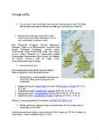
o The Celts are best known for their art- many bronze objects with elaborate designs; brooches; pins; mirrors; Celtic stone crosses o The Celts had 3 social orders: warriors, druids(priests) ordinary people 2) The Romans o (55 BC-Caesar) 43 AD- 410 AD- Claudius o From present-day Italy o Southern Britain became Britannia and was ruled by a roman governor o The Romans built over 20 towns: Colchester, Londinium, Winchester etc. They were good engineers and built roads and villas that had central heating, glass windows and mosaic floors o 122 AD- Hadrian's Wall; 138 AD- Antonine Wall o Druids(celtic priests) were banned and Britain was influenced by christianity 3) The Germanic Invasions I. The Anglo-Saxons o 5th century- 1066
tribes the Romans had first encountered there occupying the southern half of the country. After preliminary lowscale invasions of the island, the Romans invaded Britain in force in 43 AD, forcing their way inland through several battles against British tribes, including the Battle of the Medway, the Battle of the Thames, the Battle of Caer Caradoc and the Battle of Mona. Following a general uprising in which the Britons sacked Colchester, St Albans and London, the Romans suppressed the rebellion in the Battle of Watling Street and went on to push as far north as central Scotland in the Battle of Mons Graupius. Tribes in modernday Scotland and Northern England repeatedly rebelled against Roman rule and two military bases were established in Britannia to protect against rebellion and incursions from the north, from which Roman troops built and manned Hadrian's
o 1580 - Dover Straits maavärin of 1580 o 1607 - Bristol Kanali üleujutus, 20 Jaanuar 1607 (võimalik tsunami) o 1703 Suur torm o 1607 - Lynmouthi üleujutus, Devon o 1638 Suur äikesetorm, Devon o 1729 - Tornaado Sussex´is o 1755 Tsunami lööklaine Cornwall ,Lisboni maavärinast o 1796 - Lynmouth´i üleujutus , Devon o 1836 - Laviin Lewes´is, ainuke suur laviin Inglismaal o 1884 Colchester´i maavärin, Essex o 1931 - Dogger Bank maavärin o 1952 - Lynmouth üleujutus, Devon o 1947 - Talv 19461947 tugev külm ja lumetormid o 1881 - Eyemouth katastroof, torm, sotimaa o 1953 Põhja mere üleujutus , Inglismaa o 1968 Suur üleujutus o 1987 Suur torm o 1990 ,,The Burns' Day" Torm o 2000 Tugev üleujutus paljudes Suurbritannia piirkondades. Kõige hullemini
during the Second World War she applied for a scholarship to attend Somerville College, Oxford and was luckily accepted. She started studying Chemistry in 1944 in Oxford. Later Margaret became President of the Oxford University Conservative Association. Thatcher graduated from Oxford in 1947 with a B.Sc. in Natural Sciences and also gained a MA in 1950. Early Interest in Politics Although Margaret studied chemistry, politics interested her more. Following graduation, Margaret Roberts moved to Colchester and worked as a chemist. She became a member of the Association of Scientific Workers. During this period she joined the local Conservative Association when a friend of hers apprised that they were looking for candidates to strong Labour seats of Dartford. To support herself during the period of elections, she went to work for J. Lyons and Co., where she helped to develop methods for preserving ice cream and was paid 10 000 Krones per year. Margaret won
London, Westminster Abbey and the London Eye. 2. History Although there is some evidence of a permanent settlement before the Romans came in 43 A.D., it is more accepted by historians that the Romans were the first. The settlement was called Londinium. The first London lasted for just seventeen years, for around AD 61, a tribe of Celts led by Queen Boudica stormed London, burning it to the ground. The next heavily-planned London prospered and surpassed Colchester (another major city at the time) as the capital of the Roman province of Britannia. At its height in the 2nd century, Roman London had a population of about 60,000. However, by the 3 rd century, the city fell into a decline due to trouble in the Roman Empire and by the 5th century, it was largely abandoned. But, under the control of various English kings, London once again prospered as an international trading centre.
Roast lamb with green mint sauce and vegetables. Puddings: salty and sweet. Apple or rhubarb crumble, bread and butter pudding. Special booths for fish and chips, bangers and mash, hotdogs if people don´t have time. They eat yoghurt, potato chips, sandwiches also. Kristjan: "Ancient Freedom Fight and Boudica" Boudica was a queen of Iceny tribe, she was tortured and her daughters were raped in public. Rebels destroyed 3 cities: London, St Albus, Colchester. Wales was the headquarter. They had several beliefs. Boudica means "victory". They won several Roman troops. Roman Empire had 50 legions and over 5000 legionaries. Boudica´s army consisted of soldiers and families. There were several illnesses over the Rebel army. Boudica died shortly after the battle. She was forgotten by the Middle Ages. In Victorian era she became popular again. First play of her in 1610, 3 films, several novels, Henry Purcell has somposed a piece of music, 2
Introduced schools,a new language Latin, large farms (villas), baths. In AD 410 they had to leave . roman occupation lasted nearly 400 years. They left behind very little. Roman province of Britannia covered most of present-day England and Wales. 4. Latin influence on English *The influence of Latin is noticeable also in the names of European cities: the Latin noun colonia (settlement, colony) may be found in numerous place-names: Lincoln, Colchester, Cologne ; from Latin word castrum (military camp) were derived English affixes -chester and -castle: Manchester, Lancaster, Newcastle; Latin word portus (seaport) in Portsmouth *-tor - person, doer, masculine form. The suffix is attached to the stem: victor (`winner', from the verb vincere `to win'), spectator (spectare). *-orium - place, where the activity marked with the verb occurs: dormitorium (dormire `to sleep'). In English the suffix is -ory: dormitory.
Paganism had been eclipsed but continued to pose a political, religious challenge Boudicca Queen of Iceni people of Eastern England, led an uprising against Roman forces Prasutagus(ruler) was first allowed to rule when romans conquered England, after his death, romans decided to rule Iceni and flogged Boudicca and raped her daughters 60-62 AD Iceni rebelled, Boudicca´s warriors defeated Roman Ninth Legion, destroied capital-Colchester Finally Boudicca was defetated, she poisoned herself to avoid capture Hadrian´s wall A defensive barrier builtin 122 AD by Roman emperor Hadrian to guard the northern part of Britain against barbarian invaders Most imposing frontier of Roman Empire, controlling peoples mobements Building took several years, builders kept changing minds about the size 119 km lenght, 5m high, 3m deep The Picts, Caledonia
 annaabi.ee