.................................................................. 48 2. BELARUS .....................................................................................................................51 2.1. General information ................................................................................................... 51 2.1.1. Country Profile ................................................................................................... 51 2.1.2. Overview of Belarusian economy ....................................................................... 52 2.2. Customs Union of Belarus, Russia and Kazakhstan.................................................. 55 2.3. The Business Environment ........................................................................................ 58 2.4. Banking system.......................................................................................................... 59 2.5. Development of Private Sector ....
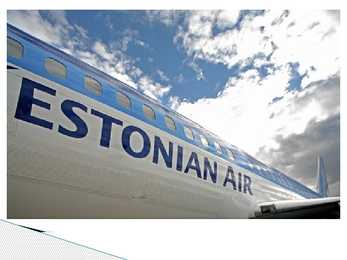
History Partners Activities Structure Strategy History On December 1, 1991 Estonian Air was created. In 1996, the Estonian state decided to privatise the airline and 66% of the shares were put on sale. In 2003, Maersk Air sold its 49% share to SAS Group. Partners v Scandinavias Airlaines v Aeroflot, Russian Airlaines v Belavia, Belarusian Airlaines v AeroSvit, Ukrainian Airlaines v Spanair, Spanish Airlaines v KLM, Royal Dutch Airlaines v Brussels Airlaines v Rossiya, Russian Airlaines Activities Ø Estonian Air'sprincipal field of activity is provided scheduled flights to both business and holiday travellers Ø Estonian Air's fields of activity include training of flight attendants, freight transport and the on-board sale of merchandise. Structure to edit Master text styles
typical of a child living in a town. I was born in a family of a teacher and a doctor. I was sent to a kindergarten at the age of three as both the parents were working. As all the children of Belarus I went to school at the age of six. Here I should say that it was my lucky chance to study for 11 years at the school of fine arts in the town of Molodechno . it turned out to be the best school in our town. There I got a proper training in such subjects as English, Russian and Belarusian literature and world culture. I usually did a lot of home preparation for them and I liked everything I was doing in them. I really tried hard in them. But despite my efforts I was not good at Math. School for me was not only lessons and learning I had a lot of friends there. We organized extra class activities such as parties and other social activities. I actively participated in most of them. I am sociable, so I have got a lot of friends among my schoolmates
economy and rebuild the country's infrastructure. The first few years helped make great changes in the social and cultural life. People had hope because the Bolsheviks introduced free universal health care, education and social security. Russian Orthodoxy was prohibited and the government started promoting atheism ( " T h e r i s e o f , " ) . In 1922, the Union of Soviet Socialist Republics (USSR) was created. At first the new nation had only four members: the Russian, Ukrainian, Belarusian and Transcaucasian Soviet republics. Over the years the number grew to 15 (Russian Soviet Federative Socialist Republic, Ukrainian Soviet Socialist Republic, Uzbek Soviet Socialist Republic, Kazakh Soviet Socialist Republic, Byelorussian Soviet Socialist Republic, Azerbaijan Soviet Socialist Republic, Georgian Soviet Socialist Republic, Tajik Soviet Socialist Republic, Moldavian Soviet Socialist Republic, Kirghiz Soviet Socialist Republic, Lithuanian Soviet Socialist Republic, Turkmen
04%); and Greeks (0.03%).[27] According to some estimates, there are actually more than 200,000 Romani people in the Czech Republic. There were 436,116 foreigners residing in the country in October 2009, according to the Czech Interior Ministry, with the largest groups being Ukrainian (132,481), Slovak (75,210), Vietnamese (61,102), Russian (29,976), Polish (19,790), German (14,156), Moldovan (10,315), Bulgarian (6,346), Mongolian (5,924), American (5,803), Chinese (5,314), British (4,461), Belarusian (4,441), Serbian (4,098), Romanian (4,021), Kazakh (3,896), Austrian (3,114), Italian (2,580), Dutch (2,553), French (2,356), Croatian (2,351), Bosnian (2,240), Armenian (2,021), Uzbek (1,969), Macedonian (1,787) and Japanese (1,581). The Jewish population of Bohemia and Moravia, 118,000 according to the 1930 census, was virtually annihilated by the Nazis during the Holocaust.There were approximately 4,000 Jews in the Czech Republic in 2005
water bodies in 2000 was 1/20 the level of 1980; in connection with the startup of new water purification plants, the pollution load of wastewater decreased; Estonia has more than 1,400 natural and manmade lakes, the smaller of which in agricultural areas need to be monitored; coastal seawater is polluted in certain locations (Central Intelligence Agency, 2012, ISSN 15538133). 2.2.3 People and society Ethnic groups: Estonian 68.7%, Russian 25.6%, Ukrainian 2.1%, Belarusian 1.2%, Finn 0.8%, other 1.6% (2008 census) Languages: Estonian (official) 67.3%, Russian 29.7%, other 2.3%, unknown 0.7% (2000 census) Religions: Evangelical Lutheran 13.6%, Orthodox 12.8%, other Christian (including Methodist, SeventhDay Adventist, Roman Catholic, Pentecostal) 1.4%, unaffiliated 34.1%, other and unspecified 32%, none 6.1% (2000 census) Population: 1,274,709 (July 2012 est.) Life expectancy at birth: total population: 73.58 years male: 68.3 years, female: 79.19 years (2012
Consonants include a fricative //, a semivowel /wu/ and /xxvxw/, whereas the Standard and Northern dialects have the consonants //, /v/, and final /l/ and /f/, respectively. The morphology features a palatalized final /t/ in 3rd person forms of verbs (this is unpalatalized in the Standard and Northern dialects). Some of these features such as akanye and yakanye, a debuccalized or lenited //, a semivowel /wu/ and palatalized final /t/ in 3rd person forms of verbs are also present in modern Belarusian and some dialects of Ukrainian (Eastern Polesian), indicating a linguistic continuum. The city of Veliky Novgorod has historically displayed a feature called chokanye or tsokanye ( or ), in which /t/ and /ts/ were switched or merged. So, ('heron') has been recorded as . Also, the second palatalization of velars did not occur there, so the so-called ² (from the Proto-Slavic diphthong *ai) did not cause /k, , x/ to shift to /ts, dz, s/;
although some rights are prohibitive in nature, they include certain obligations for it to be exercisable in this way. CP rights are ensured to all people, whereas ESC and 3 rd rights take steps to the maximum of their available resources and this might not include giving these rights to non-nationals. MOVIE Violations Freedom for economic activity? Article 1 right to self-determination. All officials spoke exclusively Russian, Belarusian is almost like prohibited. All the people in the movie use a new flag (red, white) and the original flag is prohibited. Article 2 (1) (3): There were violations against people's rights recognized in the convention because of their political or other opinion. Those whose rights were infringed did not have any remedies and couldn't have them either because if they were to claim them, the judges/ courts giving them are not competent in the sense
 annaabi.ee