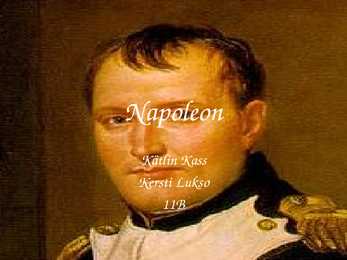
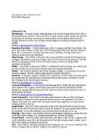
Napoleon Kätlin Kass Kersti Lukso 11B Napoleone di Buonaparte · 1 5 Aug us t 1 7 6 9 5 Ma y 1 8 2 1 · Fre nc h m ilita ry a nd p o litic a l le a d e r · Em p e ro r o f th e Fre nc h · King o f Ita ly · Mediator of the Swiss Confederation · Protector of the Confederation of the Rhine Early career · commissioned a second lieutenant in La Fere artillery · a complex threeway struggle was playing out between royalists, revolutionaries, and Corsican nationalists · conflict with Pasquale Paoli · appointed artillery commander of the French forces besieging Toulon Early Career · imprisoned in the Chateau d'Antibes in August 1794, but was released within two weeks · engaged to Desiree Clary Coronation as Emperor · the arrest of Duke of Enghien · crowned himself Emperor in1804
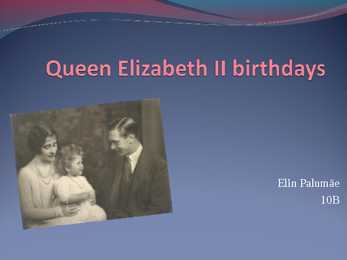
21-Aug-1930, d. 9-Feb-2002 stroke) Husband: Prince Philip (Duke of Edinburgh, b. 10-Jun-1921, m. 20-Nov-1947) Son: Prince Charles (Prince of Wales, b. 14-Nov-1948) Daughter: Princess Anne (Princess Royal, b. 15-Aug-1950) Son: Prince Andrew (Duke of York, b. 19-Feb-1960) Son: Prince Edward (Earl of Wessex, b. 10-Mar-1964) How is The Queen's real birthday marked ? To mark the real birthday of The Queen, a 41 gun royal salute is fired by the King's Troop Royal Horse Artillery in Hyde Park at 12:00 noon. There is also a 62-gun royal salute fired by the Honourable Artillery Company at the Tower of London at 1:00pm. Gun salutes are customarily fired, both on shore and at sea, as a sign of respect or welcome. No particular ceremony is held on The Queen's true birthday, although the Union Flag is flown on public buildings. How is The Queen's 'official' birthday marked? Since 1805, the Sovereign's 'official' summer birthday has been marked by the
By W. Somerset Maugham CHARACTERS: • Captain Bartlett – pilot, bald, alcoholic, queer fish • Captain Cook – discovered the Thursday Island on a Thursday. • Woman – a red flannel dressing-gown; holding a paraffin lamp; hair - a little bit over her shoulders, long black wisps, a little stoutish, keen eyes, a red nose. • French Joe aka Josep de Paoli – 93Y, Corsican, a lietutenant of artillery, French army in 1851, later communist, started new life many times, black shining eyes, really thin and old. • Boswell Johnson – really famous author, the ancestor of Joe. • Napoleon Bonaparte – a relative of French Joe, lietutenant of artillery • Russians + Prussians – Joe fougth against them in French army • Hospital Nurse PLACES: • Thursday Island in Torres Straits – where he went + Joe's final destination
Kiek in de Kök is an old German language nickname for towers, mainly those that formed parts of town fortifications. They gained the name from the ability of tower occupants to see into kitchens of nearby houses. Due to the history of the Hanseatic League and the Teutonic Order, also towers far outside modern Germany bear this name, like in Gdask and Tallinn. The tower in Tallinn is an artillery tower built in 1475.The walls are 4 m thick but the tower was then lower than today. The waterproof upper floor made of cobblestones was open and had 22 embrasures in its parapet. The parapet must have been covered by some kind of a roof but the middle part of the floor was uncovered to get the mortars and catapults in place better. Compared to the other Tallinn towers Kiek in de Kök was predominant in its fire power, due to its 27 embrasures for cannons and 30 for handguns
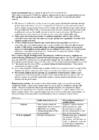
• The Submarine Service's four Vanguard-class nuclear-powered submarines carry Lockheed Martin's Trident II ballistic missiles, forming the United Kingdom's nuclear deterrent Royal Marines • The Royal Marines are the Royal Navy's amphibious troops • Contained within 3 Commando Brigade are three attached army units; 1. 1st Battalion, The Rifles, an infantry battalion 2. 29 Commando Regiment Royal Artillery, an artillery regiment 3. 24 Commando Regiment Royal Engineers Army • The British Army is made up of the Regular Army and the Army Reserve • Deployable combat formations consist of two divisions (1st Armoured and 3rd Mechanised) and eight brigades • The Army has 50 battalions (36 regular and 14 territorial) • There are four operational roles that infantry battalions can fulfil: air assault, armoured infantry, mechanised infantry,
When they rejoin the retreat the following day, chaos has broken out: soldiers, angered by the Italian defeat, pull commanding officers from the melee and execute them on sight. The battle police seize Henry, who, at a crucial moment, breaks away and dives into the river. After swimming a safe distance downstream, Henry boards a train bound for Milan. He hides beneath a tarp that covers stockpiled artillery, thinking that his obligations to the war effort are over and dreaming of his return to Catherine. Henry reunites with Catherine in the town of Stresa. From there, the two escape to safety in Switzerland, rowing all night in a tiny borrowed boat. They settle happily in a lovely alpine town called Montreux and agree to put the war behind them forever. Although Henry is sometimes plagued by guilt for abandoning the men on the front, the two succeed in living a beautiful, peaceful life
This would decrease ammunition size and weight, allowing more ammunition to be carried and eliminating the hazards of carrying explosives or propellants in a tank or naval weapons platform. Also, by firing at greater velocities, railguns have greater range, less bullet drop, less time to target, and less wind drift, bypassing the physical limitations of conventional firearms. Railguns are of particular interest to the military, as an alternative to current large artillery. Railgun ammunition, in the form of small tungsten missiles, would be relatively light, easy to transport and easy to handle. And because of their high velocities, rail gun missiles would be less susceptible to bullet drop and wind shift than current artillery shells. Course correction would be important, but all missiles fired from rail gun artillery would be guided by satellite. It would be more difficult to engineer small arm rail guns, mainly because of recoil. Recoil is
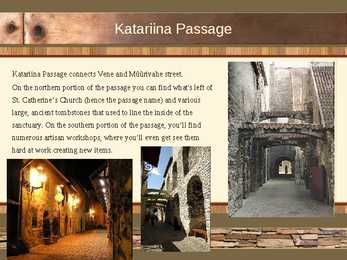
It is located in a former nunnery yard. At first it was 9 meter in height and 7 meters in diameter. The height of the tower came to it's peak in 1610 - 22,5 meters. Today it has 5 storeys. The upper floors were used for defensive purposes and the lower ones as warhouses. The shape of the tower is horseshoe. It is well preserved and many activity is held there. Kiek in de Kök Kiek in de Kök is a well-known artillery tower built between 1475 and 1483 AD. Kiek in de Kök stands six stories tall and is a historic landmark of the Livonian War. Today, the tower still houses Ivan IV's nine cannonballs, as well as a museum and photography gallery. Kiek in de Kök means Peek into the Kitchen. Tall Hermann Tower Tall Hermann Tower (Pikk Hermann ) belongs to the Toompea Castle and is easily spotted from Toompea hill in Tallinn.
vajutusega. 14 Kasutatud materjal http://en.wikipedia.org/wiki/Weapon http://en.wikipedia.org/wiki/Prehistoric_warfare http://en.wikipedia.org/wiki/Ancient_warfare http://en.wikipedia.org/wiki/Medieval_warfare http://en.wikipedia.org/wiki/Early_Modern_warfare http://en.wikipedia.org/wiki/Industrial_warfare http://en.wikipedia.org/wiki/Modern_warfare http://en.wikipedia.org/wiki/Artillery http://en.wikipedia.org/wiki/Aerial_warfare http://en.wikipedia.org/wiki/Chariot http://www.miksike.ee/documents/main/lisa/2klass/2joostes/relvad.htm http://www.miksike.ee/documents/main/lisa/5klass/5eestim/skandinaaviapronksiaeg17.ht m http://en.wikipedia.org/wiki/Siege_engine http://en.wikipedia.org/wiki/Catapult http://en.wikipedia.org/wiki/Gunpowder http://en.wikipedia.org/wiki/Breech-loading http://en.wikipedia.org/wiki/Mechanized_infantry http://en.wikipedia.org/wiki/Asymmetric_warfare
· 3,75 cl cream · 6 cl lemon juice · 3,75 cl milk · 1 tea spoon powdered sugar Preparation : Pour softly in a liqueur glass the · Finish with red Burgundy wine ingredients in the order above, in order to make each Preparation : Add 1 tea spoon rum before serving. "float" above the previous. Black Jack Artillery punch · 6 cl cognac · 1 l bourbon · 1,5 cl Kirsch · 1 l red wine · 4,5 cl black coffee, cold · 1/2 l dark rum · 1/4 l apricot brandy · 1/4 l gin Black Russian · 1 l black tea, strong · 4 cl russian vodka
on the south coast, in the Fishbourne area of West Sussex. The Romans defeated the Catuvellauni and their allies in two battles: the first, assuming a Richborough landing, on the river Medway, the second on the Thames. One of the Catuvellaunian leaders, Togodumnus, was killed, but his brother Caratacus survived to continue resistance elsewhere. Plautius halted at the Thames and sent for Claudius, who arrived with reinforcements, including artillery and elephants, for the final march to the Catuvellaunian capital, Camulodunum . The future emperor Vespasian subdued the southwest,Cogidubnus was set up as a friendly king of several territories, and treaties were made with tribes outside the area under direct Roman control.Romans built many roads and also many great bulidings like the Hadrians wall. Anglo-Saxons and Normans The history of Anglo-Saxon England broadly covers early medieval England from the end
MOOTW Military Operations Other Than War MP Military Police MRR Minimum-Risk Route MSD Minimum Safe Distance MSR Main Supply Route NAI Named Area of Interest N NATO North Atlantic Treaty Organisation NBC Nuclear, Biological and Chemical NFA No-Fire Area NFL No-Fire Line O OBJ Objective OP Observation Post, Observation Point PAA Position Area of Artillery P PDF Principal Direction of Fire PLD Probable Line of Deployment PP Passage Point PZ Pickup Zone R R3P Rearm, Refuel and Resupply Point RA Rendezvous Area RAA Rear Assembly Area RAOC Rear Area Operation Centre RCZ Rear Combat Zone RES Reserve RFL Restrictive Fire Line RGB Red, Green, Blue RHU Replenishment Holding Unit RL Release Line RL Report Line
On their way, they pass a schoolhouse that has been shattered by shells. Fresh coffins are piled by the dozens already lying next to the schoolhouse. The soldiers make jokes to distance themselves from the unpleasant knowledge that the coffins have been made for them. At the front, they listen to the enemy transports and guns. They detect that the enemy is bringing troops to the front, and they can hear that the English have strengthened their artillery. The men are disheartened by this knowledge as well as by the fact that their own shells are beginning to fall in their trenches--the barrels on the guns are worn out. The soldiers can do nothing but wait. Chance determines whether things will take a turn for the better or for the worse. Paul relates that he once left a dugout to visit friends in a different dugout. When he returned to the first, it had been completely demolished by a direct hit. He
1914, became increasingly abstract. Their vocabulary of tubular, conical, and cubed forms are laconically rendered in rough patches of primary colors plus green, black and white, as seen in the series of paintings with the title Contrasting Forms. Léger's experiences in World War I had a significant effect on his work. Mobilized in August 1914 for service in the French Army, he spent two years at the front in Argonne. He produced many sketches of artillery pieces, airplanes, and fellow soldiers while in the trenches, and painted Soldier with a Pipe (1916) while on furlough. In September 1916 he almost died after a mustard gas attack by the German troops at Verdun. During a period of convalescence in Villepinte he painted The Card Players (1917), a canvas whose robot-like, monstrous figures reflect the ambivalence of his experience of war. As he explained: ...I was stunned by the sight of the breech of a 75 millimeter in the sunlight
vahel toimus aastal 1697 Sussexis ja see on ka kõige varasem teade sellise tähtsusega kriketimängust.(1) Mängus toimusid suured muudatused 18. sajandil ja ta oli selle sajandi lõpuks muutunud Inglismaa rahvusspordiks. Panustamine mängis selles suurt rolli ja rikkad patroonid hakkasid moodustama oma "selekteeritud XI-neid". Kriket oli Londonis tähtsal kohal juba nii vara kui aastal 1707 mil mängu kogunesid vaatama suured rahvahulgad Finsbury Artillery Ground'ile. "The Hambledon Club" loodi mõni aeg enne 1750 aastat ja nemad alustasid ka kõrgliiga mängudega aastal 1756. Järgneva kolmekümne aasta jooksul kuni MCC klubi moodustamiseni 1787 aasta Lords'i väljaku avamiseni oli Hambledon selle mängu parim klubi ja keskus. MCC muutus kiiresti selle spordiala parimaks klubiks ja Laws of Cricket (kriketi reeglite) järelevaatajaks.(1) 19. sajandil muudeti altkäe vise ära "üle käe" viske vastu millest omakorda kujunes
the sufferings of disabled men or render their death inevitable (this would be contrary to the laws humanity). General principles: superfluous injury or unnecessary suffering to understand if injury is necessary we should compare it to military advantage, there is a balance, a proportionality . This convention prohibited explosive bullets (regular bullet permitted, explosive bullets prohibited, artillery shells permitted why? Because military advantage is the same in a regular and explosive shell, artillery shell is not comparable because it can have more military advantage; if military advantage is equal, but sufferings are more serious, then it is prohibited) a weapon would be of a nature to cause superfluous injury or unnecessary suffering, i.e. when they resulted in (SIrUS project) (exists on doctrinal level and is important, but
its weary troops and hungry civilians for the supreme effort that was to bring final victory. It was no less clear to the Allies that Germany planned to launch a climactic offensive in the spring. There were many signs—the new cipher itself was one. The question was: Where and when would the actual blow fall? The German high command, recognizing the incalculable military value of surprise, shrouded its plans in the tightest secrecy. Artillery was brought up in concealment; feints were flung out here and there along the entire front to keep the Allies off balance; the ADFGVX cipher, which had reportedly been chosen from among many candidates by a conference of German cipher specialists, constituted an element in this overall security, as did the new Schliis-selheft. The Allies bent every effort and tapped every source of information to find out the time and place of the real assault
The advantage of this position is simple: the woman can control the motion. Professor Nina o ers the following advice for all intercourse: "When in doubt, you supply the pressure and she provides the movement." The male can hold a vibrator to the clit in this position, but I opted not to because of the risk of distraction on both sides. As Nina-san sayeth: "A vibrator can be a girl's best friend, or it can be as annoying as a mosquito." I could always bring in the heavy artillery after the fact, but I wanted to be ready for empty- handed encounters. I wanted to deconstruct the orgasm, and create it at will, without any tools. That's when the note in my pocket became the keys to the kingdom, which we explore in the next chapter. That's also where we'll learn what happened with Giselle. TOOLS AND TRICKS Buckwheat Hull Pillows (www.fourhourbody.com/buckwheat) Bucky manufactures comfy pillows lled with natural buckwheat hulls
 annaabi.ee