Edward I, who built the outer curtain wall. The Tower today is principally a tourist attraction. Besides the buildings themselves, the British Crown Jewels and a remnant of the wall of the Roman fortress are on display. Primary Functions The tower's primary function was a fortress, a royal palace, and a prison for high status and royal prisoners. It has also served as a place of execution and torture, an armoury, a treasury, a zoo, the Royal Mint, a public records office, an observatory, and since 1303, the home of the Crown Jewels of the United Kingdom.
Click to edit Master text styles Second level Third level Fourth level Fifth level The Tower of London Belong to the list of UNESCO World Heritage Sites Built by William the Counqueror, when he become king Was built to guard the entrance to London from the estuary of the Thames Has had many functions:royal residence, armoury, treasury,mint and as prison for the enemies of the crown Beefeaters Forty-two Yeomen Warders known as "beefeaters" guard the Tower and live there too. ceremonial guardians of the Tower of London In principle they are responsible for looking after any prisoners at the Tower and safeguarding the British crown jewels, but in practice they act as tour guides and are a tourist attraction in their own right, a point the Yeoman Warders acknowledge.
´s most visited historic sites. Despite a grim reputation for a place of torture and death, there are so many more stories to be told about the Tower. This powerful and enduring symbol of the Norman Conquest has been enjoyed as a royal palace, served as an armoury and for a few years in the 1830s even housed a zoo! An intriguing cast of characters have played their part: including the dastardly jewel-thief Colonel Blood, tragic Lady Jane Gray and maverick zoo keeper Albert Cops. SCOTLAND Capital: Edinburgh Flag: Area: 30414 sq mi (78772 km2) Location: Symbols: Tartan Thistles
Westminster Abbey is mainly Gothic church. It served as a cathedral from 1546 1556. It is the traditional place of burial site for English monarchs . It is Located next to the Houses of Parliament. The tower of London is on the north bank of the River Thames. The tower as a whole is a complex of several buildings. The tower's primary function was a fortress, a royal palace, and a prison. It has also served as a place of execution and torture, an armoury, a treasury, a zoo, the Royal Mint, a public records office, an observatory, and since 1303, the home of the Crown Jewels of the United Kingdom. London also has many beautiful bridges, parks and churches. The oldest is the London Bridge, which was originally made from wood. In 1209 it was replaced by a stone bridge. That followed with a granite bridge in 1831 and the present bridge in 1973. The most recent bridge is the Millennium Bridge. It is one of the world's first horizontal
James I. It was customary for each monarch to lodge in the Tower before his coronation and to ride in procession to Westminster through the city of London from the Tower. John Stow wrote during the reign of Elizabeth I, The Tower of London was "...a citadel to defend or command the city, a royal palace for assemblies or treaties, a prison of state for the most dangerous offenders; the only place of coinage for all England...The armoury for warlike provision; the treasury of the ornaments and jewels of the crown; and general conserver of the most records of the queen's courts of justice". In fact the Tower was no longer used as a royal residence, except before coronations, when Stow wrote those words. The Tudors had changed all that. St. Paul's Cathedral St. Paul's Cathedral has had an eventful history. The first records date from 604 AD, when
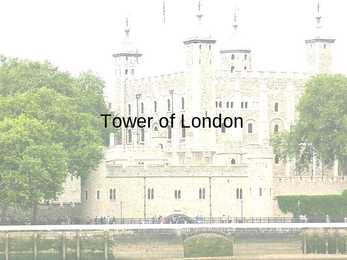
by exceptionally high tides and storm surges moving up from the sea. · The Tower - Tower of London, is a historic castle on the north bank of the River Thames in central London. The castle was used as a prison since at least 1100, although that was not its primary purpose. A grand palace early in its history, it served as a royal residence. The Tower has served variously as an armoury, a treasury, a menagerie, the home of the Royal Mint, a public records office, and the home of the Crown Jewels of the United Kingdom. The peak period of the castle's use as a prison was the 16th and 17th centuries, when many figures fallen into
The Imperial State Crown was made for Queen Victoria and first used at her coronation in 1838. It is possibly the most valuable crown in the world, containing many precious diamonds, rubies, emeralds and sapphires. For centuries the Tower of London has been the main arsenal in the kingdom from which the royal armies and fleets were equipped. It also housed king's personal armours and weapons. Among the armour on display in the White Tower Armoury are four suits of Henry VII. They are of different sizes because Henry grew fatter with age. The Tower is guarded by the Yeoman Warders, a company of 38 ex-servicemen (also known as the Beefeaters). Usually they are seen in the dark blue uniforms with red decorations, but on state occasions they wear the scarlet and gold uniforms with a white neck ruff and a special bonnet. Among their duties is the ceremonial closing of the gates each evening, the 700
eastern edge of the City of London by the open space known as Tower Hill. It was founded towards the end of 1066 as part of the Norman Conquest of England. The White Tower, which gives the entire castle its name, was built by William the Conqueror in 1078. The Tower of London has played a prominent role in English history. It was besieged several times and controlling it has been important to controlling the country. The Tower has served variously as an armoury, a treasury, a menagerie, the home of the Royal Mint, a public records office, and the home of the Crown Jewels of the United Kingdom. Buckingham Palace - Buckingham Palace is the official London residence of the British monarch.[1] Located in the City of Westminster, the palace is a setting for state occasions and royal hospitality. It has been a rallying point for the British people at times of national rejoicing and crisis.
Sophia acted as regent during the minority of the sovereigns and exercised all power. For seven years, she ruled as an autocrat. A large hole was cut in the back of the dual-seated throne used by Ivan and Peter. Sophia would sit behind the throne and listen as Peter conversed with nobles, while feeding him information and giving him responses to questions and problems. This throne can be seen in the Kremlin Armoury in Moscow. Peter was not particularly concerned that others ruled in his name. He engaged in such pastimes as shipbuilding and sailing, as well as mock battles with his toy army. Peter's mother sought to force him to adopt a more conventional approach and arranged his marriage to Eudoxia Lopukhina in 1689. The marriage was a failure, and ten years later Peter forced his wife to become a nun and thus freed himself from the union.
 annaabi.ee