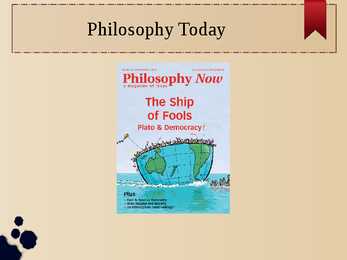
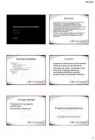
Philosophy Today The Great Divide Most contemporary philosophers follow one of two approaches "Continental" philosophy "Analytic" philosophy Continental philosophy is more influential on the European continent Analytic philosophy is predominant in the major research universities in the English-speaking world Analytic Philosophy Analytic philosophy developed from attempts in the early 20th century to make our concepts precise. The model of this procedure was science. Emphasis in contemporary analytic philosophy is on language and meaning, and meaning is understood as a relation between language and objective reality. Thus, understanding the structure of language is what reveals the structure of reality. Continental Philosophy At the same time that analytic philosophy was emerging, E. Husserl was developing his "phenomenological" approach...
TEKST 2. Durbin, Paul T. (1984). A Guide to The Culture of Science, Technology, 3. Broad Synthetic vs. Narrow Analytic. Third, one may approach science and Medicine. The Free Press. pp. 217-222. (Katkendid) from a narrow analytic or a broad synthetic point of view. That is, one could see one's task as primarily dissecting various features of science to see how they look or work, or C. Frameworks for Philosophy of Science as primarily locating science within a broader framework of human activities and artifacts. Questions about, for example, the form and function of scientific explanations In this section our aim is to examine alternative approaches to t...
Individual Differences (Differential Psychology) Psychology 1 It is generally assumed that: Differential Psychology · People vary on a range of psychological attributes Ian Deary · It is possible to measure and study these individual differences · Individual differences are useful for explaining and predicting behaviour and performance Differential psychology reading Human...
Philosophy of Language Philosophy of Language: a Contemporary Introduction introduces the student to the main issues and theories in twentieth and twenty-first-century phi- losophy of language, focusing specifically on linguistic phenomena. Topics are structured in four parts in the book. Part I, Reference and Referring, includes topics such as Russell's Theory of Descriptions, Donnellan's distinction, problems of anaphora, the description theory of proper names, Searle's cluster theory, and the causalhistorical theory. Part II, Theories of Meaning, surveys the competing theories of linguistic mean- ing and compares their various advantages and liabilities. Part III, Pragmatics and Speech Acts, introduces the basic concepts of linguistic pragmatics, includes a detailed discussion of the problem of indirect force and surveys approaches to metaphor. Part IV, new to this edition, examines the four theories of metaphor. Features...
The Death of the Author The Death of the Author - Roland Barthes Source: UbuWeb | UbuWeb Papers 1 The Death of the Author In his story Sarrasine, Balzac, speaking of a castrato disguised as a woman, writes this sentence: “It was Woman, with her sudden fears, her irrational whims, her instinctive fears, her unprovoked bravado, her daring and her delicious delicacy of feeling” Who is speaking in this way? Is it the story’s hero, concerned to ignore the castrato con- cealed beneath the woman? Is it the man Balzac, endowed by his personal experience with a philosophy of Woman? Is it the author Balzac, professing certain “literary” ideas of femininity? Is it universal wisdom? or romantic psychology? It will always be impossible to know, for the good reason that all writing is itself this special voice, consisting of several indiscernible voices, and t...
9/6/2011 Eesmärk · Kursuse läbinud üliõpilane: omab teadmisi teadusfilosoofia sissejuhatusest, äriuuringute spetsiifikast, uuringu ülesehitusest ja uurimisprotsessi etappidest; teadmisi kvantitatiivsete ja kvalitatiivsete andmete kogumise ja Majandusalased uurimismee...
Some of the things you will learn in THE CODEBREAKERS • How secret Japanese messages were decoded in Washington hours before Pearl Harbor. • How German codebreakers helped usher in the Russian Revolution. • How John F. Kennedy escaped capture in the Pacific because the Japanese failed to solve a simple cipher. • How codebreaking determined a presidential election, convicted an underworld syndicate head, won the battle of Midway, led to cruel Allied defeats in North Africa, and broke up a vast Nazi spy ring. • How one American became the world's most famous codebreaker, and another became the world's greatest. • How codes and codebreakers operate today within the secret agencies of the U.S. and Russia. • And incredibly much more. "For many evenings of gripping reading, no better choice can be made than this book." —Christian Science Monitor THE ...
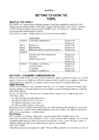
CHAPTER 1 GETTING TO KNOW THE TOEFL WHAT IS THE TOEFL? The TOEFL is a comprehensive English language examination required by more than 3,000 colleges and universities in the United States, Canada, and other parts of the world. In addition, foreign born professionals frequently need a TOEFL score for certification to practice their profession in the United States or Canada. The TOEFL is a timed test that consists of the three sections listed here. THE TOEFL Section 1 Listening Comprehension 50 questions 35 minutes Part A Statements 20 questions Part B Short Dialogs 15 questions ...
 annaabi.ee