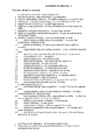
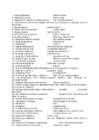
9. real evidence – material objects as evidence 10. circumstantial evidence - evidence inferred from the facts 11. litigation – a dispute in the court 12. legal aid – payment from the public funds to help smb to pay for the services of the lawyer III 1. omama õigust kohtu poole pöörduda – to have the right of recourse to court 2. kohtu poole pöörduma – to take recourse to a court 3. kohtus asju arutama, lahendama – to adjudicate matters in court 4. oma õigusi kaitsma – to protect one`s rights 5. tsiviilhagi – civil action 6. hagiavaldust kohtusse andma – to file a statement of claim with a court 7. pooli esindama – to represent parties 8. toimikut uurima – to examine a file 9. kohtuistungitel osalema – to participate in court sessions 10. kohtu koosseis – panel of the court 11. kohtule ütlusi andma – to give statements to the court 12
inquisitional procedure - the judge takes a active role in preparing evidence, questioning witnesses and finding the truth. 13. litigation - the process of taking legal action = court action 14. legal aid - payment by the state from public funds for those who cannot afford the services of a lawyer 1. omama õigust kohtu poole pöörduda right of recourse to a court 2. kohtu poole pöörduma take recourse to a court 3. kohtus asju arutama, läbi vaatama adjudicate / hear matters in court, try cases 4. tsiviilhagi civil action 5. menetlusosalised participants in the proceedings 6. pooli esindama represent parties 7. kohtukoosseis court panel, panel of the court 8. kohtunikku taandama challenge a judge 9. kohtus ütlusi andma give statements to a court 10. tõendeid esitama submit evidence 11
violently toward us. And some prescriptive laws are made by governments. When governments make laws they use a system of courts backed by the power of the police to enforce these laws. 2. Sources of law (general) Precedent – a decision about a particular legal case that makes it likely that other similar cases will be decided in the same way Solve a dispute – to find a solution to a disagreement; to adjudicate Judiciary – a country’s body of judges Government – system by which a state or community is controlled Judge – a person who is in charge of a trial in a court and makes decisions on legal matters Civil code – a collection of laws designed to deal with different areas of private law Private law – a set of rules that deal with disagreements between people or companies Common law – the legal system in England and most of the US that has developed from old
15. Affiliation (liitumine/ kuuluvus) - the process officially attaching or connecting sb to an organization; connection to political party, religional group or something else; the man is legally related to the child a. Paternity cases – isaduse tõestamine 16. Illegitimate child (vallaslaps) - a child who is born to parents who are not married to each other a. Bastard, love child 17. Adjudicate (otsust langetama) - to make a formal judgement on a disputed matter a. – settle a little dispute 18. Leave (luba) - time allowed away from work for a holiday or illness a. To grant a leave – give sb the permission 19. Litigate (kohut käima, süüdistust nõudma) - to ask for a disagreement to be discussed in a court of law so that a judgment can be made that must be accepted by both sides in the argument 20
in formal atmosphere rules of procedure party to.. millegi pool conciliation lepitamine adversarial võistlev expert witness ekspert tunnistaja costs are awarded to give a judgement to challenge/contest vaidlustama increasing access to the court võistlev vorm enquiry juurdlus; uurimine labor dispute committee/ - nt tööl on vaidlusta lahendaminseks see komitee, et ei peaks kohtusse minema. Adjudication kohumõistmine; (ametnikul on õigus kohut mõista (nt politseid) Adjudicate kohut mõistma Jurisdiction is limited by the type To exceed sth midagi ületama Try civil cases - ? Probate testamendi kinnitamine (kinnitatud testament) Divorce Will tahe, soov; testament =testament Draw up a will/make a will testamenti koostama Legal aid/legal services Lay ppl tavakodanik Eye-witness pealtnägija Witness tunnistaja vmt (on nt kuulnud vüi näinud, mis juthus) Appellant - appeleerija Respondent kostja
to transfer (ülekandma) - to move, carry or transport from one person or place to another original court (algupärane kohus, I astme kohus) - the court where case is heard for the first time appellate court (apellatsioonikohus) - higher level court which hears the appeals from orginal court jurisdiction (kohtualluvus) - the power or authority to decide legal cases criminal matter (kriminaal asi) - wrongful act that is considered unacceptable and described in Penal Code to adjudicate on the dispute (kohtuotsust langetama konflikti kohta) - judicially making a decision about who is right amount of the claim (nõude summa) - amount payable on the maturity of a policy or when a claim is raised probate (testamendi kinnitamine) - to establish that a will is valid divorce (lahutus) - legal ending to a marriage; complete separation Roman law (Rooma õigus) - the code of laws of ancient Rome: the basis for the modern legal system in many countries
The Code became effective on June 1, 2003. The Council of Representatives amended this version of the Ethics Code on February 20, 2010. The amendments became effective on June 1, 2010. Inquiries concerning the substance or interpretation of the APA Ethics Code should be addressed to the Director, Office of Ethics, American Psychological Association, 750 First St. NE, Washington, DC 20002-4242. The standards in this Ethics Code will be used to adjudicate complaints brought concerning alleged conduct occurring on or after the effective date. Complaints will be adjudicated on the basis of the version of the Ethics Code that was in effect at the time the conduct occurred. General Principles and Ethical Standards General Principles, as opposed to Ethical Standards, are aspirational in nature. Their intent is to guide and inspire psychologists toward the very highest ethical ideals of the profession
· "Use" theories face two main obstacles: explaining how language use differs from ordinary conventional rule-governed activities that generate no meaning; and explaining how a sentence can mean that so-and-so. · Brandom's "use" theory overcomes some of these obstacles. "Use" theories 85 Questions 1 Can the Wittgensteinian "Use Theory" as we have sketched it be defended against one or more of objections 14? 2 Adjudicate objection 5. Can you make a better reply than Waismann's? 3 Come up with a Wittgensteinian reply to objection 6. 4 Can a red/green color-blind person understand the word "red"? Think about this in regard to "use" theories. 5 If you have read Brandom, discuss his views. Further reading · The literature on Wittgenstein is so vast that I hesitate to mention one or two or three exegetical works to the exclusion of others. But: Rhees (195960); Pitcher (1964: ch
 annaabi.ee