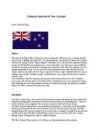
New Zealand has hundreds of waterfalls. Sutherland falls on the South Island is the fifth highest waterfall in he world. New Zealand enjoys a temperate and moist climate, without extremes of heat or cold. Seasons are the reverse of the Northern Hemisphere History A brown-skinned people called Maori were the first people to live in New Zealand. Europeans first visited the country in 1642, but they didn't start to settle on the island until the late 1700''. Today, New Zealanders are descendants of early European settlers who arrived in 1800's. The settlers came mainly from Britain. The country was once part of the British Empire. Today, it is an independent member of the Commonwealth of Nations. Economy The economy of new zealand has long depended on farming and foreign trade. The sale of butter, cheese, meat and wool to other countries provides much of the nation's income. Tourism has also become an importand source of income. New Zealand has few minerals.
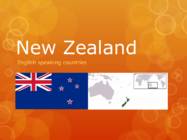
New Zealand English speaking countries Where? o It is in the southwestern Pacific Ocean o Next to the Australia About Capital-Wellington Largest city-Auckland Government-Unitary parliamentary constitutional monarchy • Monarch - Queen Elizabeth II • Governor-general - Jerry Mateparae • Prime minister - John Key About Area-268,021 km2 Population-4,509,461 ( January 2014 ) Anthem-"God Defend New Zealand„ New Zealanders are calling their country Aotearoa. History o Māori were the first to arrive in New Zealand, journeying in canoes from Hawaiki about 1,000 years ago. A Dutchman, Abel Tasman, was the first European to sight the country In 1840, the Treaty of Waitangi was signed, an agreement between the British Crown and Maori Nature New Zealand is made up of two main islands and a number of smaller islands The South Island is the largest landmass of New Zealand
In 1642, a Dutch Explorer Abel Tasman, was the first European to discover New Zealand In 1769, Captain James Cook reached the islands. The first European to land on them 18th and 19th centuries Europeans began to officially settle on New Zealand The Treaty of Waitangi - protection Maori lands if the tribes recognize British control MAORI PAKEHA 20TH CENTURY MILITARY New Zealand Thousands of New After World War I troops fought Zealanders died was established overseas again in overseas in the the tradition of the Second World First World War ANZAC (Australian and War in support of New Zealand Army Corps) the UK The United States New Zealand protected New fought in Korea in Zealand against the 1950s and in Japan during the Vietnam in the
temperatures rarely falling below 0 'C or rising above 30 'C in populated areas. its isolation from continental (influences and exposure to cold southerly winds and ocean currents) give(s) the climate a much milder character. In winter the South Island mountains and central North Island have heavy snowfalls. New Zealand has about 4,3 million people. The population is unevenly distributed. Three fourths of New Zealanders live on warmer North Island and about 84 per cent of the people live in urban areas and about half of these in the four largest cities. The largest centre with over 1 million inhabitants is Auckland. ..................................................................................................................................................... In 1642, the Dutch sailor Abel Tasman visited New Zealand and named it Zeeland. After
New Zealand is a constitutional monarchy with a parlamentary democracy. The House of Representatives - with 120 members an 5 seats for Maoris. Queen Elizabeth is Queen of New Zealand and is represented as head of state by the Governorgeneral. Free education and medical healthcare for children and adult alike are part of the Goverment social platforms. Economy has traditionally been based on exports. Biggest cities: Although agriculture is important to the New Zealand economy, most New Zealanders live in cities. Of our 3.65 million population almost three quarters live in urban areas. Auckland is the largest city while Wellington is the country's capital city. Greater Auckland contains almost one quarter of the country's population. The largest cities are: Auckland, Manukau, North Shore, Wellington, Christchurch, Dunedin, and Hamilton . Arts: New Zealand art is visual art created in New Zealand or by New Zealanders. It includes traditional
marked? Since 1805, the Sovereign's 'official' summer birthday has been marked by the Trooping the Colour ceremony, which is also known as the Queen's Birthday Parade, and is normally held on the second Saturday in June. The list of Birthday Honours is also announced at the time of the UK Official Birthday celebrations. The day is also marked by the flying of the Union flag on government buildings The Queen Birthday is celebrated in other countrys too Australia & New Zealanders mark the occasion in style by taking the day off work. Most of Australia marks the official birthday on second Monday in June. Western Australia mark the official birthday on last Monday in september on first Monday in October. On New Zealand, the first Monday in June is the Queen's birthday. Queen's birthday celebrating video Pictures Queen Elizabeth II and
Culture The contemporary New Zealand has got very diverse culture, which has been affected by nnglish, scottish, irish and maori cultures. Although most of the immigrants came from England, many people also came from Scotland with earlier British settlers and took along their own cultural elements. People say that in New Zealand there are more bagpipe ensembles than in Scotland. Thanks to permanent immigration from England and the fact that many young new-zealanders spend time in England for getting "over-sea experiences", the cultural connection between New Zealand and England won't get lost. Also the traditional English language stays preserved. Every year local people organize the Pacific Islands-themed festival Pasifika. It's held in Western Springs (a park in the west of the city), Auckland. Conclusion In conclusin I might say that New Zealand seems to be a paradise for me. The
protected land. It's a huge beach, with everything you could possibly need for a day by the ocean -- car parks, idyllic picnic spots, walking and jogging tracks, secluded spaces for sunbathing and easy put-ins for boats. The beach is popular with local surfers, as well as wedding parties. 10. Ninety Mile Beach, Northland-While the name Ninety Mile Beach is actually a misnomer (it's really only 55 miles long, and New Zealanders use kilometers rather than miles), it is justly a top tourist destination for its staggering beauty. With sand dunes reminiscent of a desert landscape, it stretches from just west of Kaitaia right to Cape Reinga, the northernmost tip of New Zealand. Golden sands and impressive breakers alongside the magical Aupouri Forest make this perhaps the most famous beach in New Zealand -- it's certainly the biggest.
power is exercised by the Cabinet of New Zealand. Some Quick facts Capital: Wellington Government: Representative parliamentary democracy and Constitutional monarchy Currency: New Zealand dollar (NZD) Area: 270,534 sq km Population: 4,347,000 (February 2009 est.) Language: English, Maori, and New Zealand sign language Religion: unspecified/none 43%, Anglican 17%, Roman Catholic 14%, Presbyterian 11%, Methodist 3%, Pentecostal 1.7%, Baptist 1.3%, other Christian 9%, other 3% Culture New Zealanders have made a profound impact in the areas of art, poetry, music, film, and architecture. Not only have the artists reached local recognition, but also gained worldwide apperception. New Kiwi self-confidence is revealed intensely in literature, film and theater. Opera diva Kiri Te Kanawa performs regularly nationally and internationally. Writers such as Witi Ihimaera, Albert Wendt, Patricia Grace, and Keri Hulme are also international figures. Fine Arts
badges. It was later featured in the badges of the South Canterbury Battalion in 1886 and the Hastings Rifle Volunteers in 1887. Soon after, kiwis appeared in many military badges. During the First World War, the giant kiwi was carved on the chalk hill above Sling Camp in England. During the war, the name "Kiwi" for New Zealand soldiers came into general use. The Kiwi bird has since become the well-known national symbol for New Zealand. All New Zealanders overseas (and at home) are still called "Kiwis". The Kiwi is still closely associated with the Armed Forces of NZ. The New Zealand dollar is often referred to as the "Kiwi", and the kiwi fruit is known as a "Kiwi" in some countries. Kiwis are prominent in the coat of arms, crests and badges of many New Zealand cities, clubs and organisations. Used sources: http://www.mch.govt.nz/emblems/index.html http://en.wikipedia.org/wiki/Category:National_symbols_of_New_Zealand http://www.chemistry.co
create an aura of invincibility around him, accept his mistreatments, disrespects, looting of your possessions, disrespect of your women, but then turn around to complain about his unfairness. Today in Africa, if you are Caucasian, you are God’s incarnate. In Africa, if you are Caucasian, it means being the following: Europeans (British, French, German, Italian, Israeli, Russians, Turkish, Greek, Belgian, Nordics, Australians and New Zealanders); Asians (Chinese, Indians, Pakistanis, Japanese) and of course Americans and Canadians (excluding Blacks of course). If you are one of these groups, you are accorded the respect and worship reserved for God. Being seen in the company of a Caucasian person accords you instantly respectability and credibility. It accords you intelligence. 23 If you want to be successful, bring in a Caucasian partner
population Aboutonethirdof New Zealand's pE0pLE:Arthoughweilington city,it is nottherargest. is thecapitar 15%ofallNew liveinruralareas' Zealanders ci$ inNewZealand' thelargest tooay,onlyabout of Auckland, There settlers. numbers arealsoincreasing aredescendants
population Aboutonethirdof New Zealand's pE0pLE:Arthoughweilington city,it is nottherargest. is thecapitar 15%ofallNew liveinruralareas' Zealanders ci$ inNewZealand' thelargest tooay,onlyabout of Auckland, There settlers. numbers arealsoincreasing aredescendants
population Aboutonethirdof New Zealand's pE0pLE:Arthoughweilington city,it is nottherargest. is thecapitar 15%ofallNew liveinruralareas' Zealanders ci$ inNewZealand' thelargest tooay,onlyabout of Auckland, There settlers. numbers arealsoincreasing aredescendants
population Aboutonethirdof New Zealand's pE0pLE:Arthoughweilington city,it is nottherargest. is thecapitar 15%ofallNew liveinruralareas' Zealanders ci$ inNewZealand' thelargest tooay,onlyabout of Auckland, There settlers. numbers arealsoincreasing aredescendants
 annaabi.ee