 50 punkti
Autor soovib selle materjali allalaadimise eest saada 50 punkti.
50 punkti
Autor soovib selle materjali allalaadimise eest saada 50 punkti.
 ~ 6 lehte
Lehekülgede arv dokumendis
~ 6 lehte
Lehekülgede arv dokumendis
 2011-05-29
Kuupäev, millal dokument üles laeti
2011-05-29
Kuupäev, millal dokument üles laeti
 11 laadimist
Kokku alla laetud
11 laadimist
Kokku alla laetud
 0 arvamust
Teiste kasutajate poolt lisatud kommentaarid
0 arvamust
Teiste kasutajate poolt lisatud kommentaarid
 Heleriiii
Õppematerjali autor
Heleriiii
Õppematerjali autor
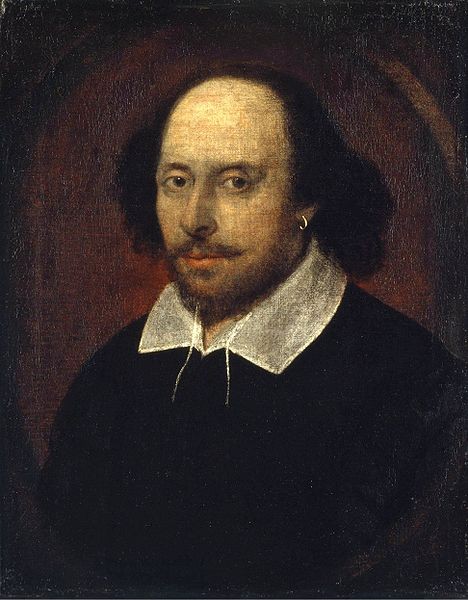
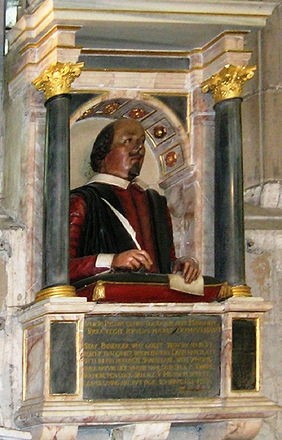
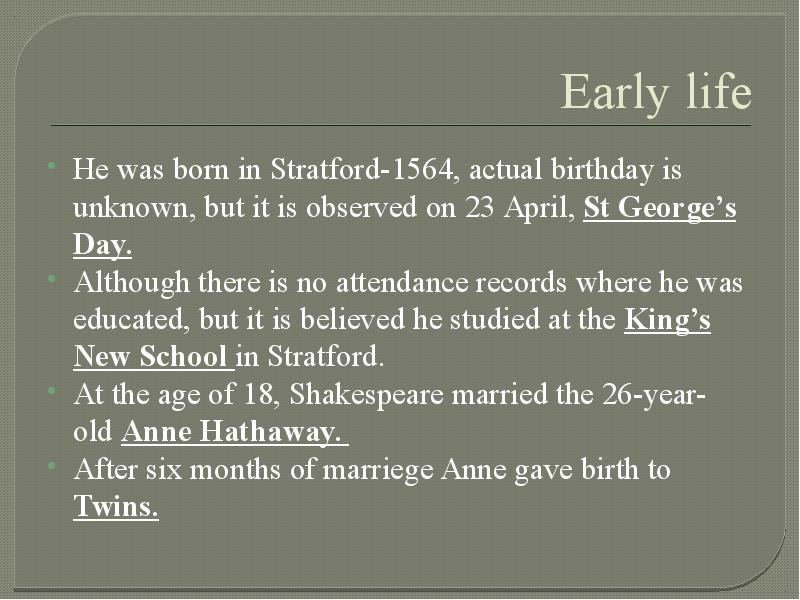
Shakespeare Elulugu · Was born in 1564, probably on April 23, in the small country town of Stratford-on- Avon · Father was a prosperous glove maker and held several important positions in the town government · Mother, Mary Arden, was the daughter of a wealthy landowner · By the age of 7, Shakespeare was probably attending the local grammar school · In 1582, at the age of 18, he married Anne Hathaway (26), the daughter of a farmer who lived about a mile from Stratford · Daughter Susanna (born in 1583) and twins, Hamnet and Judith (born in 1585; Hamnet died in 1596) · From 1585 to 1592, a period some scholars call ,,the lost years" · From 1592 the recors about Shakespeare are much fuller.
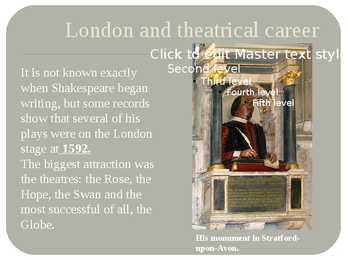
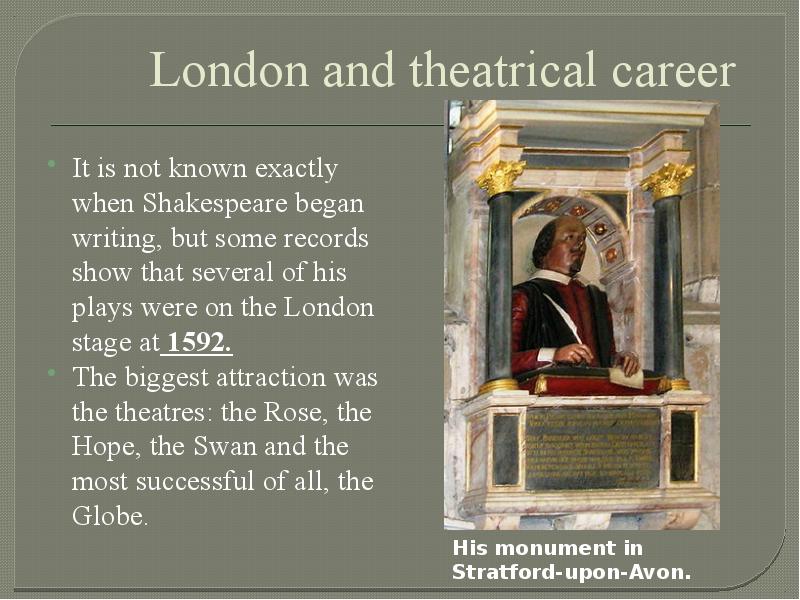
Globe Theater The Globe Theatre was a theatre in London associated with William Shakespeare. He wrote there many of his greatest plays. It was first built in 1599 by Shakespeare's playing company, the Lord Chamberlain's Men, and was destroyed by fire on 29 June 1613. It was rebuilt in June 1614 and closed in 1642. It stood on the bank of the River Thames in Southwark, London, England, UK. In 1987, though, after many years of careful research, work began to build a new theatre as much like the original as possible. The New Globe was built with the same materials and
1476 a man called Caxton opened the first printing shop in London. Books became cheaper. Until that books were copied by clergyman. More books could be produced. Literacy spread, knowledge of reading. By te end of Renaissance half of the people could read. Monasteries wasn't so important anymore. Grammar schools came. Students are taught English, Latin, Ancient History, Greek, Religion and Arithmetic. One of the oldest schools was Stratford, Shakespeare taught there. Art and Literature The word Renaissance means the rebirth of ancient Rome and Greek art and literature. Ancient artists showed man as a creature full of joy of life and they glorified the beauty of man. The learned man tried to arouse (äratada) peoples interest in the origin of nature. A group of scientists called humanists came into being. Were gratelyinterested in science. Especially natural science, fond of experimenting (alkeemia). Leonardo da
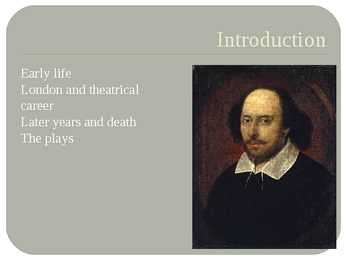
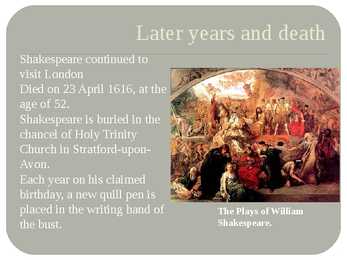
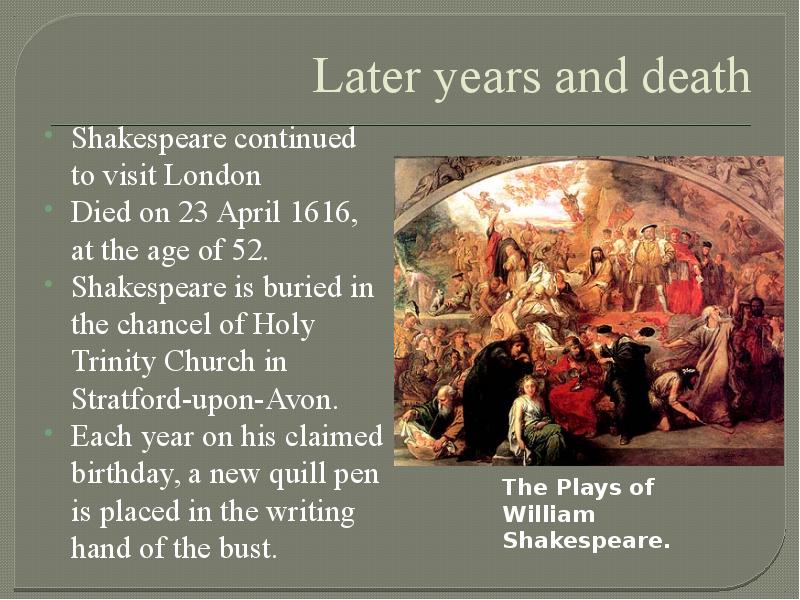
EARLY LIFE: ·Born in Stratford- upon-Avon on April 23, 1564 ·Parents: John Shakespeare Mary Arden EDUCATION: · Attended King Edward IV Grammar School · Never went to university THE LOST YEARS: 1585 1592 ·Quit school ·Supported his family ·Became involved with acting MARRIAGE: · Married to Anne Hathaway · Shakespeare's children: Susanna Judith Hamnet (+ William Davenant?) CAREER IN LONDON: · Acted in several companies of players · By 1584 had become an important playwright-actor in the Lord Chamberlain's Company (the King's Men) · Wrote many great plays, for example: "A Midsummer Night's Dream" "Merchant of Venice" "Romeo and Juliet" "Othello" "Hamlet" etc. · Also wrote poems and sonnets THE GLOBE THEATRE: LATER YEARS AND DEATH: · 1610 returned to his birthplace, lived in the New Place · Died on on April 23, 1616
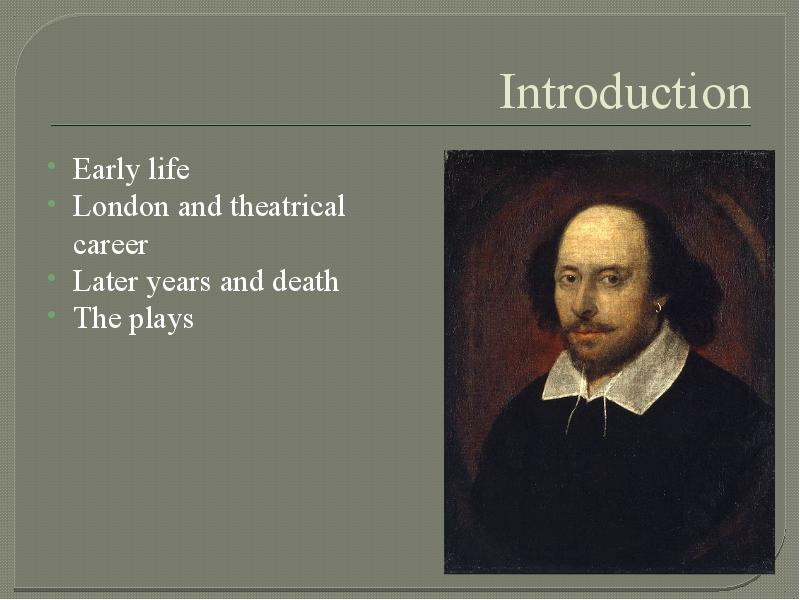
At night Grendel's mother come for revenge at night, Beowulf defeats her as well with a magic sword. At the beginning of part II 50 years have passed. Beowulf is a wise king of Jutland when a fire dragon comes to exact revenge for the theft of its precious cup. B. summons his men to battle the dragon, but only one man shows up. Despite that Beowulf manages to defeat the dragon. However he is badly injured and dies. He is buried. THE END. William SHAKESPEARE (April 23, 1564 April 23, 1616) He was baptized on the 29th of April. His father, John, was a merchant, bailiff and leading citizen; his mother, Mary Arden, was a rich farmer's daughter. He attended the local grammar school. He wed his older wife, Anne Hathaway at the age of 18 and they had 3 children - Susanna, and twins Judith/Hamnet. Susanna later became William's caretaker after the death of his wife and the twins.
The most important music of the early Renaissance was composed for use by the church--polyphonic (made up of several simultaneous melodies) masses and motets in Latin for important churches and court chapels. By the end of the sixteenth century, however, patronage was split among many areas: the Catholic Church, Protestant churches and courts, wealthy amateurs, and music printing-- all were sources of income for composers. Literature Printing press: William Caxton was the person who introduced printing in England. Before that, the books were written out in longhand, what meant a very slow jog. With the printing , it was possible to produce books in large numbers and in a short amoun of time. That way, more people could learn to read and write. The oral tradition began to loose power both in literature and in the Church affairs. Thomas More(1480-1535) One of the gratest of all English humanists mainly for the book
English writers Maria maasing Edwin Abbott Abbott · Edwin Abbott Abbott(1838-1926)was an English clergyman and writer.He was born in London. He wrote several theological works and a biography (1885) of Francis Bacon, but he is best known for his Shakespearian Grammar (1870) and religious allegory the Flatland. William Blake · William Blake (17571827) was an English poet, philosopher and artist.He was one of the most extraordinary personalities to emerge during the period of Romanticism. He believed that spiritual reality lies hidden behind the visible world of the senses and he attempted to create a symbolic language to represent his spiritual visions. He began printing his own illustrated poems in colour in 1787. The first example was Songs of innocence(1789)
in this type of group pilgrimage. Why masterpiece: It is written in English in a period when it was forgone conclusion that all serious writing had to done in Latin or French. It is a valuable social document as it gives us an insight into a cross-section of 14th-cent. LITERATURE IN THE MIDDLE AGES. Languages spoken : English, French, Latin. There was four major dialects, east became the basic dialect because it was spoken in London. By 1476, when William Caxton introduced printing, Old English into New English. Latin was generally considered to be the language of serious writing. Religious lyrics also made an appearance at this time. Throughout the Middle Ages ballads, short folk tales that tell stories, were very popular. THE RENAISSANCE: The Literary Background 16th century, - humanism. Thomas More- brought it to England and he was arrested because he refused to acknowledge Henry VIII as the Head of the Church
 annaabi.ee








Kõik kommentaarid