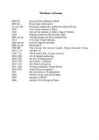
The History of Estonia 8000 BC traces of first settlement at Pulli 3000 BC Finno-Ugric tribes arrive 1st cent AD Estonians mentioned in written records by Tacitus 1030 first written mention of Tartu 1154 first written mention of Tallinn, map of Estonia 1219 Danish invasion by the Teutonic Order 13th century German invasion by the Livonian Order 1343 St George's Night uprising 15th century serfdom begins to develop 16th century Reformation 1558.1583 The Livonian War between Sweden, Poland, Denmark, Russia 1629
Estonia is a state in the Baltic region of Northern Europe. It is bordered to the north by the Gulf of Finland, to the west by the Baltic Sea, to the south by Latvia (343 km), and to the east by Lake Peipus and Russia (338.6 km). Across the Baltic Sea lies Sweden in the west and Finland in the north. The territory of Estonia covers 45,227 km2 (17,462 sq mi), and is influenced by a humid continental climate. The Estonians are a Finnic people, and the official language, Estonian, is a Finno-Ugric language closely related to Finnish, and distantly to Hungarian and to the Sami languages. Estonia is a democratic parliamentary republic divided into fifteen counties, with its capital and largest city being Tallinn. Estonia's population of 1.3 million makes it one of the least-populous member states of the European Union, Eurozone and the North Atlantic Treaty Organization. A developed country with an advanced, high-income economy, Estonia has the highest gross
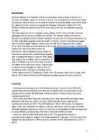
Estonia is a country in northern Europe. Estonia has land borders in the south with Latvia and in the east with Russia, it's oversea neighbours are Finland and Sweden. Estonia has got 15 counties. Estonia has been an independent country since 1991. Tallinn is the capital city of Estonia. Estonia is a member of European Union nad NATO. Estonia is a democratic republic and it's president is Toomas Hendrik Ilves. The official language of Estonia is Estonian, which is Finno-Ugric language and has many similarities with Finnish. The population of Estonia contains mainly Estonians but some Russians and other ethnicities too. Many foreign people think of Estonia as an old-timed soviet union country, but in my opinion Estonia is quite far-advanced country. Estonian national symbols are cornflower, slate, swallow and it's blue-black-white flag. There is very high level of education in Estonia, mainly because Tartu
Estonian Language Estonian laguage(previously called ,,ground language" by estonians in old days) belongs into Finno-Ugric language group. It is spoken by about 1.1 million people, mostly in Estonia. Some people have said Estonian reminds them of the sound of babbling water. Some non-Estonian people I know just say it sounds weird. Estonian language is closely related to Finnish. Originally they were a single language but they parted about 5000 years ago. Most of Estonian vocabulary is borrowed from other languages like German ang English. Very few of Estonian words are originally Estonian.
Culture Estonian Estonian is the official language of Estonia, spoken by about 1.1 million people in Estonia. It is a Finno-Ugric language and is closely related to Finnish. Theatre There are Click to edit Master text styles Second level Third level Fourth level Fifth level Eduard Viiralt Click to edit Master text styles Second level
The most important key dates in Estonian history Every country has its history and some moments are more important than the others. Here are some of the most notable dates from Estonian history. 3rd millennium BC the Finno-Ugric tribes arrive in Estonia 1154 First written mention of Tallinn (by al-Idrisi) 13th century German and Danish invade Estonia. Estonians' numerous attempts to restore independence fail 1343 St. George's Night uprising 1558-1583 the Livonian War after which Northern Estonia is occupied by Sweden and Southern Estonia occupied by Poland 1632 Tartu University was founded
Tallinn is the capital city of Estonia. It's not very large, there lives about 400 000 pedestrians. Estonia is a member of European Union and NATO. Estonia is a democratic republic and it's president is Toomas Hendrik Ilves. The territory of Estonia covers 45,227 km² and is influenced by a temperate seasonal climate. The surface there is mainly flat, but in the southern parts of Estonia it gets little bumpy. The official language of Estonia is Estonian, which is Finno-Ugric language and has many similarities with Finnish. The population of Estonia contains mainly Estonians but some Russians and other ethnicities too. Many foreign people think of Estonia as an old-timed soviet union country, but it isn't anymore, Estonia is quite far-advanced country. Estonian national symbols are cornflower, slate, swallow and it's blue- black-white flag. There is very high level of education in Estonia, mainly because Tartu University, which makes Tartu
estonian culture The culture of Estonia incorporates indigenous heritage, as represented by the country's rare Finno-Ugric national language Estonian, with mainstream Nordic and European cultural aspects. Due to its history and geography, Estonia's culture has been influenced by the traditions of the adjacent area's various Finnic, Baltic, Slavic and Germanic peoples as well as the cultural developments in the former dominant powers Sweden and Russia. Traditionally, Estonia has been seen as an area of rivalry between western and eastern Europe on many levels. An example of this geopolitical legacy is an
1%, Finns 1% Capital of Estonia: Tallinn Number of islands: 1 521 Highest point: Suur-Munamagi (Great Egg Hill) 318 m Religion: Lutheran Currency: Estonian Kroon (EEK),1 EUR = 15,65 EEK Estonia has two Independence Days - Estonia first achieved independence from the Soviet Union on the 24th February 1918 and again on the 20th August 1991 after 51 years of occupation. The second date is known as the Restoration of Independence Day The Estonian language belongs to the Finno-Ugric group and is most similar to Finnish Estonia was the first country in the world to introduce online political voting Estonia won the Eurovision Song Contest in 2001 with the song Everybody There are over 1500 Islands, 1000 lakes and 7000 rivers in Estonia Chess Grandmaster Paul Keres was born in Estonia. When he died in 1975 over 100,000 people attended his funeral, thats around 10% of the entire population of Estonia! The official name of Estonia is the Republic of Estonia.
Across the Baltic Sea lies Sweden in the west and Finland in the north. The territory of Estonia covers 45,227 km2, and is influenced by a humid continental climate. Estonia is a democratic parliamentary republic divided into fifteen counties, with its capital and largest city beingTallinn. With a population of 1.3 million, it is one of the least-populous member states of the European Union. The Estonians are a Finnic people, and the official language, Estonian, is a Finno-Ugric language closely related to Finnish The history of Estonia is a part of the history of Europe. Estonia was settled near the end of the last glacial era, beginning from around 8500 BC. Before the Germans invaded in the 13th century proto-Estonians of the Ancient Estonia worshipped the spirits of nature Starting with the Northern Crusades Estonia became a battleground for centuries where Denmark, Germany, Russia, Sweden and Poland fought their many wars over controlling the important
to the south by Latvia, and to the east by the Lake Peipsi and the Russian Federation. The territory of Estonia covers 45,227 km2. The capital, Tallinn, has around 400000 inhabitants.Tallinn's ability to blend medieval architecture with Scandinavian modernity with all the comforts you'd expect from a modern, competitive and innovative capital. Estonian language, does not belong to the Indo-European group. It belongs to the Finno-Ugric language family, which also includes Finnish and Hungarian. Estonian dialects are divided into two groups, Northern and Southern, usually associated with biggest cities of those regions Tallinn, the capital, in the north and Tartu, second largest city, in the south. In some of the southern regions, people speak Seto and Võro dialects, which are sometimes considered to be separate languages altogether. Dialects spoken
Milestones in Estonian History The Estonians are a Finno-Ugric people who came from the area near the Urals and the Volga and Oka rivers. They migrated westward to the Baltic shores some 5, 000 years ago. In the ninth century A.D. Viking ships invaded Estonia and the country became a vital link in the sea-trade between East and West. By the 12th century, the Arabian geographer al-Idrisi had placed the city on his maps. In the 13th century, Tallinn joined the Hanseatic League, the union of European commercial towns that stretched from London to Novgorod
• Estonians are seen as calm, withdrawn and shy. Of course this isn’t true for every Estonian and once you get to know them they’re very open. • Estonians are patriotic due to the hardships during it’s history and their own shared love of their home country. • Historically Estonia is one of the "least religious" countries in the world in terms attitudes, though many Estonians do look for alternative beliefs. Language • The Estonian language is finno ugric, it’s closest relatives are the Finno-Ugrian languages of the Vedic and Livonian languages. • There are many dialects, the main groups can be separated into North and South Estonian dialects. • Besides the typical spoken Estonian language the second most notewordy dialect is the Võru dialect. • Estonian is one of the languages with a larger number of noun cases than typical. • According to comparative grammar studies, Estonian
In late 2003, the Tartu Toy Museum moved to its new location, an old wooden building on Lutsu Street, which had been specially renovated to house the museum. On 13 March 2004 a new permanent exhibit was opened, including a playroom and crafts room. The permanent exhibit displays toys that children in Estonia have played with throughout the ages. The display also includes artist-made dolls, souvenir dolls from around the globe and traditional Finno-Ugric toys. On 2 December 2005 the exhibit of movie- and theatre puppets was opened in the former coach house in the museum's courtyard, displaying characters, props and sketches of animated films made in Estonia over the last half century. On the building's second floor there is a display of theatre- and movie puppets from Estonia and other parts of the world. Located in an old wooden building in the heart of Tartu's Old Town, the Toy
Estonia, officially the Republic of Estonia, is a state in the Baltic region of Northern Europe. It is bordered to the north by the Gulf of Finland, to the west by the Baltic Sea, to the south by Latvia, and to the east by Lake Peipus and Russia. Across the Baltic Sea lies Sweden in the west and Finland in the north. The territory of Estonia covers 45,227 km 2, and is influenced by a humid continental climate. The Estonians are a Finnic people, and the official language, Estonian, is a Finno-Ugric language closely related to Finnish, and distantly to Hungarian and to the Sami languages. The population of Estonia is 1.5 million. Of this number 62 per cent are Estonians. The geography of the land is surprisingly varied. Islands make up 9,2 per cent of Estonian’s total territory, the largest islands are Saaremaa, Hiiumaa and Vormsi. The highest point is Suur Munamägi, which is 317m high. Estonia has a surprisingly mild climate for an area so far north
of the Coimbra group *Abolition of serfdom 1816 *Song festival 1869 in Tartu, an organiser was J.V.Jannsen, 822 singers, men only *Declaration of independence 24th February 1918 *War of independence 1918-1920 during the Russian Civil War, resulted in a victory for Estonia *Deportation 1949 *Estonia becomes independent 20th August 1991 *Joining EU 1st May 2004 Language: Estonian language, belongs to the Balti-Finnic group of the Finno-Ugric languages, closely realted to Finnish and rather remotely to Hungarian; Latin alphabet with 32 letters , 5 of which occur only in foreign words, the phenomes include 9 vowels and 18 consonants; words are borrowed from Latin, Greek, English etc.; since 1995 the 14th of March is celebrated as the Mother Tongue Day, in 2000 UNESCO declared 21 February World Mother Tongue Day; the first estonian calendar was published in 1731, radio broadcasts started in 1924, book was published in 1535
and Jotuni. Some authors prefer tom write in Swedish, thereby reaching a larger public. The Finns have also been strongly influenced by German music. Since the late nineteenth century, however, conscious attempts to produce an indigenous Finnish music have been successful, such composers as Sibelius, Kajanus, Jarnefelt, Palmgren and Kilpinen have become widely recognised. The Finnish language is part of the Finno-Ugric branch of the Ural-Altaic family of languages related to Hungarian, Estonian and Lapponic. Most of the people are Lutherans and there is freedom of worship. (New knowledge library: universal reference encyclopedia) 7 History The first inhabitants of Finland were the Sami (Lapp) people. When Finnish speakers migrated to Finland in the first millennium B.C., the Sami were forced
in Estonia. Tallinn, Pärnu and Tartu are all hansaeatic cities. Narva Narva is the third largest city in Estonia. It is located by the Russian border, on the Narva River which drains Lake Peipsi. Narva is the easternomost city in Estonia. 8 Language Estonia's official language is Estonian. It is spoken by about 1.1 million people in Estonia and by about ten thousand people who live in various other countries. It is a Finno-Ugric language and it is closely related to Finnish. For a small nation a language plays a key role in maintaining its national identity. Estonian language uses the Latin alphabet and it has 32 letters. An interesting feature that sets Estonian apart from most languages is the vowel. The most unusal ones for foreingers are ä,ö,õ and ü. The language also has grammar durations and declinations. There are three durations (short, long and extra long and ) and fourteen decliantions
Isamaa (Fatherland Alliance) formed a coalition government with two other parties; party leader Mart Laar became premier. Laar is acknowledged as probably the most successful Politian in Estonia, taking much credit for guiding Estonia through major political and economic changes. 3 Culture The culture of Estonia incorporates indigenous heritage, as represented by the country's rare Finno-Ugric national language Estonian and the sauna, with mainstream Nordic and European cultural aspects. Due to its history and geography, Estonia's culture has been influenced by the traditions of the adjacent area's various Finnic, Baltic and Germanic peoples as well as the cultural developments in the former dominant powers Sweden and Russia. Estonian holidays are mostly based on the Western Christian calendar and Protestant traditions.
consecrate, to bless, halga sacred, a saint, Middle English halwe (see Prologue to the Canterbury Tales: ferne halwes distant shrines metonymic from the meaning "saint" TO HALLOW (as in "Our Father who art in heaven,hallowedbe thy name"), HALLOW meaning "saint" (the latter is a French loan (ALL HALLOWS' DAY, HALLOWEEN). The metonymic link between "being in one piece" and "being healthy" is fairly universal (cf. the two meanings of the Estonian word "terve" a Finno-Ugric, i.e. a non-Indo European word! or Russian "" (whole) and "" to heal (NB! Modern medicine uses "treat" and "cure" the latter when the result is positive, "heal" is generally used in alternative medicine as is "", cf also Healer and as names for Jesus). The use of a word denoting "health" in greetings and other ritual formulas ( as in HAIL!) is also fairlyuniversal (cf. Estonian "terviseks" and "tere"<"terve", Russian "()" < ""; ancient Romans used "Vale!" "be healthy
the Baltic Sea. It is unique for its well-preserved architecture from the 13-15 centuries. In contrast to the ancient town-walls and towers, Tallinn of today offers modern hotels, restaurants, sport and cultural centres. Every five years national song and folk dance festivals take place in Tallinn. The yachting regatta of the 1980 Moscow Olympic Games was held at Pirita. History Tallinn means in English "Danish town". The place is believed to have been settled by Finno-Ugric people about 2500 BC. It was first marked on a map of the world by the Arab geographer al-Idrisi in 1154. The Estonians were the first to build a stronghold on the spot of the Toompea Hill, but the real Tallinn was built by the Danes who conquered the north of Estonia in 1219. Legend has it that one day, when the Danes were about to lose a bloody battle, the sky suddenly opened and a red flag with a white cross on it dropped down upon them from the heaven
In the 13th-century Chronicle of Henricus de Lettis the town was called Lyndanise. Later came Reval (presumably after the old county of Rävala), the name used by the Germans who ruled the country for seven centuries. Russians then modified Reval to Revel. For Estonians, the town came to be called Tallinn from Taanilinn (Danish town) after Danish conquest in the 13th century. Over the course of time, Taanilinn was shortened to Tallinn The place is believed to have been settled by Finno-Ugric peoples about 2500 BC. The Danes, led by King Valdemar II, conquered northern Estonia in 1219. Legend has it that one day, when the Danes were about to lose a bloody battle, the sky suddenly opened and a red flag with a white cross on it dropped down upon them from the heavens. This is allegedly how the Danes obtained their national flag, the Dannebrog in a battle against the Estonians. In the middle of the 14th century Denmark sold its possessions in Estonia to the German Teutonic Order
Siberia. Hundreds of thousands of migrants were relocated to Estonia from other parts of the Soviet Union to conduct industrialization and militarization, contributing to an increase in population of about half a million in just 45 years. 9. Culture Estonian is the official language of the Republic of Estonia and is spoken by the majority of people in the country. It belongs to the Balto-Finnic group of the Finno-Ugric languages. Standard Estonian is based on the North-Estonian dialect. Estonian language sounds melodious, because 45 per cent of the sounds are vowels. Estonian is quite hard to learn but that is no problem for local inhabitants, because most of Estonians are hard-working and appreciate education. They are also cool and reserved, but also not too eager to open a conversation with a stranger. Estonia has rich culture. Music and dances have always played an important role in people's life
SOME PROGRAMMES WITH ESTONIAN MUSIC AND CONDUCTORS. APPENDIX H. INDEX OF PERSONAL NAMES. APPENDIX I. SELECTION OF PHOTOGRAPHS. APPENDIX J. MUSICAL EXAMPLES. PIANO ARRANGEMENTS AND SCORE SAMPLES. APPENDIX K. USEFUL ADDRESSES. ABOUT THE AUTHOR ESTONIA AND THE ESTONIANS Estonia is situated on the southern shore of the Gulf of Finland, between the Baltic Sea and Lake Peipsi. The country is populated by Estonians who belong to the Western Finnish group of nations, a branch of the Finno-Ugric stem, and speak the Estonian language. Estonia is the northernmost of the Baltic States. From west to east the length of the country is 360 kilometres and the width, from north to south, is 255 kilometres. The area is 45,227 square kilometres of which more than 4,000 square kilometres are made up by islands and islets (over 1,000); there are more than 1,400 lakes that form nearly 5% of the total area. More than 40% of the entire area is woodland
 annaabi.ee