The word Saga might be objected to on the ground that it connotes the heroic and that there is little heroism in these pages. But it is used with a suitable irony; and, after all, this long tale, though it may deal with folk in frock coats, furbelows, and a gilt- edged period, is not devoid of the essential heat of conflict. Discounting for the gigantic stature and blood-thirstiness of old days, as they have come down to us in fairy-tale and legend, the folk of the old Sagas were Forsytes, assuredly, in their possessive instincts, and as little proof against the inroads of beauty and passion as Swithin, Soames, or even Young Jolyon. And if heroic figures, in days that never were, seem to startle out from their surroundings in fashion unbecoming to a Forsyte of the Victorian era, we may be sure that tribal instinct was even then the prime force, and that "family" and the sense of home and property counted as they do to this day, for all the recent
economy and culture. From approximately the 1st to 5th centuries AD, resident farming was widely established, the population grew, and settlement expanded. Cultural influences from the Roman Empire reached Estonia, and this era is therefore also known as the Roman Iron Age. A more troubled and war-ridden middle Iron Age followed with external dangers coming both from the Baltic tribes, who attacked across the southern land border, and from overseas. Several Scandinavian sagas refer to campaigns against Estonia. Estonian pirates conducted similar raids in the Viking age and sacked and burned the Scandinavian capital of Sigtuna in 1187. By the early 13th century, Estonia was divided into eight large counties -- Saaremaa, Läänemaa, Rävala, Harju, Viru, Järva, Sakala, and Ugandi. Annual consultations were held by representatives of several counties and developments took the direction of establishing a state. Estonia until this
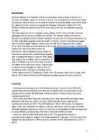
by Latvia (343 km), and to the east by the Russian Federation (338,6 km). The territory of Estonia covers 45,227 km² and is influenced by a temperate seasonal climate. The Estonians are a Finnic people closely related to the Finns, with the Estonian language sharing many similarities to Finnish. The modern name of Estonia is thought to originate from the Roman historian Tacitus, who in his book Germania (ca. AD 98) described a people called the Aestii. Similarly, ancient Scandinavian sagas refer to a land called Eistland, close to the German term Estland for the country. Early Latin and other ancient versions of the name are Estia and Hestia. Until the late 1930s, the name was often written as Esthonia in most English speaking countries. Estonia is a democratic parliamentary republic and is divided into fifteen counties. The capital and largest city is Tallinn. With a population of only 1.4 million, it is one of the least-populous members of the European Union. Estonia was
The Anglo-Saxons were farmers and fishermen and lived in small communities. They deployed a crop rotation over three fields; used heavy ploughs. In 787 AD came the Vikings from Scandinavia, who set up their own state Danelaw. Had their own religion, however their rituals did not demand sacrifices. Introduced new words (1800). Placenames withe suffixes -by and -dale. They had their own customs and laws, which we know due to sagas (oral history). They had no written language. Beowulf Beowulf is an epic or a long poem describing the adventures of an hero. It belongs to the Anglo-Saxon period, when they were still living on the mainland and then brought to Greta Britain . It was made up in the 3rd or 4th century. I was spread orally until it was written down in the 10th century. The author is unknown and the manuscript is kept in the British Museum (near Trafalgar
and the colours of them are absolutely fantastic. 8. Population Estonia is one of the most sparsely populated countries in Europe with 29 people per one square mile. The estimated population in 2007 was 1.3 million. From approximately the first to fifth centuries AD, resident farming was established and the population grew. A more troubled and war-ridden middle Iron Age followed with dangers coming both from the Baltic tribes and from overseas. Several Scandinavian sagas refer to Estonian pirates. During the wars under foreign rule, the number of Estonians diminished. At one point the population in the whole country was only half a million. Although wars devastated the country, it recovered quickly and its people with it. Under Soviet rule in the 20 th century, many Estonians, Lithuanians and Latvians were deported to the coldest parts of Siberia. Hundreds of thousands of migrants were relocated to Estonia from other
In AD 985 Norse seamen sailing from Iceland to Greenland were blown far westward off their course and sighted the coast of what must have been Labrador. The report of forested areas on the strange new coast encouraged further explorations by Norse colonists from Greenland, whose settlers lacked lumber. In AD 1000 Leif Eriksson became the first European to land in North America. According to the sagas this was the first of many Norse voyages to the eastern shores of the continent. Leif Eriksson established a colony what the Vikings described as Vinland. By 1600 the wealth from the fur trade and the fishing industry renewed French interests in North America. The King of France decided to settle what is now eastern Canada. The colony would be named New France. But for that claim to be
breath, poetry and classical harmony, while Bartók charms us with his alert and contrasting themes, juicy harmonic colouring, activated changes in rhythmic pulsation and linear polyphony. As a common feature of all Finno-Ugric composers we mark their individual starting point from national origins. Under national music I comprehend such works that express the temperament of the nation; its singular rhythms, ancient rituals, sagas, and also patriotism and the self-consciousness of the nation… Is folk melody needed as such a way of expression? I guess not; it is enough when in 1 this music these characteristic features can be found which are hidden in the folk tunes. National expression is an essential system of several characteristic features of that nation
 annaabi.ee