Excessive concern over drinking water, food, dishes and bedding. Fear of physical contact with attendants and servants. The absent, far-away stare (the tropical stare). A feeling of helplessness. Delay or refusal to learn the lg of the host country. Excessive fear of being cheated. Excessive concern over minor pains. Terrible longing to be back home. Reverse CS- re-entry shock- the unexpected confrontation with the familiar. Cultural dimensions. Non-verbal communication Nonverbal communication is usually understood as the process of communication through sending and receiving wordless messages. Such messages can be communicated through gesture; body language or posture; facial expression and eye contact; object communication such as clothing, hairstyles or even architecture; symbols and infographics. Speech may also contain nonverbal elements known as paralanguage, including voice
Burkhardt, Obiakor ja Rotatori (2004) selgitavad, et õpiraskused on seotud raskestimõistetava seguga võimetest ja puudustest õpilane võib lugeda, kuid tema õigekiri on halb, ta võib suuliselt vastata, kuid ei oska sama vastust kirjutada, võib täita töölehe esimese poole veatult, kuid teha teisele poolel palju vigu jne. Kasutatud kirjandus Kõrgesaar, J. 2002. Sissejuhatus hariduslike erivajaduste käsitlusse. Tartu Ülikool. Mamen, M. 2007. Understanding Nonverbal learning disabilities. A common-sense guide for parents and professional. J.K.Publishers Burkhardt, S.A., Obiakor, F.E., Rotatori, A.F. 2004. Current perspectives on learning disabilities. Emerald Group Publishing
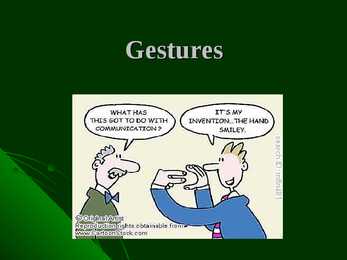
Locked hands behind head: states confidence. Sitting with a leg over the arm of the chair: suggests indifference. Legs and feet pointed in a particular direction: the direction where more interest is felt. Crossed arms: indicates submissiveness. Facial expressions A facial expression results from one or more motions or positions of the muscles of the face. These movements convey the emotional state of the individual to observers. Facial expressions are a form of nonverbal communication. They are a primary means of conveying social information among humans, but also occur in most other mammals and some other animal species. Thank you for listening !
Vocabulary list 1. internet service provider company that provides internet for a fee 2. globalization - or extending to other or all parts of the world 3. flash drive a portable miniature solid state drive that connects to a computer via a USB port 4. abbreviations a shortened form of a word 5. nonverbal communication communication without talking 6. social networking service that connects people who for example share interests, backgrounds or real-life connections 7. addiction - state of being enslaved to a habit or practice or to something that is psychologically or physically habit-forming 8. plagiarism presenting someone else's work as your own 9. distractor a person or thing that distracts the attention 10
Cultures provide people with ways of thinking--ways of seeing, hearing, and interpreting the world. The same words can mean different things to people from different cultures, even when they talk the "same" language. When the languages are different, and translation has to be used to communicate, the potential for misunderstandings increases. Second are "behavior constraints." Each culture has its own rules about proper behavior which affect verbal and nonverbal communication. Whether one looks the other person in the eye-or not; whether one says what one means overtly or talks around the issue; how close the people stand to each other when they are talking--all of these and many more are rules of politeness which differ from culture to culture. Third factor is "emotional constraints." Different cultures regulate the display of emotion differently. Some cultures get very emotional when they are debating an issue
Andra Pant NT-32 GETTING PHYSICAL Tallinn 2012 "Delivery is more important than content." Arch Lustberg, speech trainer According to wellknown social anthropologist Edward T. Hall, 60% of our communication is nonverbal. That means whenever we stand before an audience, our stance, our posture, our facial expressions, our hand gestures, our whole body dynamic communicate more than our actual spoken words. A stiff, immobile speaker is often a boring and usually ineffective speaker as. It is therefore essential to know how to be physically relaxed, which will allow your actions to complement your words.
Peripheral learning (posters, grammar charts on the walls) Students get new identities Lengthy dialogues with the target language and native language side by side (2 columns) 2 concert readings Reading I students follow the mother text. Both right and left sides of the brain get activated Reading II students relax and listen Homework includes rereading the text before sleep and next morning Language should come naturally and easily Everyday culture (dressing, nonverbal language) Focus on vocabulary and speaking, creative writing Meaning with the help of the mother tongue No formal tests Errors are not corrected immediately but afterwards 4 The goals are speaking and expressing freely, fluently and naturally; relaxed and comfortable atmosphere. It is more a student-centred method. Students are actively involved
& William, P. (2008). Loneliness. Human nature and need for social connection. W.W Norton & Company Cialdini, R. (2001). Mõjutsamise psühholoogia. Teeoria ja praktika. Pegasus Clinebell, H.C. H, Clinebell (1970). The intimate marriage. NY, Harper & Row Elgin, S.H. (1987). The Last Word on the Gentle Art of Verbal Self-Defense. Prentice Hall Press Feingold, A. (1992) Good-looking people are not what we think. Psychological Bulletin, 111, 302-341 Feldman, R., Rimé, B. (1991). Fundamentals of Nonverbal Behaviour. Cambridge University Press Hinde, R.A. (1997). Relationships. A Didactical Perspective. UK: Psychology Press Publisher Johnson, D. (1997). Reaching Out. Interpersonal Effectiveness and Self-Actualization.6thed. Krips, H. (2003). Suhtlemisoskustest õpetamisel ja juhtimisel. Kutsar, D. (1999). Lähedusest paarisuhetes. Akadeemia, 4, 747-766 (http://digar.nlib.ee/digar/show/?id=101697) Lehtsaar,L. (2008)
is pure information... It is a medium without a message, as it were, unless it is used to spell out some verbal a ad or name. This fact, characteristic of all media, means that the " Intent"_ of any medium is always .another medium. The content of writing is speech, just as the written word is the content of print, and print is the content of the telegraph. If it is asked, "What is the content of speech?," it is necessary to say, "It is an actual process of thought, which is in itself nonverbal." An abstract painting represents direct manifestation of creative thought processes as they might appear in computer designs. What we are considering here, however, are the psychic and social consequences of the designs or patterns as they amplify or accelerate existing processes. For the "message" of any medium or technology is the change of scale or pace or pattern that it introduces into human affairs. The railway did not introduce
39. Liivak, S. (2004). Hüperaktiivse õpilase õpetamise meetodid õpisituatsioonis. Bakalaureusetöö, TÜ pedagoogika osakond. 40. Little, L. (2003). Maternal perceptions of the importance of needs and resources for children with Asperger syndrome and nonverbal learning disorders. Focus on Autism and other Developmental Disabilities, 18(4), 257-266. 41. Lucker, J., R., & Molloy, A., T. (1995). Resources for working with children with attention- deficient/hyperactivity disorder (ADHDj. Elementary
) And he restricts his initial target further, distinguishing structured utterances from unstructured ones. A structured utterance has meaningful parts, such as individual words, which contribute to the utterance's overall meaning; any declarative English sentence is an example of this, since it contains words that are individually meaningful and it means what it does in virtue of those words meaning what they do. An unstructured utterance is a single expression or nonverbal gesture, such as "Ouch" or a beckoning motion that means "This way," whose meaning is not compositional in that sense. (Note that Grice uses the term "utterance" very broadly, as including nonverbal communicative acts.) After some backing and filling, Grice hypothesizes that x [an unstructured expression] means that P in S's idiolect, if and only if (roughly) S has in her/ his repertoire the following procedure: to utter x if, for some audience A, S
htm. Green, F. (1965). The "foot-in-the-door" technique. American Salesmen, 10, 14-16. .EDI REFERENCES Greenberg, M. S., Il(: Shapiro, S. P. (1971). Indebtedness: An adverse effect of asking for and receiving help. Sociometry, 34, 290-30l. Greenwald, A. F., Carnot, C. G., Beach, R, Il(: Young, B. (1987). Increasing voting behavior by asking people if they expect to vote. Journal of Applied Psychology, 72, 315-318. Gregory, S. W., Il(: Webster, S. (1996). A nonverbal signal in voices of interview partners ef- fectively predicts communication accommodation and social status perceptions. Journal of Personality and Social Psychology, 70, 1231-1240. Grier, S. A., Mensinger, J. L., Huang, S. H., Kumanyika, Il(: Stettler, N. (2007). Fast food marketing and children's fast food consumption: Exploring parental influences in an ethically diverse sample. Journal of Public Policy and Marketing, 26, 221-235. Gruner, S. J. (1996, November)
 annaabi.ee