 10 punkti
Autor soovib selle materjali allalaadimise eest saada 10 punkti.
10 punkti
Autor soovib selle materjali allalaadimise eest saada 10 punkti.
 ~ 8 lehte
Lehekülgede arv dokumendis
~ 8 lehte
Lehekülgede arv dokumendis
 2010-10-28
Kuupäev, millal dokument üles laeti
2010-10-28
Kuupäev, millal dokument üles laeti
 6 laadimist
Kokku alla laetud
6 laadimist
Kokku alla laetud
 0 arvamust
Teiste kasutajate poolt lisatud kommentaarid
0 arvamust
Teiste kasutajate poolt lisatud kommentaarid
 Liis Kivirand
Õppematerjali autor
Liis Kivirand
Õppematerjali autor
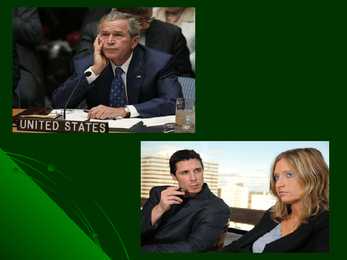
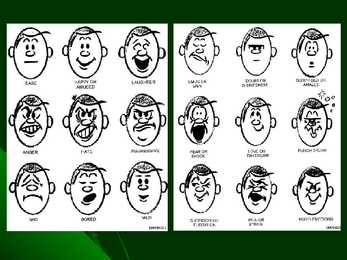
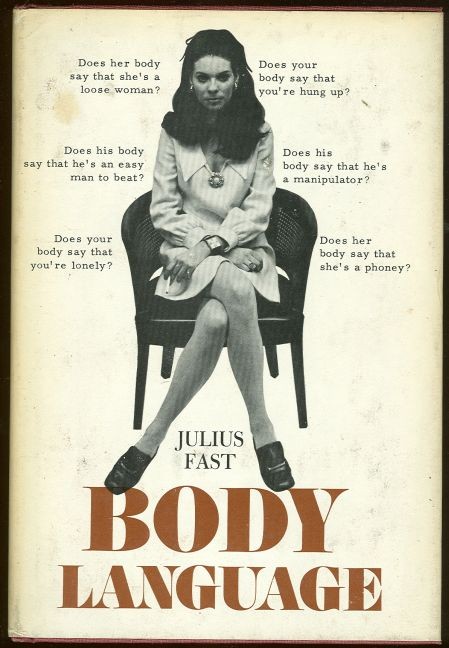
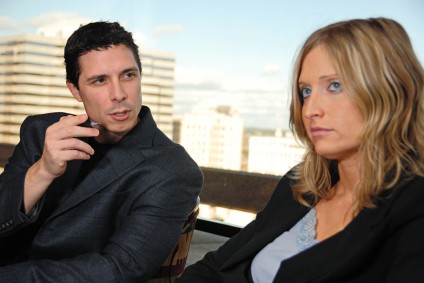
BODY LANGUAGE Denis Horenzenko What is Body Language? Body Language is the communication of personal feelings, emotions , attitudes(), thoughts through body movements gestures(), postures() , facial expressions, walking styles, positions & distance - either consciously(c) or involuntarily( ) .Its not only your tongue you communicate with but also you speak with your body movements and gestures. The Main Aspects of Body Language Gestures: A gesture is the verbal or non-verbal body movement used to express or emphasize() an idea , an emotion or a state of mind. Body Movements: This includes the head, eyes, eyebrows , lips , neck , shoulders, fingers and so on. One can distinguish() four main kinds of gesticulation(): Emblem, illustrators, regular and self-touching.
Speech may also contain nonverbal elements known as paralanguage, including voice quality, emotion and speaking style, as well as prosodic features such as rhythm, intonation and stress. 1 Likewise, written texts have nonverbal elements such as handwriting style, spatial arrangement of words, or the use of emoticons. Kinesics is the study of body movements, facial expressions, and gestures, as well as dress. Kinesic behaviors include mutual gaze, smiling, facial warmth or pleasantness, childlike behaviors, direct body orientation, and the like. Oculesics The study of the role of eyes in nonverbal communication is sometimes referred to as "oculesics". Eye contact can indicate interest, attention, and involvement. Gaze is comprised of the actions of looking while talking, looking while listening, amount of
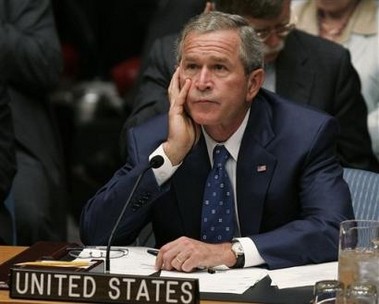
often pick up the smallest hint of a lapse in attention in the person they are speaking to. And they frequently jump to the conclusion that they are boring or a nuisance - thus compounding any sense of depression or poor self-esteem. A way to learn the secrets of body language is to watch television with the sound turned off and try to interpret what is being said simply from reading body language. You will experience that humans say a lot with their mouth which is contradicted by their body, gestures and other channels of communication. Messages are ambiguous. But a notable feature of the early years of the 21st century is the fact that the body language of different nations is gradually becoming more similar. Thus, a gesture made by someone in (say) South America can often be easily interpreted by people in Russia or Japan. Much of this is due to the effects of TV, which of course shows the same sort of `soap operas' in all parts of the globe. Words and body language
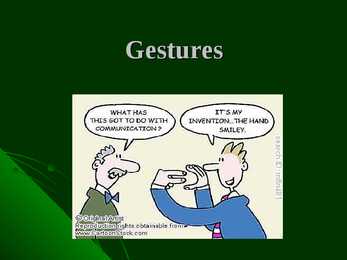
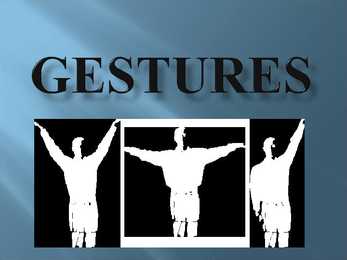
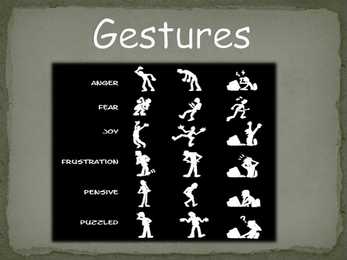
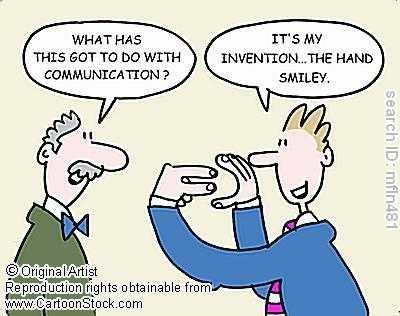
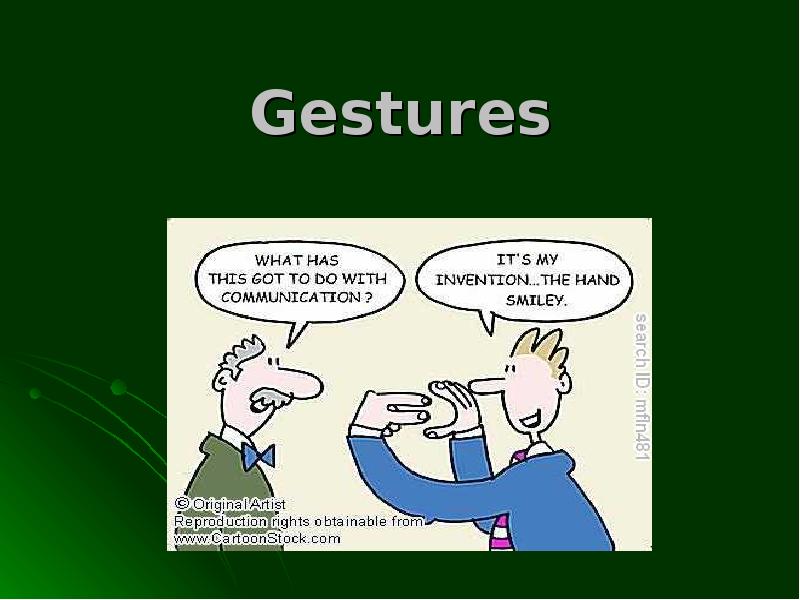
A gesture is a form of nonverbal communication in which visible bodily actions communicate particular messages, either in place of speech or together and in parallel with spoken words. Gestures include movement of the hands, face, or other parts of the body. Emblems Iconic gestures Metaphoric gestures Regulators Affect displays Beat gestures Emblems are specific gestures with specific meaning that are consciously used and consciously understood. They are used as substitutes for words and are close to sign language than everyday body language. For example, holding up the hand with all fingers closed in except the index and second finger, which are spread apart, can mean 'V for victory' or 'peace' (if the palm is away from the body) or a rather rude dismissal if the palm is towards the body.
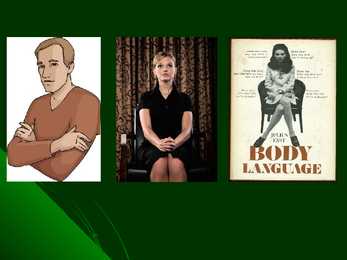
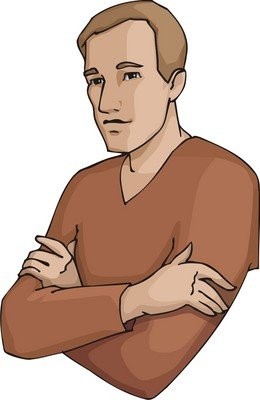
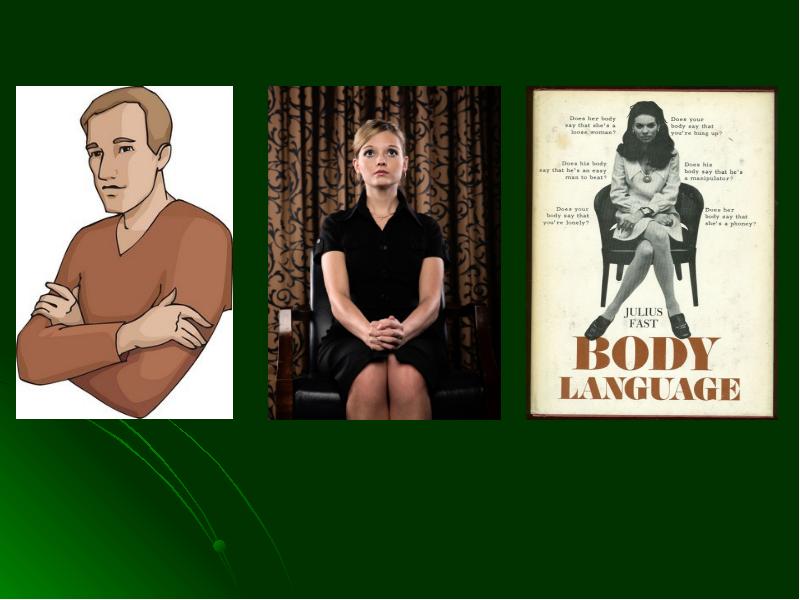
Gestures hand and arm movements are an important part of our visual picture when we speak in public. They are reinforcements of the words and ideas we are trying to convey and a nonverbal representation of how we feel. If we use gestures correctly, they will help us enhance our message and we will appear confident and relaxed. Used unconsciously or incorrectly however, speaker can distract their audience or send the wrong non verbal message. Be aware that nervousness or feelings of inadequacy can show immediately in your gestures. These can be very distractive and misinterpreted. For example: Hands on hips condescending, parental, overbearing Crossed arms cutting off, disagreeing, wanting to protect
100 Kama sutra positions Bandoleer The woman lies on the back with her knees up towards her chest. The man kneels facing her so she can put her feet on his chest. The Bridge Only try this if your man is super flexible and strong - you don't want to give him a hernia! The Grip The Grip sex position may be more comfortable if a cushion is placed under the woman's bottom to raise her hips slightly. Afternoon Delight This is a good resting position, ideal for getting your breath back during a long sex session. The Rider In the Rider sex position she kneels astride her partner but with her back to him as if in the Reverse Cowgirl, but she leans forward to balance herself on his knees. The Eagle The man kneels at the edge of the bed in front of his partner, who's lying on her back, knees slightly bent up. He holds her legs up and apart by grabbing onto her ankles as he enters her. Penetration is very deep and satisfying for the woman and the man can enjoy a pri
GETTING PHYSICAL Tallinn 2012 "Delivery is more important than content." Arch Lustberg, speech trainer According to wellknown social anthropologist Edward T. Hall, 60% of our communication is nonverbal. That means whenever we stand before an audience, our stance, our posture, our facial expressions, our hand gestures, our whole body dynamic communicate more than our actual spoken words. A stiff, immobile speaker is often a boring and usually ineffective speaker as. It is therefore essential to know how to be physically relaxed, which will allow your actions to complement your words. Before we start, two important definitions: A podium is the raised platform at the
Powerlifting Powerlifting is a strength sport, consisting of three events: Squat Bench press Deadlift Each competitor is allowed three attempts on each lift. The lifter's best valid attempt on each lift counts toward his competition total. Competitors are judged against other lifters of the same gender, weight class, and age. Powerlifting requires specialized training techniques that are focused on strength and explosive power. Traditional training methods dictated low repetitions with maximal weight. History Started to develop in the late 19th century, when weightlifting was just beginning to develop as a sport . Led by the United States and Great Britain, the International Powerlifting Federation (IPF) was founded in 1973 and held the first world championships that year. That spurred the establishment of the European Powerlifting Federation in 1974. Currently, the IFP has more than 70 member c
 annaabi.ee







Kõik kommentaarid