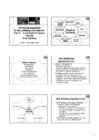
Radioactivity { What is radioactivity? Atoms that have too few or too many neutrons than a stable atom can be radioactive. Muutke teksti laade Alpha particles may be completely stopped by a Teine tase sheet of paper Kolmas tase Beta particles by aluminum shielding Neljas tase
Shifts C-NMR Qualitative analysis Gas chromatography-Mass Spectrograph Mass spectrograph is used as the detector because it provides higher knowledge of the sample's structure IR- infrared spectrograph It shows us all the functional groups for identification of the subject GC-MC spectrum To interpret (1) and (5) we look at the spectrum and we know that peak with 206 MW is (5) and (1) is 176 MW. (small peaks around the long peak are isotopes different amount of neutrons but same amount of protons) IR Infrared spectrograph In IR spectrum each functional group has a peak. Organic compounds absorb infrared radiation. Different types of bonds absorb infrared radiation at different characteristics frequencies, IR spectrum 2941 O-H ( and C-H strech) ; 1721 C=O ; 1421 O-H bend ; 1269 C-O strech ; 945 O-H bend Quantitative determination UV-VIS 220 nm (ultraviolet light)
fusion in stars were subsequently worked out by Hans Bethe throughout the remainder of that decade. Research into fusion for military purposes began in the early 1940s, as part of the Manhattan Project, but was not successful until 1952. Research into controlled fusion for civilian purposes began in the 1950s, and continues to this day. What is nuclear fission? Nuclear fission is a nuclear reaction in which the nucleus of an atom splits into smaller parts, often producing free neutrons and lighter nuclei, which may eventually produce photons (in the form of gamma rays). Fission of heavy elements is an exothermic reaction which can release large amounts of energy both as electromagnetic radiation and as kinetic energy of the fragments (heating the bulk material where fission takes place). Fission is a form of nuclear transmutation because the resulting fragments are not the same element as the original atom.
Kuna need energiad on lähedased tavalisel ruumitemperatuuril esinevatele siseenergiatele, siis nimetatakse aeglustatud neutroneid vahel ka soojuslikeks neutroniteks. Ahelreaktsiooni kriitilisena hoidmiseks peab kiireid neutrone reaktoris aeglustama (modereerima). Modereerimise vajadust võib piltlikult selgitada, mõeldes augu lähedal asuva golfipalli löömisele. Tugev löök lennutab palli august üle, kuid just paraja tugevusega löök viib palli auku. Vesi neutronite aeglustajana Neutrons from fission Loss or the water coolant have very high speeds kills the chain reactionsince and must be slowed the fuel configuration is not greatly by water "critical" without water "moderation" to maintain
know something about atoms. Everything in the universe is made of atoms--every star, every tree, every animal. The human body is made of atoms. Air and water are, too. Atoms are the building blocks of the universe. Atoms are so small that millions of them would fit on the head of a pin. Atoms are made of even smaller particles. The center of an atom is called the nucleus. It is made of particles called protons and neutrons. The protons and neutrons are very small, but electrons are much, much smaller. Electrons spin around the nucleus in shells a great distance from the nucleus. If the nucleus were the size of a tennis ball, the atom would be the size of the Empire State Building. Atoms are mostly empty space. Picture 7.1. Nucleaus and electrons 21 If you could see an atom, it would look a little like a tiny center of balls surrounded by
All of the natural elementsin the periodic table are present in cosmic rays, in roughly the same proportion as they occur in the solar system. But detailed differences provide a "fingerprint" of the cosmic ray's source. Measuring the quantity of each different element is relatively easy, since the different charges of each nucleus give very different signatures. Harder to measure, but a better fingerprint, is the isotopic composition (nuclei of the same element but with different numbers of neutrons). To tell the isotopes apart involves, in effect, weighing each atomic nucleus that enters the cosmic ray detector. About 90% of the cosmic ray nuclei are hydrogen (protons), about 9% are helium (alpha particles), and all of the rest of the elements make up only 1%. Even in this one percent there are very rare elements and isotopes. These require large detectors to collect enough particles to say something meaningful about the "fingerprint" of their source
IONIZING AND NON- system IONIZING RADIATION Consists of 4 main variables: Ionizing radiation consists of highly-energetic particles or waves that can detach (ionize) at least one electron from an atom or molecule (beta- Measures Symbol Unit particles, neutrons, alpha-particles, X-rays, Luminous flux Φ lm (lumen) gamma-rays) Non-ionizing radiation is any type of Luminous I cd (candela) electromagnetic radiation that does not carry enough energy per quantum to ionize atoms or intenstity moleculs; but has sufficient energy only for Illuminance E lx (lux)
Switching properties are analyzed at a given rate of current change. The most essential data of power switching are the forward voltage overshoot(UF(max)) when a diode turns on and the reverse current peak value(IR(max)) when a diode turns off. If Ploss=0, the efficiency is approx. Equial to 25% 50% 75% 100% What are the sources of current? carriers electrons neutrons protons Ticket No 2 Varactor Zener diode Bi-directional diode Schottky LED Photodiode Optocoupler(LED and photo) 2, 3, 4)Varactor. Zener. Bi-directional.Sch.Led. Photodiode. 5)Varactor: U=1-100V, C=10-100 microF. Zener: Zener=-2.4...-200V. Schottky: on state voltage drop=0.3V. LED: conducting current=2-10mA.Voltage drop=2-3V.
 annaabi.ee