Great Britain and France known as the Seven Years' War. The French and Indian War began in 1754 and ended with the Treaty of Paris in 1763. The war provided Great Britain enormous territorial gains in North America. With the Peace Treaty of 1763, France gave up all claims to mainland North America, and former French colonies were transferred to Britain aka New France became a British colony. 11. Who were the Loyalists? What is the difference between United Empire Loyalists and Late Loyalists? Loyalists were people who maintained loyalty to the British Crown. After the American Revolutionary War they had to settle in Quebec and modern-day Ontario, because of offer of free land and also because they were repressed. The leading loyalists' properties were often confiscated and driven out of towns, so some of them sought refuge in Canada. United Empire Loyalists remained loyal to Britain after the American Revolution, migrated from the US to Upper and Lower Canada
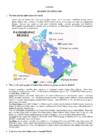
Newfoundland of French origin? New France and One more province that has a large French-speaking population. Québec City 8. Compare the roles of the Governor General and the Prime Minister in Canada. The Governor General is the representative of the monarc and carries out most of the monarch's constitutional and ceremonial duties. The Governor General is appointed by the queen on advice from the Canadian Prime Minister The Prime Minister is the head of government 10. Who were the Loyalists, why and when did they move to Canada? Loyalists were American colonists, of different ethnic backgrounds, who supported the British cause during the American Revolution (1775–83). Tens of thousands migrated to British North America during and after the revolutionary war — boosting the population and heavily influencing the politics and culture of what would become Canada.The vast majority of Loyalists were neither well-to-do nor particularly high in social
- John Cabot Italian; wanted to reach China; sighted land in 1497; the exact place is not known; received sponsorship from King Henry VII - Jacques Cartier French; did altogether three expeditions; visited present-day Quebec City and Montreal 6. Immigrants: - From 1760s mostly from France (it was a French colony) - 1760s to the end of the 19th century mostly from the UK (either directly or US Loyalists) - The early 20th century from Continental Europe (Scandinavians, Italians, Ukrainians) - At present visible minorities (coloured people) from developing world. 7. British Columbia has the highest percentage of population of British origin. Quebec has the highest percentage of population of French origin. Also, Ontario has a large number of French-speaking people. 8
The following spring they also conquered Montreal. The British renamed the new French-speaking region Quebec. They allowed the French to keep their Roman Catholic religion, civil law system and language, so that they would not try to break away from Britain. From 1775 to 1784, many British came to the former New France area from south. The people in American colonies were fighting for independence and those people who fled north were the one who wanted to remain loyal to Britain (United Empire Loyalists). Britain created two new colonies: New Brunswick and Upper Canada. New Brunswick was created in 1784. Upper Canada became part of Quebec in 1791. Upper Canada was the English-speaking colony and Lower Canada was the French-speaking colony. They were reunited in 1841, called Canada West and Canada East and the capital of them was Montreal. They become provinces of Ontario and Quebec in 1867. Uniting all the Canadian provinces soon became a necessity. There were five reasons why it
Most of Canada's territory was inhabited and developed later than other European colonies in the Americas, with the result that themes and symbols of pioneers, trappers, and traders were important in the early development of Canadian culture. The British conquest of Quebec in 1759 brought a large francophone population under British rule, creating a need for compromise and accommodation, while the migration of United Empire Loyalists from the Thirteen Colonies brought in strong British and American influences. In parts of Canada, especially the major cities of Montreal, Vancouver, and Toronto, multiculturalism itself is the cultural norm and diversity is the force that unites the community. In Quebec, cultural identity is strong, and many Quebecois commentators speak of a Quebec culture as distinguished from English Canadian culture. Canadian popular media is heavily influenced by America
others Madras, Bombay, Calcutta Traded in coffee, textiles, later tea from China After Regulating Act and India Act, the company lost independence, monoply was broken, power handed over to British Crown in 19 C The biggest rival of the English were french They fought the Seven Years War which the britsih won The American War of Independence 1775-1783 Anti-British patriots were eager to break upn with Britain. The Loyalists wanted to be under English Flag The Stamp Act demanded colonists to pay extra-taxes, which ended in protest 1773 Boston Tea Party- a cargo was destroyed because the colonists didn´t want britain to show its power The Quebec Act made thing worse. The Continental Congress severed relations with UK George Washingotn was appointed a commader of military forces. 80 000 loyalists left for Canada Canada as a british colony
world's first socialist state but also to the traditional Communist activity of fomenting class struggle and the revolution of the proletariat. They felt justified in using subversion as well as the more orthodox methods of propaganda and political agitation in advancing Marxism in countries that had not yet reached Russia's stage of historical development. It was during the Spanish Civil War, in which Russia actively aided the Loyalists, that a cryptographic element that had served the revolutionary predecessors of Lenin & Co. reappeared in a form both streamlined and more secure. This was the straddling checkerboard. Its straddling feature makes use of cipher equivalents of two different lengths—lengths usually of one digit and two digits; the two sets of equivalents are so constructed that the cryptographer can unambiguously separate them when they are run together. The
 annaabi.ee