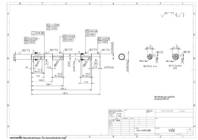
WEIGHT: SCALE:1:5 SHEET 1 OF 1 8 7 SOLIDWORKS Educational Product. For Instructional Use Only. 6 5 4 3 2 1
adjacent agreements in the mid-high 90's--slightly higher than the agreement coefficients for trained human raters. Several validity studies have suggested that AES engines tap the same construct as that being evaluated by human raters. Page, Keith, & LaVoie (1995) examined the construct validity of AES, Keith (2003) summarized several discriminant and true score validity studies of the technology, and Attali & Burstein (2006) demonstrated the relationship between AES and instructional activities associated with writing. AES is not without its detractors. Ericcson & Haswell (2006) performed a comprehensive critique of the technology from the perspective of those who teach postsecondary writing. Objections to the technology ranged from a concern about the ethics of using computers rather than humans to teach writing to the lack of synchronicity between how human graders approach the rating task and the process by which AES
mittemõistmine nii käitumis- kui ka õppimisprobleeme. Seetõttu on äärmiselt oluline, et õpetaja teadlikult analüüsiks oma kõnemaneeri ja sõnakasutust, mille kaudu ta tunnis juhtnööre jagab ja õppematerjali edastab ning kasutaks erinevaid meetodeid ja strateegiaid, et ka emotsionaal- ja käitumisraskustega õpilased tema juhtnööre mõistaksid ja seeläbi maksimaalselt õppetöös osaleda saaksid. Kasutatud kirjandus Harrison, Janet S. ; And Others, Teacher Instructional Language and Negative Reinforcement: A Conceptual Framework for Working with Students with Emotional and Behavioral Disorders. Education and Treatment of Children, v19 n2 p183-96 May 1996. Haydon, Todd ; Borders, Christy ; Embury, Dusty ; Clarke, Laura, Using Effective Instructional Delivery as a Classwide Management Tool, Beyond Behavior, v18 n2 p12-17 Win 2009. 6 pp. Scott, Terrance M. ; Park, Kristy Lee ; Swain-Bradway, Jessica ; Landers, Eric, Positive
Haigestumist ja tervenemist soodustavad psühhosotsiaalsed tegurid. Tallinn: TPÜ Kirjastus. Roomeldi, M., Haldre, L., Susi, A., Metsis, L., Kõrgesaar, R. (2003). Hüperaktiivne laps. Abiks lapsevanematele ja pedagoogidele. Tartu: Tartu Ülikooli Kirjastus. Sousa, D. A. (2001). How the special needs brain learns. Thousand Oaks: Corwin Press. U.S. Department of Education. (2004). Teaching Children with Attention Deficit Hyperactivity Disorder: Instructional Strategies and Practices. [On-line]. http://www.addresources.org/article_strategies_classroom.php. (10.03.2010). Wong, B. Y. L. (1998). Learning about learning disabilities. Academic Press: San Diego. , . . (2005). . [WWW]. http://adhd-kids.narod.ru/articles/monina.html. (12.03.2010). 12
project. 2 ABSTRACT........................................................................................2 REFERENCES...................................................................................11 INTRODUCTION Due to the rapid expansion of technology over the past decade, hypermedia instructional programs have become commonplace. Learners of all ages have increased access to technology such as the World Wide Web, which provides a seemingly limitless amount of information. New technologies such as Mp3, podcasting, and social networking are booming. In contrast to more traditional environments, technology offers greater opportunities for interactivity and learner control. There are more educators and language teachers using the Internet in language teaching as well. Many
pdf (11.09.2008) 8. Loogma, K., Ümarik, M., Kruusvall, J., Laanpere, M. E-õppe kui innovatsiooni difusioon kutseõpetajate hulgas. Uuringu raport. Tallinn: Tallinna Ülikool, 2007, 112 lk. 9. Paulsen, M.F. The online report on pedagogical techniques for computer- mediated communication. http://www.emoderators.com/moderators/cmcped.html (15.09.2008) 10. Pitt, T.J., Clark, A. Creating powerful online courses using multiple instructional strategies. http://www.emoderators.com/moderators/pitt.html (15.09.2008) 11. Rogers, E. M. Diffusion of Innovations (5th ed.). New York: Free Press, 2003 viidatud läbi Loogma, K., Ümarik, M., Kruusvall, J., Laanpere, M. E-õppe kui innovatsiooni difusioon kutseõpetajate hulgas. Uuringu raport. Tallinn: Tallinna Ülikool, 2007, 112 lk. 12. Õppiv Tiiger. E-õppe arengukava üldhariduses aastatel 2006-2009. Projekt. Koostatud 14.05.2005. 13. Ümarik, M
Milliste parameetritega mooduleid kirjeldada, et õpiobjektid oleksid kergesti taaskasutatavad. Sellele küsimusele vastuse leidmiseks on otsitud abi õpitehnoloogia standarditest. 2.2.3.1 Õpitehnoloogia standardid Õpitehnoloogia standardid on alles kujunemisjärgus. Pigem on tegemist spetsifikatsioonide kui standarditega. Nad täienevad ja muutuvad pidevalt ja seetõttu pole üldist heakskiitu leidnud. Õpitehnoloogia alaseid spetsifikatsioone pakuvad näiteks: 1. EduComi IMS (Instructional Management Systems) 2. IEEE LSTC LOM (Institute of Electrical and Electronic Engineering Learning System Technology Committee Learning Object Metadata) 3. USA DoD ADLNet SCORM (Department of Defence Advanced Distributed Learning Network Sharable Content Object Reference Model) Standardite eesmärk on erinevate õpisüsteemide koostöövõime (interoperaablus). See tähendab: 1. kursuste ülekandmist ühest süsteemist teise; 2
Instruction-Set Architecture ISAKMP Internet Security Association and Key Management Protocol ISAM Indexed Sequential-Access Management/Method ISAPI Internet Server API [Microsoft] ISAPS Intelligent Scene Analysis based on Photographic Space [Canon] ISBN International Standard Book Number ISC Instruction Set Computer + Inter-Systems Communication [IBM] ISCSI (iSCSI) Internet SCSI ISD Image Section Descriptor + Instructional Systems Design ISDN Integrated Services Digital Network ISH Information Super Highway ISI Internally Specified Index ISIS Integrated Systems and Information Services ISKM Internet Starter Kit for the Macintosh ISL Interactive System Language + Inter Switch Link [Cisco] ISM Integrated Services Model [IETF] + Internet Service Manager [Microsoft] ISMF Interactive Storage Management Facility ISOC Internet Society
approach to screenwriting in years. In the perfect companion piece to his first book, Snyder delivers even more insider's information gleaned from a 20-year track record as "one of Hollywood's most successful spec screenwriters," giving you the clues to write your movie. BLAKE SNYDER Designed for screenwriters, novelists, and movie fans, this book gives readers the key breakdowns of the 50 most instructional movies from the past 30 years. From M*A*S*H to Crash, from Alien to Saw, from 10 to Eternal Sunshine of the Spotless Mind, Snyder reveals how screenwriters who came before you tackled the same challenges you are facing with the film you want to write - or the one you are currently working on. Writing a "rom-com"? Check out the "Buddy Love" chapter for a "beat for beat" dissection of When Harry Met Sally... plus references to 10 other great romantic comedies that will make your story sing.
emigrant, Professor Novo-paschenny, who under the Czar had been attached to an astronomical observatory in Pulkovo, outside St. Petersburg. He developed much of the technical aspects of the work, but seems to have held only a relatively subordinate post as a chief cryptanalyst in one of the national offices, ap parently Referat V 9, which was probably Russia. Head of Analytical Cryptanalysis (Gruppe TV) was Dr. Erich Hiittenhain, who also directed that group's instructional activity (Referat IVd). Referat IVa, which tested German cryptosystems, frequently with mathematical tools to calculate theoretical limits of security and to find improvements, was headed by mathematician Dr. Karl Stein, who held the rank of lieutenant, surprisingly low for so lofty a position. Referat IVb, headed by Engineer Wilhelm Rotscheidt, used tabulating machines and special-purpose devices. It invented the prototype of the translucent-
videotape all his trainees at 30 frames per second. As he says, "you can learn more in one hour of video analysis than you can in a year of self-correction without video." Casio claims it can record slow-motion videos at up to 1,000 frames per second. "Pose Method of Running" by Dr. Nicholas Romanov (www.fourhourbody.com/pose-method) This book teaches running as a skill with its own theory, concepts, and exercises. Just mind the ankles. CrossFit Exercises (www.fourhourbody.com/crossfit) Instructional videos of almost every single CrossFit exercise and routine. GENr8 Vitargo S2 (www.fourhourbody.com/genr8) This is the carbohydrate supplement that Brian uses to rapidly replenish glycogen. He can consume up to 1,100 calories an hour of Vitargo. Don't try that with Gatorade. Trail Runner (www.trailrunnermag.com) The only magazine dedicated to o -road running, written by trail runners who have races and runs from 5K to 200-plus miles. Trail Runner's
 annaabi.ee