butterfy life cycle Pilt 14 Fertilizing · Nitrogen produces vegetative or topp growth. · Phosphorous produces flower buds, fruit and root development. · Potassium builds strong healty plants. · The summer most plants need very little nitrogen, because they grow slowly · Liquid fertilizers work quickly, because they absorbed through the roots and foliage. Summary · Caring about the plants depends on plants type and size or age. · Habitation should be chosen according to what plant needs. · Flowers show always better breathtaking effect if you plant them in groupings. References · www.keeleveeb.ee · http://gardening-articles.com/ Thank you for listening!
planet. Tall, broad-leaved evergreen trees are the dominant plants, forming a leafy canopy over the forest floor. The undergrowth or understory in a rainforest generally consists of shade-tolerant shrubs, herbs, ferns, small trees and large woody vines. The temperature ranges from 5°C to 50°C. Human uses of tropical and subtropical forests: o Habitation - Humans have and do exploit rainforests for food and shelter in several parts of the world. o Cultivated foods and spices - Coffee, chocolate, bananas etc. all originally came from tropical rainforests, and are still mostly grown in regions that were formerly primary forest. o Pharmaceutical and biodiversity resource - Tropical rainforests are called the 'world's largest "pharmacy"' because of the large amount of natural "medicines" there.
The capital city is Washington D.C. The major caracteristic of the United States is probably its great variety. Itranges from the Arctic to the subtropical, from the moist rain forest to the arid desert, from the rugged mountain peak to the flat prairie. Althought the total population of the United States is large by world standartst, over 302 million. The country embraces some of the world´s largest urban concentrations as well as some of the most extensive areas that are almost devoid of habitation. The population is highly diverse. In addition to native Americans and the descendants of Africans taken as slaves to America, the national character has been enriched. As to its history, the United States is a relatively young countrybut first of the European colonies to separate succsessfully from its motherland. The United States achieved its current size only in the mid - 20th century when it emeged as a world power. The nation
What are the biggest dangers to wild animals in Estonia? Wild animals in Estonia, like in many other places in the world, are in danger. Forest industry, agriculture and other human activities in the nature, as well as pollution, disturb and even endanger the life of wild animals. Firstly, big forest machines disturb animals. For example, in winter the machines disturb animals who hibernate in winter. As a result, animals can leave their habitations and go somewhere else where is quiter. In addition to disturbing animals, the forest industry endanger wild animals' lives. Some machines can simply kill some animals accidentally. Besides, there are some species which are rear in Estonian forests. These species should be protected. A further problem is poaching- although it is not a very big problem in Estonia, it affects the number of animals. There are, however, a lot of wild animals in ou...
Open more national parks, building fewer new roads, planting more new forests and cutting pollution. These are things, that everyone can help with, if they wanted to. In conclusion, it can be said that although human activities damage and pollute the environment of wild animals, their life in Estonia is not necessarily inevitable. In fact, there are several places in Estonia which have been turned into wild life reserves and where wild animals, especially birds, have everything they need for habitation. Meelis Liiv 11B
Edinburgh Castle UK, Scotland an ancient stronghold. History a centre of military activity. Human habitation since 9th century BC. Nowadays Scotland's second-most-visited tourist attraction. The New Barrack Block is home to the official headquarters of the Royal Regiment of Scotland. St. Margaret's Chapel the oldest surviving building in the castle and in Edinburgh. dates from the early 12th century. King David I built it as a private chapel for the royal family. He dedicated it to his mother, Saint Margaret of Scotland, who died in the castle in 1093. St
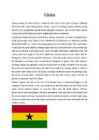
Although relatively small in area and population, Ghana is one of the leading countries of Africa, partly because of its considerable natural wealth and partly because it was the first black African country south of the Sahara to achieve independence from colonial rule. In addition to being known for its lush forests, diverse animal life, and miles of sandy beaches along a picturesque coast, Ghana is also celebrated for its rich history--its habitation possibly dating from 10,000 BC--and as a fascinating repository of cultural heritage. The country takes it name from the great medieval trading empire that was located northwest of the modern-day state until its demise in the 13th century. Direct sea trade with Europe, established in the 15th century, had much impact on the area's inhabitants, many of whom actively traded with the Portuguese, Dutch, British, and other Europeans. Forts and castles, many of which still dot
San Francisco San Francisco, officially the City and County of San Francisco, is the leading financial and cultural of stateof California and it's located in the far-west of USA. The earliest archaeological evidence of human habitation of the territory of the city of San Francisco dates to 3000 BC. The Yelamu group of the Ohlone people resided in several small villages when a Spanish exploration party, led by Don Gaspar de Portolà arrived on November 2, 1769, the first documented European visit to San Francisco Bay. Upon independence from Spain in 1821, the area became part of Mexico. Under Mexican rule, the mission system gradually ended and its lands began to be privatized. In 1835, Englishman
soil types. The predominant varieties are Shiraz, Cabernet Sauvignon, Chardonnay, Merlot, Sémillon, Pinot noir, Riesling, and Sauvignon blanc. Sport Around 24 per cent Australians over the age of 15 regularly participate Australia has strong international teams in cricket, field hockey, netball, rugby league, and rugby union, having been Olympic or world champions at least twice in each sport in the last 25 years for both men and women where applicable. History. Human habitation of the Australian continent is estimated to have begun between 42,000 and 48,000 years ago, possibly with the migration of people by land bridges and short seacrossings from what is now SouthEast Asia. These first inhabitants may have been ancestors of modern Indigenous Australians. Exploration by Europeans till 1812 1606 Willem Janszoon 1606 Luis Váez de Torres
plateau that rises into barren, rolling hills near the west coast. Mount Kosciusko Climate Australia is warm and dry. There is very little extremely cold regions in Australia. Summer last from December to February. Histor y. Human habitation of Australia is estimated to have begun between 42,000 and 48,000 years ago, possibly with the migration of people by land bridges and short seacrossings from what is now Southeast Asia. These first inhabitants may have been ancestors of modern Indigenous Australians. At the time of European settlement in the late 18th century, most Indigenous Australians were hunter gatherers, with a complex oral culture and spiritual values based on reverence for the land and a belief in the Dreamtime
was initially used to refer to Ireland. By the 11th century at the latest, Scotia was being used to refer to (Gaelic-speaking) Scotland north of the river Forth, alongside Albania or Albany, both derived from the Gaelic Alba. The use of the words Scots and Scotland to encompass all of what is now Scotland became common in the Late Middle Ages. History Repeated glaciations, which covered the entire land-mass of modern Scotland, have destroyed any traces of human habitation that may have existed before the Mesolithic period. It is believed that the first post-glacial groups of hunter-gatherers arrived in Scotland around 12,800 years ago, as the ice sheet retreated after the last glaciation. Groups of settlers began building the first known permanent houses on Scottish soil around 9,500 years ago, and the first villages around 6,000 years ago. The well-preserved village of Skara Brae on the Mainland of Orkney dates from this period
Edinburgh Castle is an ancient stronghold which dominates the sky-line of the city of Edinburgh from its position atop Castle Rock. It is Scotland's second most visited tourist attraction. Human habitation of the site is dated back as far as the 9th century BC. As it stands today though, few of the castle's structures pre-date the Lang Siege of the 16th century, with the notable exception of St Margaret's Chapel, the oldest surviving building in Edinburgh, which dates from the early 12th century.As with all castles, Edinburgh's fortress has been a centre of military activity. As an ancient fortress Edinburgh Castle is one of the
The capital of Estonia is Tallinn and the official language is Estonian. The currency is Eesti kroon. The main religion is Lutheran. Anniversary of the republic is celebrated on February 20. The national flower is cornflower, national bird is barn swallow and national stone is limestone. It is a land of great natural beauty with a long and varied history and rich culture. It has served as a junction of international trade routes for centuries. History. The oldest marks of habitation on the territory of Estonia date from the 8th millennium BC. Fortified settlements were established in the 1 st century BC. The ancestors of Estonians formed several independent states headed by elected elders. Until the beginning of the 13th century Estonia was politically independent. Then began a long chain of occupation and control by foreign powers. In the 1200s the German crusaders converted Estonia into a Christianity by force and took control over South Estonia.
employer. Personal Income Tax: 22% paid on earned income (except for tax free minimum) by all people, it is called proportional income tax and is equal for people with different income. Value Added Tax: 18%, one of the government's main sources of income, paid by people when they buy any goods. It is not noticiable because prices already include it. Excise Duties: imposed on alcohol, tobacco, petrol etc. to limit the use of these goods. POPULATION The earliest traces of human habitation date from prehistoric times. In th the 13 century the population numbered between 100 000 and 200 000, but this figure changed as a result of wars, epidemics and migrations. In the mid 1800s many Estonians emigrated in the hope of finding good farmland and better living conditions. The census of 2000 showed that 47 different nationalities live in Estonia: 67,9% Estonians, 25,6% are Russian and also Ukrainians, Belarussians, Finns and Tatars. Estonian citizenship does not
taken by hard-nosed, right-wing economist Václav Klaus. More change was to come: the decision on whether the Czech Republic should join the European Union was settled by a referendum - with 77% voting in favour - and on 1 May 2004 the Czech Republic became a member of the EU. However, the parliamentary elections of June 2006 ended in stalemate - it looks like a rocky road ahead for Czech politics in the next few years. From the beginning The oldest evidence of human habitation in the Prague valley dates from 600, 000 BC, but more numerous clues were left by hunters during the last Ice Age, about 25, 000 years ago. Permanent communities were established around 4000 BC in the northwestern parts of Prague, and the area was inhabited continuously by various Germanic and Celtic tribes before the arrival of the Slavs. The name Bohemia came from a Celtic tribe called Boii, and is still used today for the western part of the Czech Republic. Foundation of Prague
Memorial, the National Gallery of Australia, the National Portrait Gallery currently housed at Old Parliament House, the National Library of Australia, the National Archives of Australia, and the National Museum of Australia. Many Commonwealth government buildings in Canberra are open to the public, including Parliament House, the High Court and the Royal Australian Mint 14 . History The first human habitation of Australia is estimated to have occurred 50,000 years ago. More than 6000 years before the arrival of the European settlers Aboriginal people inhabited most areas of the Australian European settlement. There were estimated 300,000 Indigenous Australians living on the continent. By the end of 19th century, because of the white people who came to conquer the new lands and mine the gold, there were only 60 000 native Australians left
 annaabi.ee