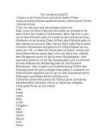
Test 3(Lektion21und22) 1.Räume in der Schule.Such und schreib sieben Wörter. 1)Klassenzimmer,Physiksaal,Musikzimmer,Lehrerzimmer,Toilette ,Sekretariat,Aula. 2.Setz vor oder nach und den richtigen Artikel ein. Hallo Leute!Ich heisse Tanja.Ich bin14Jahre alt und gehe in die achte Klasse des Pestalozzi Gymnasiums, Mein Tag sieht so aus: (a)Vor dem Frühstück gehe ich schnell ins Bad und dusche.Dann frühstücke ich mit meinen Eltern.(b)Nach dem Frühstück gebe ich dem hamster ein bisschen Salat oder ein Stück Apfel.Dann nehme ich meine Schulsachen und gehe los.Die Schule beginnt bei uns schon um 7.45. (c) Nach der Schule gehe ich immer schnell nach Hause.Meine Mutter wartet dann schon mit dem Essen .(d)Nach dem Mittagessen mache ich gleich meine Hausaufgaben. Aber
Religion. The students stay in one classroom for the 4 years. · 5th through 8th grades, where different teachers teach different subjects. The students no longer have one classroom, but rather move around the school to get to their classes. People who have completed only primary education are classified as "unqualified workers". Secondary education Secondary schools in Croatia are subdivided into: · Gymnasiums: · prirodoslovno-matematicka gimnazija (specializing in math, informatics and science) · jezicna gimnazija (with a focus on foreign languages and with less science) · klasicna gimnazija (with a curriculum centered around classics, namely Latin and Ancient Greek) · opa gimnazija (which covers a general education and is not as specific). Education in gymnasia lasts for four years.
Technology. While in the first half of secondary school all pupils must study the same subjects, in the second half of secondary level and especially in the Sixth Form, more options are available for the British students when compared to students in Estonia. In the Sixth Form, they only have to choose 3 compulsory subjects with a vast range of extra subjects offered by the school like Economics, Food Technology, Government and Politics, Photography, Psychology and Theatre Studies. Several Gymnasiums in Estonia also give their students the chance to choose some of their subjects from a selection of facultative subjects but there are by far more than 3 compulsory subjects for Estonian Gymnasium students than for the Sixth Form students in Britain. Lastly, schools in Britain seem to offer more facilities than in Estonia. Our schools usually do not have tennis and squash courts or football and hockey fields of their own. In addition,
as history, geography, biology, chemistry, physics, informatics and in addition to English, often a second language (usually German, French or Italian). The students no longer have one classroom, but rather move around the school to get to their classes. 5 After finishing elementary school, students can continue their education in secondary schools that are divided into • Gymnasiums: • prirodoslovno-matematička gimnazija (specializing in math, informatics and science) • jezična gimnazija (with a focus on foreign languages and with less science) • klasična gimnazija (with a curriculum centered around classics, namely Latin and Ancient Greek) • opća gimnazija (which covers a general education and is not as specific). Education in gymnasia lasts for four years.
Using this the hypothesis was raised. What roll has dancing become in an Estonian mens life? The goal of this research is to find out the Estonian mens ability to dance according to the age and dance style. For students to have a good dancing skill and ability in dancing, it is important to have a high self esteem and the patience to learn the art of dancing. For the results there was compiled a inquiry that was submitted to Tallinn’s Nõmme Gymnasiums, Saku Gymnasiums, Tallinn’s 32.highschool ja Tallinn’s Polütehnikums 16-19 year old students on paper. The answering was from the 7th until the 30th of march 2017. There were 107 answers submitted of which all of them were answered by male stundents. From the results, we can conclude that all the men that participated in the inquiry could dance at least on type of dances. 3 Sisukord Resümee..............
" (Socrates) Basketball is one of the world's most popular and widely viewed sports. Basketball was invented 1891 in Springfield by the local university physical education teacher James Naismith. He was trying to keep his gym class active on a rainy day. He sought a vigorous indoor game to keep his students occupied and at proper levels of fitness during the long New England winters. After rejecting other ideas as either too rough or poorly suited to walled-in gymnasiums, he wrote the basic rules and nailed a peach basket onto a 3,05 m elevated track. In contrast with modern basketball nets, this peach basket retained its bottom, and balls had to be retrieved manually after each "basket" or point scored. In January 1892 there was also the first official competition with nine players which ended at 1-0; the shot was made fron 7,6 m on a court just half the size of a present-day court. Basketball was spread from USA to Asia, Europe and South America
SUMMARY The choice of subject came out of interest to find out the number of students with reading and writing disorders in Põlva Co-Educational Gymnasium primary school. In todays society it is impossible to overestimate the importance of the ability to read. Children who do not fully learn how to read in school will never do it properly. Estonian teachers estimate that 15-25% of the students in primary school suffer from reading and writing disorders. Põlva Co- Educational Gymnasiums statistics are supporting this belief. The purpose of this research was to find out how many primary school students in Põlva-Co Educational have these problems and what kind of support are they getting. Research contains data provided by the mentor, which was used as a base for calculations and analysis. This research clarafies that 26% of primary school students in Põlva Co-Educational Gymnasium have writing and reading disorders.
skin, what causes acne and which areas are the most infected, how make-up affects pimples and how acne and acne scars change a person's appearance. To achieve her purpose, the author compiled a questionnaire of seven questions about acne. The questionnaire was carried out among the students of the 3 secondary school classes. The research showed that acne is very widely spread among the secondary students of Saaremaa Co-educational Gymnasiums and students are aware about the causes of acne. Girls used a bigger variety of skin care products and they knew better how make-up affects pimples compared to the relevant knowledge of boys. The majority of the students thought that acne and acne scars do not affect a persons' appearance. The author believes that this issue should be discussed further in our society, because people do not understand fully how serious this disease and its consequences are.
Interviews klar zu machen. Der Autorin wurde bekannt, dass die Befragten nie wussten, was nächst passiert, man konnte nur abwarten. Unwissenheit vor der Zukunft machte den Familien viel Sorgen. Angst und Unsicherheit waren an der Tagesordnung, man musste tapfer sein und hoffen, dass sie an einem Tag von einer fremden Macht entkommen. Die Hypothese in der Einführung ist als wahr erwiesen. Es zeigte sich, dass die ausgewählten Lehrer des Deutschen Gymnasiums Kadriorg wirklich unter einer Menge fremder Mächte erdulden hatten, und unter dem psychischen Terror leben mussten. Mit dieser Forschungarbeit hat die Autorin viel Erfahrung bekommen. 26 KASUTATUD MATERJALID 1. Pajur, A. Tannberg, T. Vahtre, L. Ant, J. Laar, M. Jaanson, K. Nutt, M. Raag, R. Vahtre, S. Kasekamp, A. ,,Eesti ajalugu VI, Vabadussõjast taasiseseisvuseni" Tartumaa, 2005, 463 lk
 annaabi.ee