them of the heavy burden of gold they had stolen from the Indians of South America. 11. The development of poetry during the Elizabethan time. The queen loved music and dancing and her court entertainments were notable. Elizabeth was not only a master politician but also a poet of no mean ability. Most famous of the courtier poets were the Earl of Essex, Sir Walter Raleigh, and Sir Philip Sidney. Edmund Spenser, unsuccessfully seeking court preferment, wrote the Faerie Queene, a long allegorical epic in which Gloriana, the Faerie Queene, represented Elizabeth. The popularity of sonnet led to the writing of sonnet sequences, usually telling the story of unrequited love. Lyric poetry also flourished as courtier and commoner alike found in song an outlet for the exuberant Renaissance spirit. 12. What was the leading genre in English literature at that time? How did it develop?
Rulers of England: Henry VII (brings prosperity, repairs economic situation; made alliances); Henry VIII (beginning of English reformation; killed "traitors"; 6 marriages); Mary I (Catholic); Elizabeth I (The Virgin Queen restores order; Religious Settlement; cautious measures in foreign affairs) Authors: Thomas Kyd's "The Spanish Tradegy" (revenge); Christopher Marlowe (moral dramas; blank verse); Ben Jonson (comedies; theory of humors, caricature and satire); Edmund Spenser's "Faerie Queen" (longest, most famous poem; Spenserian stanza) Late Renaissance (until 17th century) humanism a set of ethics about how people should live/act Prose: influence of reformation on liturgical material; King James Bible (translation) Poetry: metaphysical poetry (unusual metaphors, simple verse forms, witty parallels between things) History: Union of Crowns (1603); English Civil War (16421651) Oliver Cromwell (d 1659); Restoration Age (16601700); The Glorious Revolution (1688)
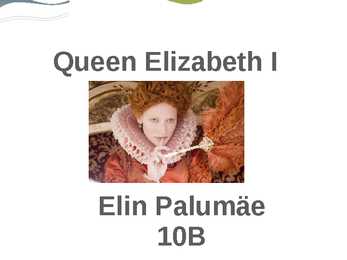
who was never a major patron of the During this period and into the Jacobean era arts.As Elizabeth aged her image that followed, the English theatre reached its gradually changed. highest peaks. She was portrayed as Belphoebe or Astraea, and after the Armada, as Gloriana, the eternally youthful Faerie Queene of Edmund Spenser's poem. Death Despite the presence of several other claimants to the throne, the transition of To rectify this, James had power went smoothly. Parliament pass the James's succession set aside Succession to the Crown Act Henry VIII's Third 1603. The question of Succession Act and will in whether Parliament could favour of the line of Henry's control the succession to the
Draama taasavastamine 15.-16. saj. Püsivate teatrite ehitamine Eelkõige Rooma draamakirjanike mõju (Seneca, Plautus) Renessansi eepika 1) Otsene antiigijäljendus (Pierre de Ronsard, La Franciade) 2) Kaasaegne kangelaseepika (Luís Vaz de Camões, Os Lusíadas) 3) Keskajateemaline rüütlieepika (Lodovico Ariosto, Orlando Furioso; Edmund Spenser, The Faerie Queene; Torquato Tasso, La Gerusalemme liberata) 4) Kristlik eepika (John Milton, Paradise Lost, Paradise Regained) Barokk 16. lõpp – 18. saj. algus. Keskus: Itaalia, Hispaania, Prantsusmaa. Klassitsismi suund Prantsusmaal, Saksamaal. Reaktsioon renessanssile: kristluse rõhutamine, orienteerus prantsuse aristokraatlikule maitsele, juhindus klišeedest. Antiigist teemad ja tegelased, klassikalise vormi diktaat, esteetiline kontroll ja ja moraalne talitsetus (reeglid, normid)
· The ballad stanza comprises four lines consisting of alternate iambic tetrameters and trimesters and rhyming a b a b. It must be distinguished from the ballade, a verse form consisting of 3 eight-lined stanzas and a four-lined stanza of dedication. · The Spenserian stanza consists of 9 lines: eight iambic pentameters followed by one iambic hexameter. Its rhyming scheme is a b a b b c b c c. E. Spenser used in his "the Faerie Queen" · Ottava rima is a stanza of 8 iambic pentameters rhyming a b a b a b c c. It is borrowed from Italian poetry in the 16th century. · Rhyme Royal is a stanza of seven iambic pentameters rhyming a b a b b c c. James U of Scotland used it in his "King's Quair" · Terza rima is a verse written in triplets, lines being iambic pentameters with the rhyme scheme a b a b c b c d c and so on ending with a couplet to avoid one word unrhymed (Shelley's "Ode to the West Wind"
de Uus huvi looduse vastu: a) inimese Ronsard, La Franciade) tähtsusetuse tunnetamine; b) 2) Kaasaegne kangelaseepika looduse (Luís Vaz de keerukuse/lõpmatuse tajumine Camões, Os Lusíadas) Versailles' palee kabel 3) Keskajateemaline rüütlieepika (Lodovico Talvepalee, St. Peterburg Ariosto, Orlando Furioso; Edmund Kadrioru loss Spenser, The Faerie Queene; Torquato Tasso, Gian Lorenzo Bernini (15981680) La Bernini, San Pietro kolonnaad Gerusalemme liberata) 4) Kristlik eepika (John Milton, Bernini, Proserpina röövimine Paradise Lost, Paradise Regained) Baroki kunsti iseloomustavad: liikuvus Renessansi proosa rahutus François Rabelais, kirg
" and locks her in a room in his castle containing only a spinning wheel and piles of straw, warning that he's going to have her killed in the morning if she doesn't spin the straw into gold as her daddy promised. T h e girl doesn't know what to do and begins to weep. At once the door opens and a little man, or "manikin" as the tale says, comes in, asking her why she is crying so. Apparently he has been attracted by her strong emotions, as faerie folk are said to be. W h e n she explains her predicament he says he can spin straw into gold, no problem, and asks what she can give him if he does the job for her. She hands over her necklace and he at once sits down and spins the straw, whir, whir, whir, into shining gold wire on a spool. In the morning the little man has vanished. T h e king is very pleased with the gold, but being greedy, locks the girl into a bigger room with more straw, and again
 annaabi.ee