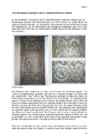
Epitaph Das Renaissance-Epitaph in der St. Benedikt Kirche in Herbern An der nördlichen Chorwand in der St. Benedikt Kirche in Herbern befindet sich ein Renaissance-Epitaph, eine Steinmetzarbeit von 2,87m Höhe und 1,35m Breite. Es zeigt den Grafen Hermann von Merveldt zu Westerwinkel und seine Gemahlin Ursula von Deipenbrock. Da die Sterbedaten des Ehepaares angegeben sind, weiß man, dass das Werk Ende des 16. Jahrhunderts erstellt worden ist. Der Bildhauer ist bis- her unbekannt. (Fotos: Cramer) Das Ehepaar steht betend da, mit Kopf und Schultern an ein Kissen gelehnt. Die Tracht ist zeitgenössisch, spanisch
Epitaaf on lahkunu mälestuseks kirjutatud lühike tekst, tavaliselt hauasambal. Vappepitaaf ehk surnusilt on üksikisiku mälestuseks kirikusse üles seatud mälestusmärk. Suur osa Niguliste muuseumi väljapanekust on pühendatud reformatsioonijärgsele kirikukunstile, millest kaalukaima osa moodustavad epitaafid ja vappepitaafid. Hasselblatti epitaaf: Johann Hobbingi epitaaf: Dietrich Mölleri epitaaf: Adolf Eberschildti epitaaf: Epitaph mälestuseks Mustpea liikmetele: Friedrich Wartmanni epitaaf: Uexkülli vappepitaaf: Anton Philipp von Saltza vappepitaaf: Eestimaa aadliku ja Rootsi ohvitseri Heinrich von Knorringi vappepitaaf: 8. Kirjelda “Surmatantsu” ja lisa olulisi andmeid selle kohta. Niguliste muuseumis eksponeeritav Põhja-Euroopa ühe kuulsaima kunstniku Bernt Notke “Surmatants” on rahvusvaheliselt kõige tuntum keskajast pärinev kunstiteos Eestis
Samuel Rosenberg's 1974 book Naked is the Best Disguise purports to explain how Conan Doyle left, throughout his writings, open clues that related to hidden and suppressed aspects of his mentality. Conan Doyle was found clutching his chest in the family garden on 7 July 1930. He soon died of his heart attack, aged 71, and is buried in the Church Yard at Minstead in the New Forest, Hampshire, England. His last words were directed toward his wife: "You are wonderful." The epitaph on his gravestone reads: STEEL TRUE BLADE STRAIGHT ARTHUR CONAN DOYLE KNIGHT PATRIOT, PHYSICIAN & MAN OF LETTERS Undershaw, the home Conan Doyle had built near Hindhead, south of London, and lived in for at least a decade, was a hotel and restaurant from 1924 until 2004. It was then bought by a developer, and has been empty since then while conservationists and Conan Doyle fans fight to preserve it. A statue honours Conan Doyle at Crowborough Cross in Crowborough, East Sussex,
kin to bury him next to the main portal of the church. All church-goers would then step over his gravestone and his sins would be redeemed. P o r g a s s a a r, Kristina; A l j a s, Eva-Grete; K u u s k e m a a, Jüri. Tallinn: Medieval capital. Tallinn: PhotoTour I Choir II Body III Vestry IV Chapel of the Freiherr von Güldenbandt V St. George's chapel VI The Fersen's sepulchar chapel VII Chancery of congregation room IX southwest chapel 1. Nicolaes Millich Epitaph of Johan Hastfer 1676 2. Box of the Mannteufels 1750s 3. Box of Patkuls 2nd quarter of the 18th cent. 4. Hermann Berents and Hinrik Martens Golgotha group on the transverse beam of the triumphal arch 1694 5. Arent Passer Grave slab of Otto von Uexküll 17th century 6. Arent Passer Perts of Carl Horn's sarcophagus 1601 7. Arent Passer Grave monument of Pontus de la Gardie 1589-95 8. Christian Ackermann Reredos 1694-96 9
in 1695. The outer case is by Grinling Gibbons. In the North Quire Aisle you can see a sculpture of Mother and Child by Henry Moore. In the South Transept you can see memorials to, amongst others, Nelson and Scott of the Antartic. The Crypt is the largest in Europe and contains memorials to some of the country's greatest men including the tombs of the Duke of Wellington, Admiral Nelson and Sir Christopher Wren whose epitaph says "If you seek his monument look around you". London Bridge A bridge has existed at or near the present site of London Bridge for nearly 2,000 years. The first bridge across the Thames in London was built by the Romans around 50 AD. It was built near the present site of the London Bridge and it was made of wood. The site was chosen because it was the place where the Thames was rather low most of the time. This wooden bridge was destroyed in 60 AD by the army of Queen Boudicca.
Was quite well off. Became shareholder (aktsionär) in several theatres. i.e. was one of the owners of the theatres. Begun buying property both in London and Stratford. Is career as a dramatist lasted for 20 years. After that ver difficult years followed because he lost his parents, brother and only son with short time. In about 1610 he left London and settled down in Stratford. Was 52 when died. Buried in the local church in Stratford. Before death designed his own epitaph( text on tombstone). If anybody touched is bones and ashes, he would be cursed. That stopped reburying Three periods in his literary period I Optimistic period II Pessimistic period III Romantic The Optimistic period He wrote poems and sonnets (154), world famous comedies, bright comedies, two tragedies "Romeo and Juliet" and some historical plays. 4 different items. Sonnet A poem of 14 lines, perfected in Italy by Petrarch. Each line has 10 syllables an d the
Anomie, erinevalt 1970ndate alguses, New York Dolls ajakohastanud esialgset metsikus 1950 rock 'n' roll on mood, mis hiljem sai tuntuks kui glam punki. In 1993, California's Green Day and Bad Religion were both signed to major labels. The next year, Green Day put out Dookie, which became a huge hit, selling nine million albums in the United States in just over two years.[322] Bad Religion's Stranger Than Fiction was certified gold.[323] Other California punk bands on indie label Epitaph, run by Bad Religion guitarist Brett Gurewitz, also began achieving mainstream popularity. In 1994, Epitaph released Let's Go by Rancid, Punk in Drublic by NOFX, and Smash by The Offspring, each eventually certified gold or better. That June, Green Day's "Longview" reached number one on Billboard's Modern Rock Tracks chart and became a top forty airplay hit, arguably the first ever American punk song to do so; just one month later, The Offspring's "Come Out and Play" followed suit
Mary's Cathedral The church contains a large number of monuments, for example the tomb monument of the Swedish Commander-in-Chief Pontus de la Cardie and his wife which is the oldest (1589), the tomb monuments to two Russian admirals (neither of them Russian by nationality) Samuel Greigh and Adam Johann v. Krusenstern (the first Russian circumnavigator). The altar and the pulpit were made by the well- known 17th cent. master Christian Ackermann. He is also the author of the majority of the epitaph coats of arms in the church. St. Nicholas Church During the Reformation in 1524 many valuable works of art were destroyed in Tallinn. The locks on the doors of St. Nicholas Church had been poured full of molten lead and they could not be opened. Therefore it was the only church where masterpieces of the 14-15th century painting, woodcarving and stone-carving survived. The Church of the Holy Ghost There are 57 paintings on the wall of the gallery known as The Bible of the Poor
Unless things mortal move them not at all, Would have made milch the burning eyes of heaven, And passion in the gods.' LORD POLONIUS Look, whether he has not turned his colour and has tears in's eyes. Pray you, no more. HAMLET 'Tis well: I'll have thee speak out the rest soon. Good my lord, will you see the players well bestowed? Do you hear, let them be well used; for they are the abstract and brief chronicles of the time: after your death you were better have a bad epitaph than their ill report while you live. LORD POLONIUS My lord, I will use them according to their desert. HAMLET 79 God's bodykins, man, much better: use every man after his desert, and who should 'scape whipping? Use them after your own honour and dignity: the less they deserve, the more merit is in your bounty. Take them in. LORD POLONIUS Come, sirs. HAMLET Follow him, friends: we'll hear a play to-morrow.
differently. Russian disapproves of such kind funeral more rather than Estonians and would solve in their advantage only in that case if the deceased has such a decision during the lifetime. If the deceased hasn't expressed of such request during the lifetime, so cremation avoid. In this bachelor's work were carried out the comparative analysis of modern symbolic of monuments of the Tallinn cemeteries. Often it is possible to explain value of many symbols of monuments, comparing them with an epitaph present on monuments. More often people, representing on a gravestone this or that engraving, try to display important during the lifetime for the died place, the engraving can specify in a specialty or a hobby of the dead also. For 58 example, more popular a portrait of the person in a uniform become to represent on a monument
The rhythmic patterns proceed in several layers where Aav is fond of using triplets. The qualities of the work are in the use of an archaic national idiom and the originality of harmony and timbres. Aav had no inclination to delve into the philosophy of music. In his music his heroes are men of action and he is there with them. His only symphony is among the notable ones composed in the Thirties, and its influence on the development of Estonian symphonism was immense. The epitaph: “It is a pity he died young” is usually used as a vulgar euphemism, here it is written with sincere regret. According to the musicologist Ofelia Tuisk: There has been no other Estonian symphonist in whose music the spontaneous, lush temperament, sincerity to the point of vulgarity, unforced free train of thought and exceptional instinct for inflection are joined. Sincerity and easy in use of melody are the charming features of his music
The association appears to be the only one of its kind in the world. While many people make and break ciphers in sport, others do it in earnest. The variety and quantity of non-political cryptography can only equal the number of motives that impel people to secrecy, and these motives, like their ciphers, are most heterogeneous. In the graveyard of New York's Trinity Church, on Broadway at the foot of Wall Street in the very heart of the financial district, stands a tombstone with an epitaph partly in cipher. Under it lies James Leeson, who died September 28, 1794, aged 38. The cipher inscription is in the ancient pigpen cipher, whose use goes back hundreds of years, and it reads Remember Death. Why Leeson had it carved there no one, perhaps, will ever know, but his motive may well have been that of the ancient Egyptians who first used cryptography in their sepulchral inscriptions: to stay passersby and bring the dead to life in their memory.
 annaabi.ee