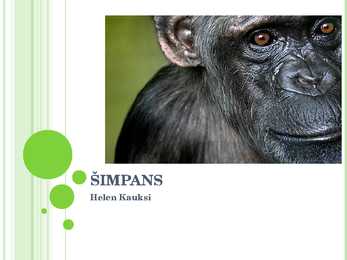
ja zestide abil. Nutavad valjuhäälselt On omad tervitus ja leppimis märguanded Magavad pesades kindlates asendites TOITUMINE Omnivoor Puuviljad Lehed Putukad Joob vett INTELLIGENTSUS Tunneb ära ennast peeglist Näitavad üles vanemliku hoolt Oskavad viipekeelt Väljendavad meeleolusid. Kasutavad lihtsaid tööriistu KASUTATUD KIRJANDUS www.miksike.ee/docs/.../loomade_kaitumine_ppt_ martinkulvik.ppt http://www.kidsplanet.org/factsheets/chimpanzee. html http://et.wikipedia.org/wiki/%C5%A0impans_ %28perekond%29 http://www.annaabi.com/materjal26511 geograafiareferaatl%C3%B5unaameerika loomad Philip Whitfield "Laste Loomaentsüklopeedia" AITÄH TÄHELEPANU EEST!
ü Not true Second level Third level ü Almost all brain is Fourth level Fifth level working all the time ü cerebral cortex-ajukoor! Yawning is "contagious" ü Tough to deny it isn't ü It's something psyhological ü Even chimpanzee yawn Click to edit Master text styles Second level Third level Fourth level Fifth level Thank you for listening!
Antropogeneesi õied From left to right, the FBI assigns the above individuals to the following races: White, Black, White (Hispanic), Asian. Top row males, bottom row females. Homo sapiens · Kujunes ca 250 000 a tagasi. Ca 200 000 aastat suhteliselt väikesed muutused · Ca 50 000 aastat tagasi kiired muutused (areng?!). Suure hüppe teooria vt J. Diamond, The Third Chimpanzee · Mis muutus: uued jahipidamisviisid, riietus, luunõelad, koopamaalid, kaaslaste matmine. · Käitumuslikult kujunes välja tänapäevane inimene · Aju osakaal/roll: kaasaegse inimese aju tarbib ca 20 watti (400 kilokalorit) päevas, mis on ca 1/5 kogu inimkeha energiavajadusest · Kas inimese käitumine ja suhtepilt on ajaloos muutunud, millised on muutuste suunad? Kas oleme osa suuremast hoovusest, laiemast arenguprotsessist? Vaidlused: evolutsioon ja
She often wore a gray wool shawl. (non-coordinate) Your cousin has an easy, happy smile. (coordinate) The 1) relentless, 2) powerful 3) summer sun beat down on them. (1-2 are coordinate; 2-3 are non-coordinate.) The 1) relentless, 2) powerful, 3) oppressive sun beat down on them. (Both 1-2 and 2-3 are coordinate.) 7. Use a comma near the end of a sentence to separate contrasted coordinate elements or to indicate a distinct pause or shift. He was merely ignorant, not stupid. The chimpanzee seemed reflective, almost human. You're one of the senator's close friends, aren't you? The speaker seemed innocent, even gullible. 8. Use commas to set off phrases at the end of the sentence that refer back to the beginning or middle of the sentence. Such phrases are free modifiers that can be placed anywhere in the sentence without causing confusion. (If the placement of the modifier causes confusion, then it is not "free" and must remain "bound" to the word it modifies.)
others believe Because Sally didn't see Anne move the marble, she will have a "false belief" that the marble is still in the basket. Most 4-year-olds can grasp this, and say that Sally will look in the basket. They know the marble is not there, but they also understand that Sally is missing the key bit of information. Chimps can knowingly deceive others, so they understand the world view of others to some extent. However, they cannot understand others' false beliefs. In a chimpanzee version of the Sally-Anne task, researchers found that they understand when a competitor is ignorant of the location of food, but not when they have been misinformed. Tomasello puts it like this: chimpanzees know what others know and what others can see, but not what others believe. We are unique in the level of abstractness with which we can reason about others' mental states This tells us something profound about ourselves. While we are not the only
cardboard (n) carer (n) carnival (n) carpenter (n) carry out (phr v) cartoon (n) case (n) casserole (n) cause (n) cause a stir (phr) cave (n) cell (n) cell (n) cellar (n) central to (adj) (under) certain circumstances (phr) chain (n) chain (v) chalk (n) challenge (v) change your mind (idm) 4 chapter (n) character (n) charge (v) chart (n) chat show (n) chauvinism (n unc) check-in (n) cheer up (phr v) chest (n) chest of drawers (n) chewy (adj) chilli (n) chimpanzee (n) choir (n) cholesterol (n) chord (n) choreography (n) chronologically (adv) chuck (v) chuckle (v) chunk (n) circuit board (n) circulation (n) circus (n) civilisation (n) claim (v) classical (adj) claw (n) clearing (n) click your fingers (phr) client (n) climax (n) clip (n) close-up (adj) clown (n) clue (n) cluttered (adj) code (n) coincidence (n) collapse (v) collide with (v) colonise (v) coma (n) combat (v) come forward (phr v) come up to scratch (idm) come upon (phr v) coming (adj)
Scale Soomus Domestic animals Koduloomad Wild animals Metsloomad Kangaroo Känguru Dolphin Delfiin Penguin Pingviin Deer Hirv, hirved Insect Putukas Horse Hobune Dog Koer Lion Lõvi Swan Luik Chimpanzee Simpans Hippo Jõehobu Whale Vaal Flower Lill Vegetable Juurvili Fruit Puuvili Berry Mari Tulip Tulp Snowdrop Lumikelluke Poppy Moon Sunflower Päevalill Oaktree Tammepuu
Homo sapiens Kujunes ca 250 000 a tagasi. Ca 200 000 aastat suhteliselt vähemuutuv Ca 50 000 aastat tagasi – kiired muutused (areng?!). Suure hüppe teooria – vt J. Diamond, The Third Chimpanzee Mis muutus: uued jahipidamisviisid, riietus, luunõelad, koopamaalid, kaaslaste matmine. Käitumuslikult tänapäevane inimene ?! Tunnused: eneseteadvus (olen olemas), abstraktne mõtlemine (mõisteaparaat), tulevikukavandamine (eesmärgiseade),
seoseid, tendentse kirjeldav, tõenäosuslik. Konstruktivistlik vaatepunkt. 1. Inimsuhete ajalooline areng Meenutuseks: meie ühine ajalugu Vanaisad: homo erectus (2,0mln), homo neandertalensis (0,2 mln) Homo sapiens Kujunes ca 250 000 a tagasi. Ca 200 000 aastat suhteliselt väikesed muutused Ca 50 000 aastat tagasi kiired muutused (areng?!). Suure hüppe teooria vt J. Diamond, The Third Chimpanzee Mis muutus: uued jahipidamisviisid, riietus, luunõelad, koopamaalid, kaaslaste matmine. Käitumuslikult kujunes välja tänapäevane inimene Aju osakaal/roll: kaasaegse inimese aju tarbib ca 20 watti (400 kilokalorit) päevas, mis on ca 1/5 kogu inimkeha energiavajadusest Kas inimese käitumine ja suhtepilt on ajaloos muutunud, millised on muutuste suunad? Kas oleme osa suuremast hoovusest, laiemast arenguprotsessist?
carp la carpa ostrich el avestruz cat el gato owl el buho caterpillar la oruga ox el buey cheetah el guepardo oyster la ostra 42 chicken el pollo parrot el loro chimpanzee el chimpancé partridge la perdiz claw la zarpa paw la pata cockroach la cucaracha penguin el pingüino cod el bacalao pig el cerdo cocoon el capullo pigeon el pichón cow la vaca pike el sollo crab el cangrejo pony el potro crayfish el cangrejo rabbit el conejo
a human ancestor that had developed bipedalism, but which lacked the large brain of modern humans. Antropogeneesi õied From left to right, the FBI assigns the above individuals to the following races: White, Black, White (Hispanic), Asian. Top row males, bottom row females. Homo sapiens • Kujunes ca 250 000 a tagasi. Ca 200 000 aastat suhteliselt väikesed muutused • Ca 50 000 aastat tagasi – kiired muutused (areng?!). Suure hüppe teooria – vt J. Diamond, The Third Chimpanzee • Mis muutus: uued jahipidamisviisid, riietus, luunõelad, koopamaalid, kaaslaste matmine. • Käitumuslikult kujunes välja tänapäevane inimene • Aju osakaal/roll: kaasaegse inimese aju tarbib ca 20 watti (400 kilokalorit) päevas, mis on ca 1/5 kogu inimkeha energiavajadusest • Kas inimese käitumine ja suhtepilt on ajaloos muutunud, millised on muutuste suunad? Kas oleme osa suuremast hoovusest, laiemast arenguprotsessist?
 annaabi.ee