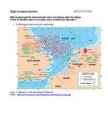
1. Suurbritannia traditsioonilised energiavarad Joonis 1. Maagaasi ja nafta paiknemine Põhjameres. Allikas: http://www.acorn-ps.com/web/image/content/map/sns_map.jpg Joonis 2. Kivisöe kaevandused Suurbritannias. Allikas: The Business at a Glance UK Coal Annual Report and Accounts 2008. http://ukcoal.annualreport2008.com/2008_Highlights/The_Business_at_a_Glance/Default.aspx?id=178 Joonis 3. Traditsioonilised maavarad Euroopas. Allikas: Major mineral fuel resources in Europe, Caucasus and Central Asia Maps and Graphics at UNEP/GRID Arendal. http://maps.grida.no/go/graphic/major-mineral-fuel-resources-in-europe- caucasus-and-central-asia1 Suurbritannias leidub traditsioonilistest energiavaradest peamiselt naftat, maagaasi ja kivisütt. Leidub ka uraani, kuid seda on vähem kui fossiilseid kütuseid. Uraaniumit kaevandati Cornwallis 1873. -1903. 1970.aastatel avastati Orkney'st laialdased uraaniumi varad, kuid rahva soovil neid kaevandama ei hakatud.
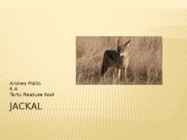
Andres Mällo 6.A Tartu Raatuse Kool JACKAL WHERE DOES IT LIVE ? ✕ Central Africa ✕ The Caucasus ✕ Southeast Asia ✕ Reeds ✕ Cracks between the stones ✕ Seasonal migrations. WHAT DOES IT EAT ? ✕ Omnivore ✕ Small mammals and birds ✕ Poisonous snakes ✕ Chickens and waterfowls ✕ Animal remains ✕ Fruits and berries JACKAL’S ENEMIES Predators Foxes Wolves Eagles Leopards Hyenas MATING ✕ Mating season ✕ 60-63 days ✕ March – May ✕ Puppies MORE ABOUT JACKAL ✕ 90-105 cm ✕ 6.8-11kg ✕ 12-14 years.
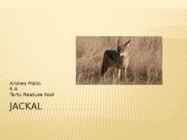
Andres Mällo 6.A Tartu Raatuse Kool JACKAL WHERE DOES IT LIVE ? Central Africa The Caucasus Southeast Asia Reeds Cracks between the stones Seasonal migrations. WHAT DOES IT EAT ? Omnivore Small mammals and birds Poisonous snakes Chickens and waterfowls Animal remains Fruits and berries JACKAL'S ENEMIES Predators Foxes Wolves Eagles Leopards Hyenas MATING Mating season 60-63 days March May Puppies MORE ABOUT JACKAL 90-105 cm 6.8-11kg 12-14 years. 16 km an hour Excellent hunters Communicate Jackal's live in packs
million people as of 2012. Population of Russia is 143 800 000. Population density is 8.4/km2. The offical language is russian. President of Russia is Vladimir Putin. National anthem of Russia: Gosudarstvenny Gimn Rossiyskoy Federatsii https://www.youtube.com/watch?v=AOAtz8xWM0w Vladimir Putin Kreml Mount Elbrus Topography and climate Mount Elbrus is the highest point in Caucasus, Russia and Europe (5 642 m). Russia has thousands of rivers. Longest river in Russia is Volga. Lake Baikal is the largest fresh water lake in Russia. Humid continental climate is the dominant in Russia. Record low temperature is -71,2. Record high temperature is 43,2. Interesting facts Russian Federation spans trough 9 time zones, (UTC+3 to +12a). Largest city`s are Moscow, Saint Peterburg and Novosibirsk.
* Names of groups of islands, desert, mountain ford University ranges, regions: the Phillippines, the East/West Indies, The Sahara, the Alps, the Ruhr * Names of some theatres (Her Majesty's), ho- tels (Brown's), restaurants (Leoni's) and hos- · Expectional geographical names: the Crimea, pitals (Guy's). (NB! The possesive case!) the Caucasus, the Ukraine, the Congo, the Hague, the City, the East/West End, the Su- dan, the Yemen, the Mall, the Strand, the North/ South Pole, the Equator, the Middle East, the Isle of... · Names of theatres, cinemas, hotels, pubs, ca- fes, restaurants, museums, galleries, libraries, hospitals, banks etc.: the Bolshoi Theatre, the Tate Gallery, the Optiva Bank, the British Mu- seum etc. · Names of certain buildings / istitutions: the Kremlin; the Tower.
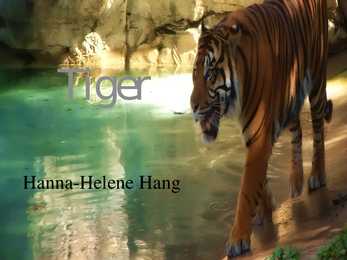
Altaic, Korean or North China tiger; The South China Tiger, also known as the Amoy or Xiamen tiger. Extinct subspecies are: The Bali Tiger was limited to the island of Bali; The Javan tiger was limited to the Indonesian island of Java; The Caspian Tiger, also known as the Persian tiger or Turanian tiger was the westernmost population of Siberian tiger, found in Iran, Iraq, Afghanistan, Turkey, Mongolia, Kazakhstan, the Caucasus, Tajikistan, Turkmenistan, and Uzbekistan. Colour variations White tigers: an animal which is rare in the wild. Golden tabby tigers: golden tabby tigers have light gold fur, pale legs and faint orange stripes. Their fur tends to be much thicker than normal. Other colour variations: there are also unconfirmed reports of a "blue" or slate coloured tiger, the Maltese Tiger, and largely or totally black tigers, and these are
1994 2 lisalepet juures-Keskkonna küsimused, Tööjõu küsimused NAFTA probleemid-Kanada vastuseis, USA probleemid (B.Clinton ja Kongress), Mehhiko immigrandid, Mehhiko majandus (peso devalveerimine 1994) SAFTA South American Free Trade Area (the Union of South American Nations – USAN) South Asian Free Trade Agreement (2004) Aasia ja organisatsioonid, lepingulised ühendused: ASEAN – Association of SE Asian Nations APEC – Asia Pacific Economic Cooperation EAEC - East Asia Economic Caucasus EAEC East Asia Economic Caucasus- 6 ASEAN’i riiki + Hiina, Jaapan ja Lõuna Korea, Erimeelsused suured, Ei tegutse Majanduslik julgeolek (riigi seisukohalt)- Maavarade olemasolu, Maavarade omamine, Maavarade kasutamine Regionaalne julgeolek – organisatsioonide alus- Regioon ja julgeolek, Geograafia ja rahu, Geograafia ja huvid, Ajalugu (Euroopa – kokkuhoid) Europol (EL) – 1975/1993 – uus peakorter Haagis ÜRO eelne Esimene maailmasõda – Rahvasteliit Teine maailmasõda – ÜRO
central point of the struggles among the Jews, Armenians, and Greeks in the Ottoman Empire. (Matossian, 1994) 1.4. Armenian Genocide, 1905-1917 period On November 2, 1914, the Ottoman Empire entered World War I on the side of the Central Powers. The Middle Eastern became the center of action of World War I. The strugglers were the Ottoman Empire, with some help from the other Central Powers, and mainly the British and the Russians among the Allies of World War I. The conflicts at the Caucasus Campaign, the Persian Campaign and the Gallipoli Campaign affected seriously areas, where the Armenian people lived. Before the declaration of war at the Armenian congress at Erzurum the Ottoman government requested the Ottoman Armenians to contribute the conquest of Transcaucasia by inciting a rebellion with the Russian Armenians against the tsarist army in the event of a Caucasus front. (Wikipedia, 2011) 1.5. Death marches
It lived in Eurasia, from Ireland to east of Lake Baikal. The Giant Deer is famous for its size (2.1 meters tall+ antlers 3.65 meters) The cause of theis extinction is still unknown. Some say they died because of their large antlers(could not move in the forest), others say they were hunted down. Extinct about 7,700 years ago *CASPIAN TIGER: The Caspian tiger or Persian tiger was the westernmost subspecies of tiger, found in Iran, Iraq, Afghanistan, Turkey, Mongolia, Kazakhstan, Caucasus, Tajikistan, Turkmenistan and Uzbekistan until it apparently became extinct in the 1970s. Of all the tigers known to the world, the Caspian tiger was the third largest. The body of this subspecies was quite stocky with strong legs, big wide paws and unusually large claws. The ears were short and small. Around the cheeks the Caspian tiger was generously furred and the rest of its fur was long and thick. The colouration resembled that of the Bengal tiger. It assumebly became extinct in 1970.
Also Samara (Kuibishev). Hundreds of thousands. SU hadn't been keeping recs of evacuation. Travel docs, but no central recs. Censuses, 1939 and 1959. Majority of Js who evacuated went back to former home repubs. Didn't go back to shtetl, in ruins or occupied by others. Went to nearby cities. J comm in Uzbekistan grew 80%. Small families in comm prior to. 51,000 Js, Bukharins, now 95,000 in 1959. Same growth in almost every SU area of Central Asia and Caucasus, doubling local pop. Who are these? Skilled workers, accountants, doctors. Continued in this trajectory in Tashkent. In contrast, Sephardi Js less educated, menial labor, shop keepers. 2 J communities, distinct ethnically, denominationally, class (esp), basic identity. See selves as SU Js. Bukharin, Georgian, mtn Js see themselves as Js; conn to SU regime is looser, haven't benefitted from SU authority. Live in diff parts of city or outside of it. Almost no contact, no friction
(Joseph, J.S., 2006). TURKEY'S LOCATION The strategic location of Turkey presents a unique challenge to the EU's external role and policies as "it lies at the epicenter of a series of conflicts, real and potential" in the region. Turkish accession will bring closer to the EU the instability and tensions of a strategically vital region with strong, conflicting energy-related interests. The unstable neighbourhoods of the Middle East, Caucasus and Central Asia will become the immediate neighbourhood of the EU and its member states. As a major power in the region Turkey could be drawn into conflicts that work against European, Central Asian and Middle Eastern integration and peace (Joseph, J.S., 2006). In conjunction with this point, the addition of new long external borders will present a major challenge to the EU as it will involve critical policies and issues such as migration, asylum and drug-smuggling.
free movement of persons, limited the ENP to visa facilitation agreements, and shifted its focus to economic incentives avoiding mentioning of the political ones. Another fundamental difference of the ENP is lack of conditionality as an implementation strategy, which proved very effective in the cases of the candidate countries. Notwithstanding the "mutual commitment to common values" (Commission 2004: 12), the exclusion of membership is a frustrating fact for Ukraine, Moldova, and the South Caucasus given their outspoken membership aspirations, which are not likely to be satisfied by the "special relationship" (Lisbon Treaty). The asserted desire of the East European countries in the early 1990s, to acquire back their Europeanness and join the EU stipulated the establishment of the accession requirements that were not defined previously. Along with the EU's capacity to absorb new members, the Copenhagen Council in June 1993 stated that: Membership requires that the
tulemus, et konkreetset asja on mitu} Tabel wals.info Squamish (Kuipers 1967) total: k°a'i 'play hide and seek' k°ai from the root k°ai partial: s- 'old people' 'l'lmut from the singular s- 'lmu't Tabel wals.info Reduplicative prefixes, suffixes and infixes: a. Hunzib (Nakh-Daghestanian; eastern Caucasus) initial CV(C) reduplication (van den Berg 1995: 34) bat'iyab `different' bat'bat'iya `very b different' mugá `after' mu.mugá `much later' b. Choctaw (Muskogean; Mississippi and Alabama) medial CV reduplication (Kimball 1988: 440) tonoli `to roll' tononoli `to roll
Moreover, most of the Roman villas, baths and temples, the cities they had founded were soon destroyed or fell into disrepair. Almost the only lasting reminders of their presence are place names like Chester, Lancaster and Gloucester which include variants of the Roman word castra (a military camp). 23 Notes 1. In the 1st с. BC – the 4th c. AD Rome founded the greatest ancient empire whose provinces extended from the Caucasus in the east and Egypt in the south to Spain and Gaul in the west and Britain in the north-west. In 395 the empire was divided into two parts – the Western (Rome) and the Eastern (Constantinople, Byzantium) empires. The former collapsed in the 5th century (476). Byzantium lasted for another thousand years and fell to the Turks in 1453. Gaius Julius Caesar ['si:zə] (100 – 44 BC), the Roman statesman, general and author
for sustainable development and international education. Our mandate is to support the German Government in achieving its objectives in these fields. We provide viable, forward-looking solutions for political, economic, ecological and social development in a globalised world. Sometimes working under difficult conditions, we promote complex reforms and change processes. Our corporate objective is to improve people's lives on a sustainable basis. Contact Information: GIZ Regional Office South Caucasus 4 Elene Akhvlediani Agmarti 0103 Tbilisi, Georgia Tel.: +995 32 201800 Fax: +995 32 201801 www.giz.de About Georgian National Investment Agency The Georgian National Investment Agency (GNIA) was established in 2002 under the Ministry of Economic Development as a part of the liberalization drive. GNIA is the only government agency responsible for investment and export promotion, which offers a "one-stop-shop" customer
Enigma. It failed commercially during the 1920s but became the standard cipher machine for all three armed forces when Hitler rearmed Germany in the 1930s. A Swedish inventor, Arvid Gerhard Damm, patented a cumbersome mechanism that seems never to have been built. The company that he founded likewise had at first no commercial success. But a young man, son of one of the investors in the firm, changed all that. Boris Caesar Wilhelm Hagelin, born on July 2, 1892, in the Caucasus, where his father was working, studied for three or four years in St. Petersburg, then returned to Sweden and was graduated from the Royal Institute of Technology in Stockholm in 1914 with a degree in mechanical engineering. He worked six years for ASEA, Sweden's General Electric, and one in the United States for the Standard Oil Company (New Jersey). In 1922, his father put him into the Damm firm to represent his investment.
 annaabi.ee